Home
Class 11
PHYSICS
Two identical loudspeakers are driven in...

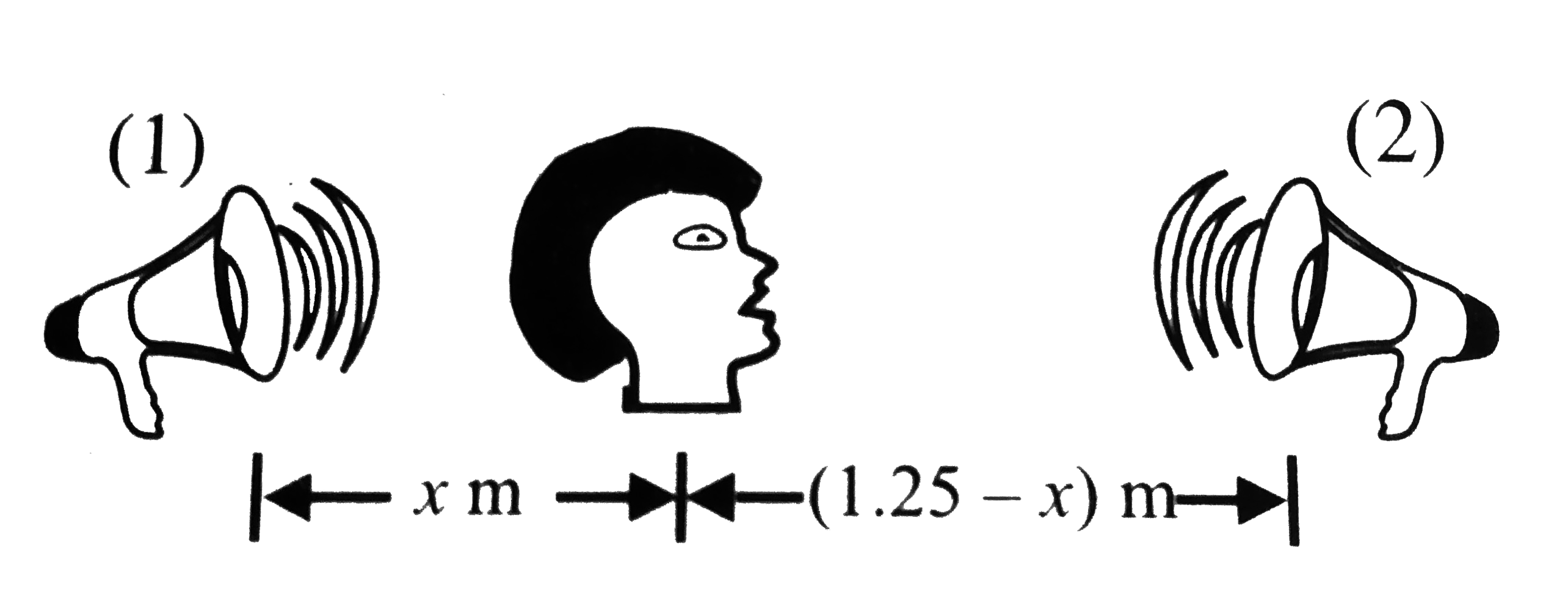
Two identical loudspeakers are driven in phase by a common oscillator at `800 Hz` and face each other at a distance of `1.25 m`. Locate the points along the line joining the two speakers where relative minimum of sound pressure amplitude would be expected. ( Use `v = 343 m//s`.)

Text Solution

Verified by Experts

Two identical waves moving in opposite directions constitute a standing wave .We must find the nodes.
The wavelength is
` lambda = (v)/(f) = ( 343 m//s)/( 800 Hz) = 0.429 m`
The two waves moving in opposite directions along the line between the two speakers will add to produce a standing wave within this distance between nodes.
Distance node to node ` = lambda//2 = 0.214 m`
Because the speakers vibrate in phase , air compressions from each will simultaneously reach the point halfway between the speakers , to produce antinode of pressure here . A node of pressure will be located at this distance on either side of the midpoint.
Distance node to antinode ` = lambda //4 = 0.107 m`
Therefore nodes of sound pressure will appear at these distances from either speaker.
`[ 1//2 ( 1.25 m) + 0.107 m = 0.732 m`
and `1//2 ( 1.25 m) - 0.107 m = 0.518 m ]`
The standing wave contains a chain of equally spaced nodes at distances from either of the speakers
`0.732 m + 0.214 m = 0.946 m`
` 0.947 m + 0.214 m = 1.16 m`
also at ` 0.518 m - 0.214 m = 0.303 m`
`0.303 m - 0.214 m = 0.089 m`
The standing wave exists only along the line segment between the speakers . No nodes or antinodes appear at distances greater than `1.252 m` or less than `0`, because waves add to gives standing wave only if they are travelling in opposite directions and not in the same direction . Thus , the distances from either of the speakers to the nodes of pressure between the speakers are `0.089 m , 0.303 m , 0.732 m , 0.946 m and 1.16 m`
Promotional Banner

Similar Questions

Explore conceptually related problems

The distance between the two identical speakers shown in Fig. 14.3.3 are 4.00m. They are driven by the same osicllator. Initially a listner stays at L at a distance 8.0 m from the centre of the line connecting the two speakers. The listner then walks to the point A where AL=0.4m. The first minium is sound intensity in heard just the listener reaches the point A. Find the frequency of the oscillator. Speed of sound in air is 340 m/s.

Find out the points on the line joining two charges +qand -3q (kept at as distance of 1.0 m ) where electric potential is zero.

Two identical loudspeakers are placed on a line at distance 4m and 6m from a microphone lying on the line joining them. The output of each speaker at the microphone is 2mW . If the two speakers are connected in series and excited by the same oscillator and they vibrate in phase with each other, the resultant ouput of the microphone will be (frequency of oscillator =660 Hz and speed of sound =330 m//s )

Two points masses 'm' and 2m are kept at certain distance as shows in figure. Draw E - r and V - r graphs along the line joining them corresponding to given mass system.

Two factories are sounding their sirens at 800 Hz. A man goes from one factory to the other at a speed of 2 m/s. The velocity of sound is 320 m/s. The number of beats heard by the person is 1 s will be

A and B are two identical sound sources cachemitting a note of frequency 1000 Hz. A person moves from A to B along the line joining the two sources. How fast should be move to that he has 7 beats per second. velocity of sound 330 m/s ?

Two identical loudspeakers are located at point A & B, 2 m apart. The loudspeakers are driven by the same amplifier (coherent and are in phase). A small detector is moved out from point B along a line frequency below which there will be no position

An oscillator of frequency 680 Hz drives two speakers . The speakers are fixed on a vertical pole at a distance 3 m from each other as shown in Fig. 7.103. A person whose height is almost the same as that of the lower speaker walks towards the lower speaker in a direction perpendicular to the pole. Assuming that there is no reflection of sound from the ground and speed of sound is v = 340 m//s , answer the following questions. At some instant , when the person is at a distance 4 m from the pole , the wave function ( at the person's location) that describes the waves coming from the lower speaker y = A cos (kx - omega t) , where A is the amplitude , omega = 2 pi v with v = 680 Hz (given) and k = 2 pi//lambda Wave function ( at the person's location) that describes waves coming from the upper speaker can be expressed as :

Two loudspeakers radiate in phase at 170 H_(Z) . An observer sits at 8 m from one speaker and 11 m from the other . The intensity level from either speaker acting alone is 60 dB . The speed of sound is 340 m//s . Find the observer intensity when both speakers are on together.

An oscillator of frequency 680 Hz drives two speakers . The speakers are fixed on a vertical pole at a distance 3 m from each other as shown in Fig. 7.103. A person whose height is almost the same as that of the lower speaker walks towards the lower speaker in a direction perpendicular to the pole. Assuming that there is no reflection of sound from the ground and speed of sound is v = 340 m//s , answer the following questions. How far is the person from the pole when he hears a minimum in sound intensity a second time ?
