Home
Class 11
PHYSICS
A metal rod length l=100 cm is changed a...

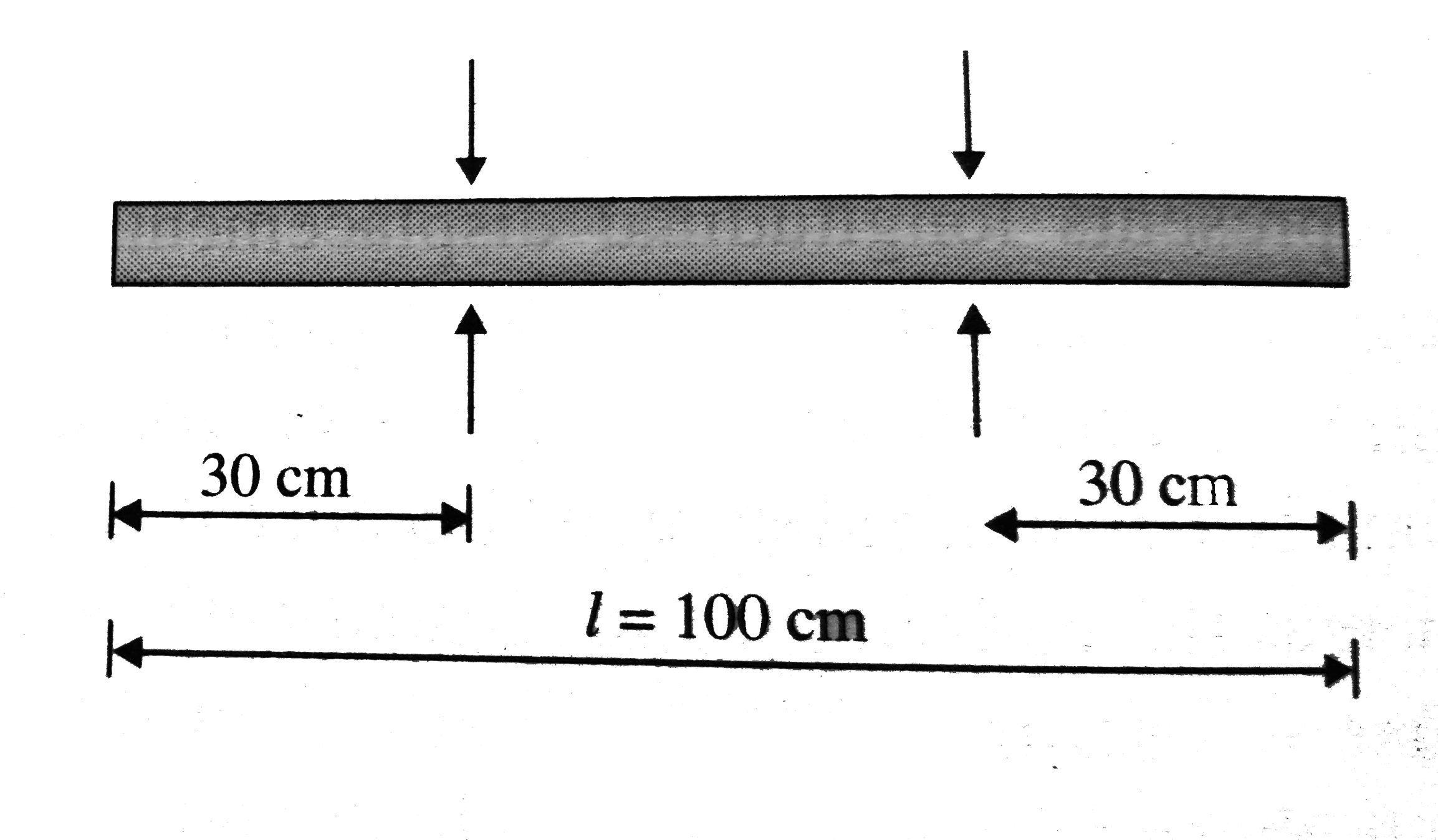
A metal rod length l=100 cm is changed at two points A and B as shown in fig. Distance of each clamp from neared and is a=30 cm. if density and Young's modulus of elesticity of rod material are `rho=9000 kg//m^(3)` and `Y=144 Gpa,` respectively, calculate minimum and next higher frequency of natural longitudinal oscillations of the rod.

Text Solution

Verified by Experts
Speed of longitudinal waves in the rod is
`v = sqrt(( Y)/( rho)) = 4000 m//s`
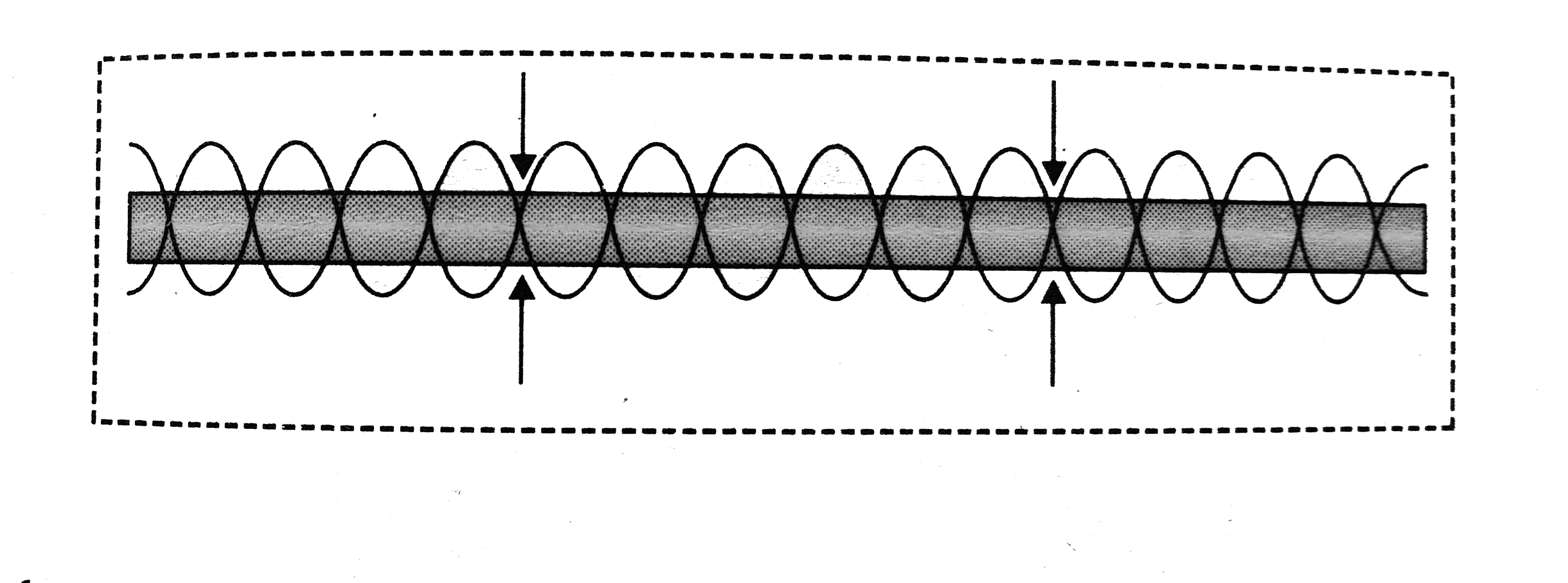
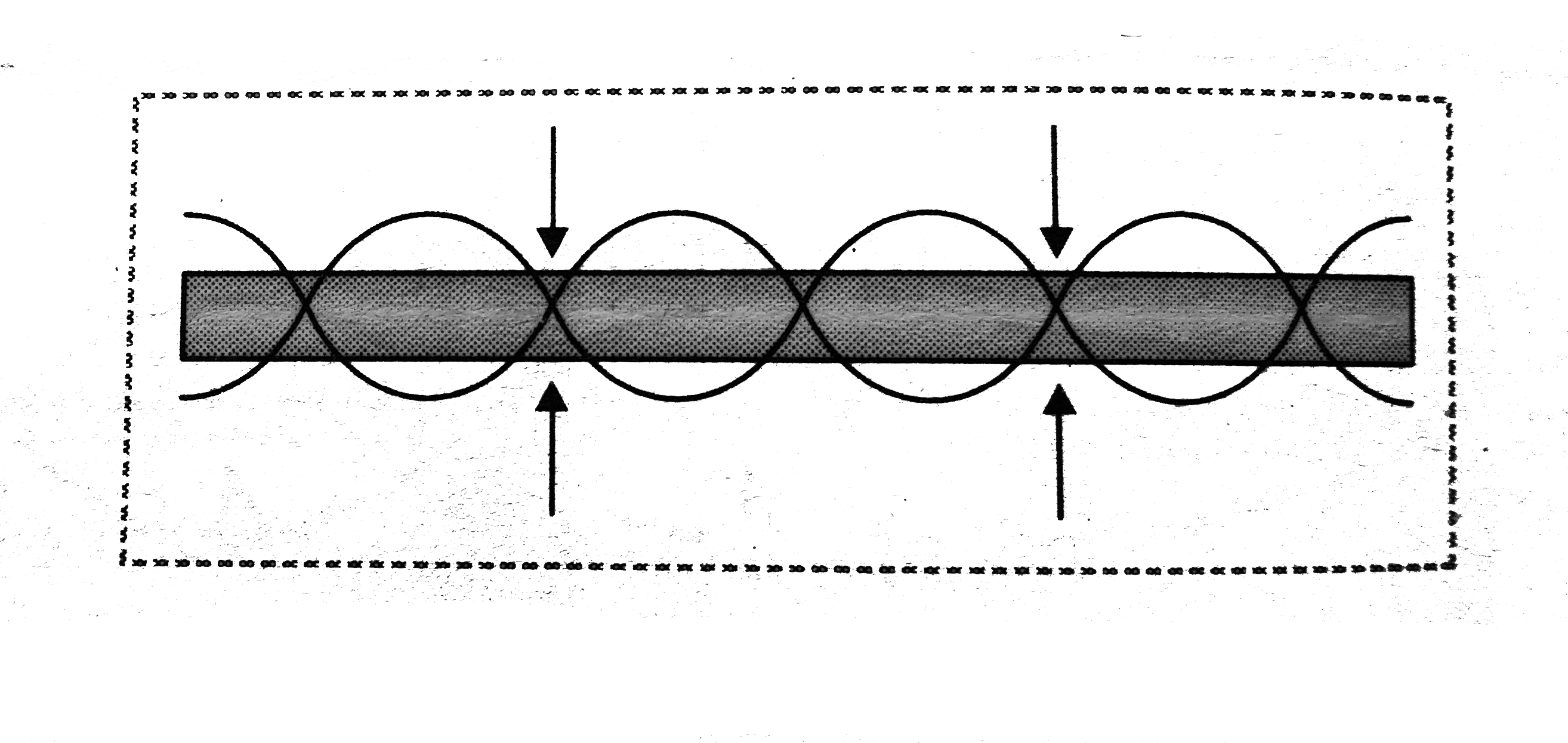
Since points `A and B` are clamped , therefore , nodes are formed at these points or rod oscillates with integer number of loops in the middle part . Let number of these loops be `m` .
Since , length of each loop is `lambda //2` , therefore ,
` m lambda//2 = ( 1 - 2 a)`
or `m lambda = 80 cm` (i)
Since the ends of the rod are free, therfore , antinodes are formed at each end of the rod or at one end of each end part is an antinode and at the other end is a node . It means that number of loops in each end part will be an odd multiple of half . Let these be `( 2n - 1)//2` where `n` is an integer. Then,
`(( 2n -1)/( 2)) ( lambda)/(2) = a or ( 2n - 1) lambda = 120 cm` (ii)
Dividing Eq. (i) by Eq. (ii),
`(m)/(( 2n -1)) = (2)/(3)` (iii)
Minimum possible frequency corresponds to maximum possible wavelength , hence , minimum number of loops.
Hence , from Eq. (iii) , for minimum frequency `m` should be wqual to `2 and ( 2 n -1 )` should be equal to `3 or n = 2`.
Substituting ` m = 2` in Eq . (i), Maximum wavelength `lambda_(0) = 40 cm`
Minimum frequency ,
`f_(0) = (v)/( lambda_(0)) = 10 KHz`
Next higher frequency corresponds to next higher integer values of `m and n` which satisfy Eq. (iii). Hence , for this case `m = 6 and ( 2n -1) = 9 or n = 5`.
Substituting ` m = 6 ` in Eq. (i) ,
` lambda = ( 80)/( 6) cm or ( 40)/( 3) cm`
Therefore , next higher frequency ,
`f_(1) = (v)/( lambda) = 30 Hz`
( It means rod oscillates with odd harmonics.)


Promotional Banner

Similar Questions

Explore conceptually related problems

A metal rod of length 1m is clamped at two points as shown in the figure. Distance of the clamp from the two ends are 5 cm and 15 cm, respectively. Find the minimum and next higher frequency of natural longitudinal oscillation of the rod. Given that Young's modulus of elasticity and density of aluminium are Y= 1.6 xx 10^(11) Nm^(-2) and rho = 2500 kgm^-3 , respectively.

A uniform rod of length 20 cm is clamped at the two points A and B as shown. Then the fundamental frequency of longitudinal vibration of the rod is (Y=2xx10^(11) N//m^2,rho=8xx10^3 kg//m^3)

Three cylindrical rods A, B and C of equal lengths and equal diameters are joined in series as shown if Fig. Their thermal conductivities are 2K, K and 0.5K, respectively. In steady state, if the free ends of rods A and C are at 100^@C and 0^@C , respectively, calculate the temperature at the two junction points. Assume negligible loss by radiaiotn through the curved surface. What will be the equivalent thermal conductivity?

A rod of nickel of length l is clamped at its midpoint . The rod is stuck and vibrations are set up in the rod . Find the general expression for the frequency of the longitudinal vibrations of the rod . Young's modulus and density of the rod is Y and rho , respectively.

A granite rod of 60 cm length is clamped at its middle point and is set into longitudinal vibrations. The density of granite is 2.7 xx10^(3) kg//m^(3) and its Young’s modulus is 9.27 xx10^(10) Pa. What will be the fundamental frequency of the longitudinal vibrations ?

An aluminum rod having a length 100 cm is clamped at its middle point and set into longitudinal vibrations. Let the rod vibrate in its fundamental mode. The density of aluminum is 2600 kg//m^(3) and its Young's modulus is 7.8xx10^(10) N//m^(2) . The frequency of the sound produced is :-

A metallic rod of length 1m has one end free and other end rigidly clamped. Longitudinal stationary waves are set up in the rod in such a way that there are total six antinodes present along the rod. The amplitude of an antinode is 4 xx 10^(-6) m . young's modulus and density of the rod are 6.4 xx 10^(10) N//m^(2) and 4 xx 10^(3) Kg//m^(3) respectively. Consider the free end to be at origin and at t=0 particles at free end are at positive extreme. The magnitude of strain at midpoint of the rod at t = 1 sec is

A metallic rod of length 1m has one end free and other end rigidly clamped. Longitudinal stationary waves are set up in the rod in such a way that there are total six antinodes present along the rod. The amplitude of an antinode is 4 xx 10^(-6) m . young's modulus and density of the rod are 6.4 xx 10^(10) N//m^(2) and 4 xx 10^(3) Kg//m^(3) respectively. Consider the free end to be at origin and at t=0 particles at free end are at positive extreme. The equation describing stress developed in the rod is

Two uniform thin rods each of length L and mass m are joined as shown in the figure. Find the distance of centre of mass the system from point O

A metallic rod of length 1m has one end free and other end rigidly clamped. Longitudinal stationary waves are set up in the rod in such a way that there are total six antinodes present along the rod. The amplitude of an antinode is 4 xx 10^(-6) m . young's modulus and density of the rod are 6.4 xx 10^(10) N//m^(2) and 4 xx 10^(3) Kg//m^(3) respectively. Consider the free end to be at origin and at t=0 particles at free end are at positive extreme. The equation describing displacements of particles about their mean positions is.