Home
Class 11
CHEMISTRY
A single electron orbits around a statio...

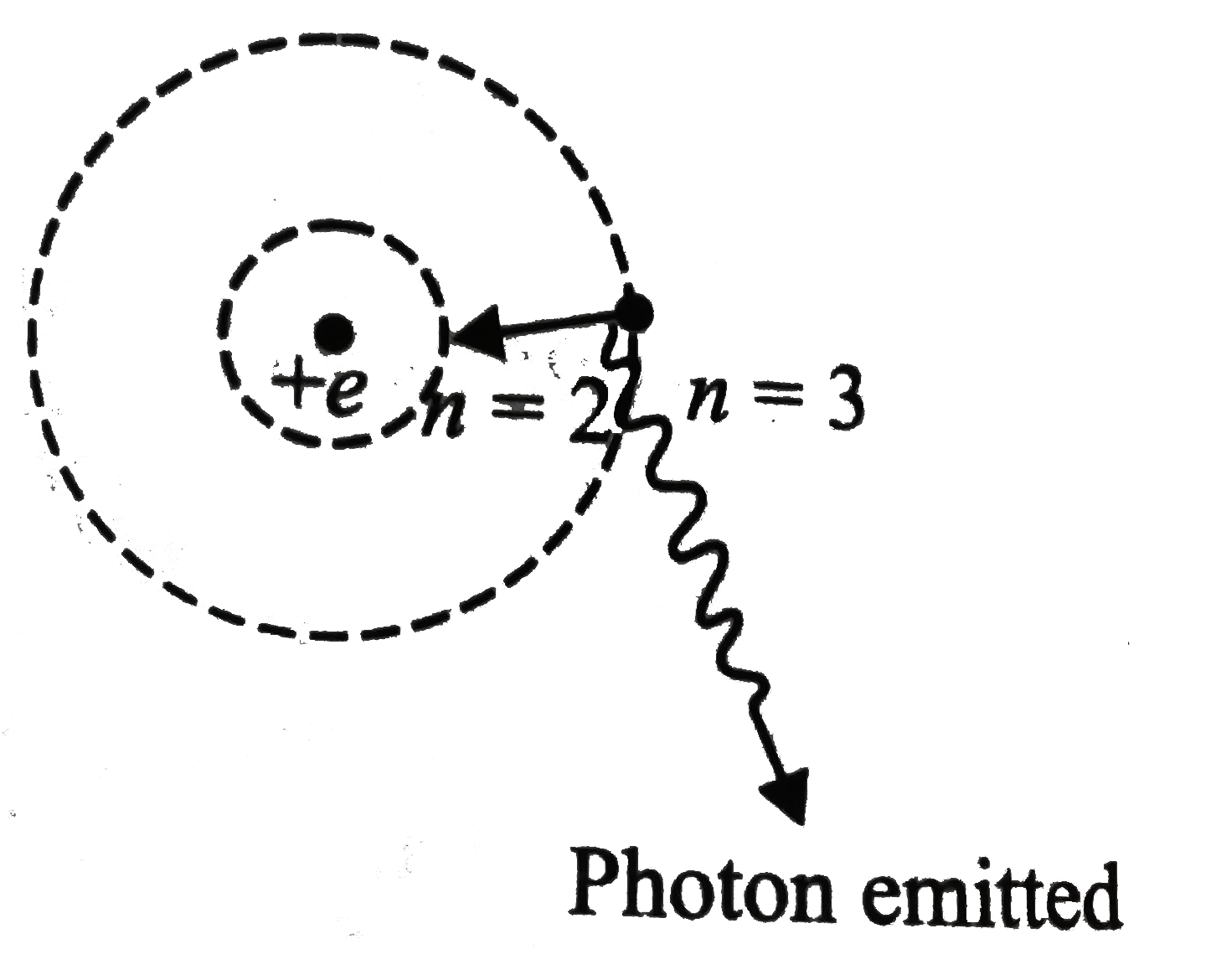
A single electron orbits around a stationary nucless of charge `+ Ze` where `Z` is a constant and e is the magnitude of electronic charge ,if respuires 47.2 e
is excite the electron from the second bohr orbit to the third bohr orbit
a. Find the value of Z

Text Solution

Verified by Experts

Since the nucless has a chaarge `+ Ze`, the atomic nucless of the ion is Z
a. The transition is `n_(!) = 2 rarr n_(2) = 3 ` by abserbing a photon of energy `47.2 eV`
`rArr Delta E = 47.2 eV`
Using the relation :
`Delta E = 13.6Z^(2)((1)/(n_(1)^(2)) - (1)/(n_(2)^(2)))eV`
`rArr 47.2 = 13.6Z^(2)((1)/(Z^(2)) - (1)/(3^2)) rArr Z = 3`
The required transition is `n_(1) = 3 rarr n_(2) = 4` by abserbing aphoton of energy of nergy `Delta E`
Find `Delta E`by using the relation
`Delta E=13.6Z^(2)((1)/(n_(1)^(2)) - (1)/(n_(2)^(2)))`
`rArr Delta E=13..6(5)^(2)((1)/(3^(2)) - (1)/(4^(2)))`
`Delta E = 16.53 eV`
c. The required transition is `n_(1) = 2 rarr n_(2) rarr n_(2) = 4`by abserbed aphoton of energy` Delata E `
Find `Delta E`by using the relation
`Delta E=13..6(5)^(2)((1)/(Z^(2))- (1)/(oo^(2)))`
`rArr Delta E = 8.5 eV`
Find the `lambda` of relation corresponding to energy `85eV`
`rArr lambda =- (hc)/(E ) = (6.63 xx 10^(-34) xx 3 xx 10^(8))/(85(1.6 xx 10^(-19)))`
`= 146.25 xx 10^(-10) = 146.25 Å`
d. If energy of electron be `E_(n)` then `KE = - E_(n) ` and `PE = 2E_(n)`
`E_(n) = (-13.6Z^(2))/(n^(2)) = (-13.65 xx 5^(2))/(1^(2)) = - 340 eV`
`KE = (-340 ev) = 340 ev`
`PE = 2(-34 eV) = -680 eV`
e. Ionization energy `= Delta E = 13.6(5)^(2)((1)/(2^(2)) - (1)/(oo^(2)))`
`:. Delta E = 85 eV`
Promotional Banner

Topper's Solved these Questions

  • ATOMIC STRUCTURE

    CENGAGE CHEMISTRY ENGLISH|Exercise Exercises (Subjective)|52 Videos
  • ATOMIC STRUCTURE

    CENGAGE CHEMISTRY ENGLISH|Exercise Exercises Linked Comprehension|50 Videos
  • APPENDIX - INORGANIC VOLUME 1

    CENGAGE CHEMISTRY ENGLISH|Exercise chapter-7 Single correct answer|1 Videos
  • CHEMICAL BONDING AND MOLECULAR STRUCTURE

    CENGAGE CHEMISTRY ENGLISH|Exercise Archives Subjective|15 Videos

Similar Questions

Explore conceptually related problems

A single electron orbit around a stationary nucleus of charge + Ze where Z is a constant and e is the magnitude of the electronic charge. It requires 47.2 eV to excite the electron from the second bohr orbit to the third bohr orbit. Find (i) The value of Z (ii) The energy required by nucleus to excite the electron from the third to the fourth bohr orbit (iii) The wavelength of the electronmagnetic radiation required to remove the electron from the first bohr orbit to inlinity (iv) The energy potential energy potential energy and the angular momentum of the electron in the first bohr orbit (v) The radius of the first bohr orbit (The ionization energy of hydrogen atom = 13.6 eV bohr radius = 5.3 xx 10^(-11) matre velocity of light = 3 xx 10^(8) m//sec planks 's constant = 6.6 xx 10^(-34) jules - sec )

A single electron orbits around a stationary nucleus of charge +Ze , where Z is a constant and e is the electronic charge. It requires 47.2 eV to excited the electron from the second Bohr orbit to the third Bohr orbit. Find (i) the value of Z, (ii) the energy required to excite the electron from the third to the fourth Bohr orbit and (iii) the wavelength of the electromagnetic radiation radiation to remove the electron from the first Bohr orbit to infinity.

A single electron orbits a stationary nucleus of charge + Ze , where Z is a constant and e is the magnitude of electronic charge . It requires 47.2 eV to excite electron from second Bohr orbit to third Bhor orbit . Find a the value of Z b the energy required to excite the electron from the third to the fourth Bohr orbit. c. the wavelength of electromagnetic rediation required to remove the electron from the first Bohr orbit to infinity. d Find the KE,PE , and angular momentum of electron in the first Bohr orbit. e. the redius of the first Bohr orbit [The ionization energy of hydrogen atom = 13.6 eV Bohr radius = 5.3 xx 10^(_11) m , "velocity of light" = 3 xx 10^(-8)jm s ^(-1) , Planck's constant = 6.6 xx 10^(-34)j - s]

A single electron ion has nuclear chrage +Ze where Z is atomic number and e is electronic charge. It requires 16.52 eV to excite the electron from the second Bohr orbit to third Bohr orbit. Find (a) The atomic number of element? (b) The energy required for transition of electron from first to third orbit? (c ) Wavelength of photon required to remove electron from first Bohr orbit to infinity? (d) The kinetic energy of electron on first Bohr orbit?

An electron from one Bohr stationary orbit can go to next higher orbit:

A single electron orbits around a stationary nucleus of charge +Ze. It requires 47.2 eV to excite the electron from the 2^"nd" to 3^"rd" Bohr orbit. Find atomic number 'Z' of atom .

Energy required for the electron excitation in Li^(++) from the first to the third Bohr orbit is:

If the PE of an electron in the first Bohr orbit of H is zero , the total energy of the electron in second Bohr orbit is

If the speed of electron in the first bohr orbit of hydrogen atom is x then the speed of the electron in the third Bohr orbit of hydrogen is

If the speed of electron in the first bohr orbit of hydrogen atom is x then the speed of the electron in the third Bohr orbit of hydrogen is

CENGAGE CHEMISTRY ENGLISH-ATOMIC STRUCTURE-Concept Applicationexercise(4.3)
  1. A single electron orbits around a stationary nucless of charge + Ze wh...

    Text Solution

    |

  2. How many quantum number are needed in designate an orbital ? Name the...

    Text Solution

    |

  3. The principal quantum number of n of an atomic orbitals is 5 what are ...

    Text Solution

    |

  4. (a) An atomic orbital has n=3. What are the possible values of l? (b...

    Text Solution

    |

  5. What is the lowest value of n that allows g orbital to exist?

    Text Solution

    |

  6. Given the notation for the sub-shell deotected by the following quant...

    Text Solution

    |

  7. How many electron on a fully filled f sub-shell have m(1) = 0 ?

    Text Solution

    |

  8. An electron is in one of the 3d orbitals. Give the possible values of ...

    Text Solution

    |

  9. If the largest value ofm(1) for an electron is + 3 in what type of su...

    Text Solution

    |

  10. Explain giving reasons, which of the following sets of quantum numbers...

    Text Solution

    |

  11. How many electron in atom may have the following quantum number ? A n ...

    Text Solution

    |

  12. How many orbitals are possible in a. 4th energy level b. 5f sub-she...

    Text Solution

    |

  13. What are the possible values of l and m(1) for an atomic orbital 4f?

    Text Solution

    |

  14. What is the shape of 1s and 2s orbital .Give two point of difference ...

    Text Solution

    |

  15. (a) How many sub-shells are associated with n = 4? (b) How many electr...

    Text Solution

    |

  16. How many spherical nodes are present in 4s orbital in a hydrogen ato...

    Text Solution

    |

  17. The principal quantum number representwsw

    Text Solution

    |

  18. The energy of an electron of 2p(1) orbital is

    Text Solution

    |

  19. The orbital angular momentum of an electron of an electron in 2s orbit...

    Text Solution

    |

  20. The number of angular nodal planes of zero electron density in the d(...

    Text Solution

    |
