Home
Class 11
CHEMISTRY
The emission of electrons from a metal ...

The emission of electrons from a metal surface exposed rto light radaition of appropriate wavelength is called photoelectroic effect .The emmited electron are called photo=-weklectron work function of threshold energy may be defined as the minimum amount of energy required to ejercted electron from a most surface .According to Einstein
Maximum kinetic energy of ejected electron = Aborbed energy - Work function
`(1)/(2) mv_(max)^(2) = h(v) - h(v_(n)) = hv [(1)/(lambda) -0 (1)/(lambda_(n))]`
Where `v_(n)` and `lambda_(0)` are thereshold frequency and threshold wavelength respectively
Sopping potential : it is the miximum potential at which the photoelectric current becomes zero if `V_(0)` is the stopping potential `eV_(0) = h(v- v_(0))`
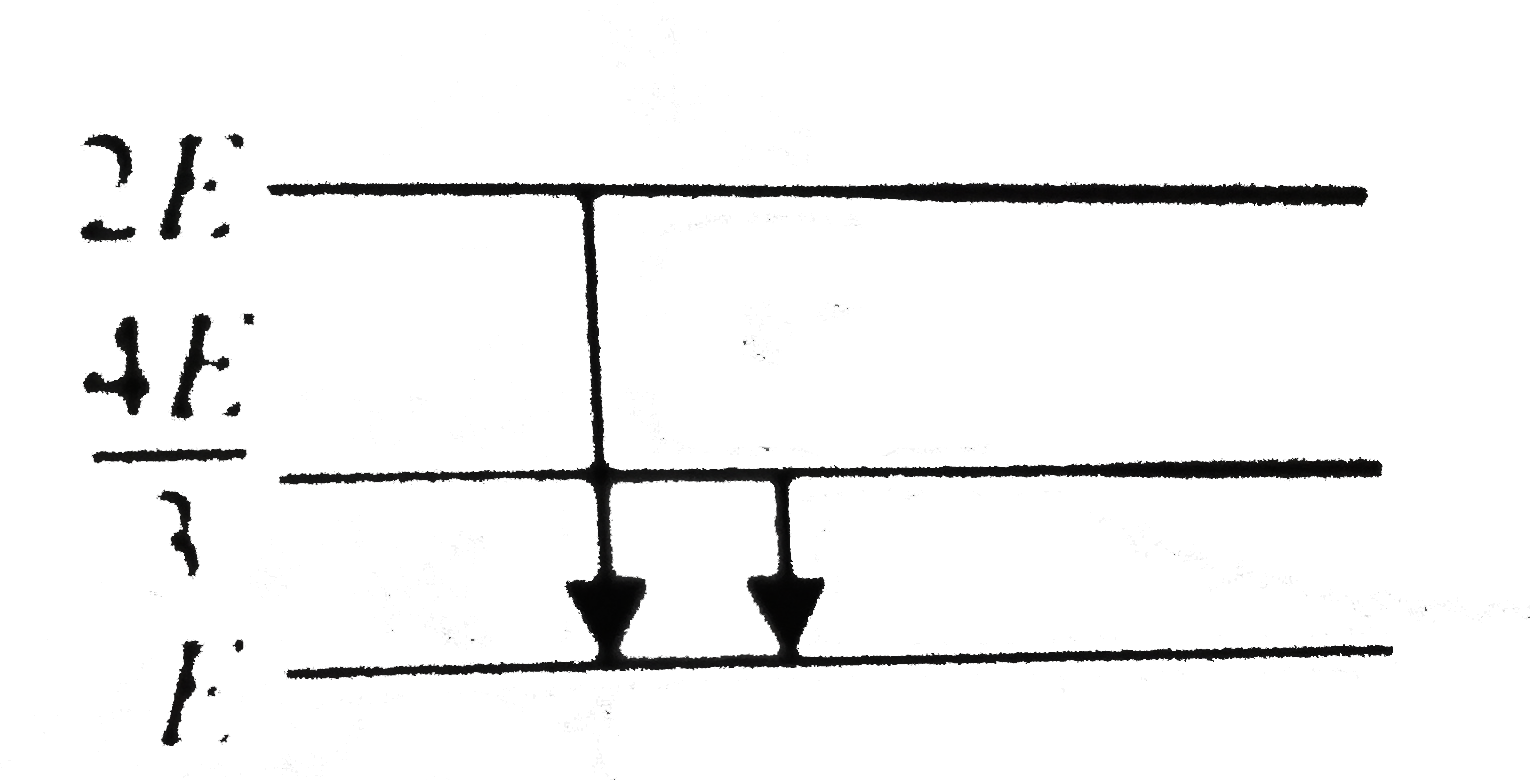
The folloeing figure indicates the energy livels of a certain atom .When the system moves from `2E` level to E lvel a photon of wavelength `lambda` is emitted .The wavelength of the photon produced during the transition from level `4E//3` to level E is

A

`(lambda)/(3)`

B

`(3lambda)/(4)`

C

`(4 lambda)/(3)`

D

`3 lambda`

Text Solution

Verified by Experts

The correct Answer is:

D
Promotional Banner

Topper's Solved these Questions

  • ATOMIC STRUCTURE

    CENGAGE CHEMISTRY ENGLISH|Exercise Exercises Multiple Correct|45 Videos
  • ATOMIC STRUCTURE

    CENGAGE CHEMISTRY ENGLISH|Exercise Exercises Single Correct|127 Videos
  • ATOMIC STRUCTURE

    CENGAGE CHEMISTRY ENGLISH|Exercise Exercises (Subjective)|52 Videos
  • APPENDIX - INORGANIC VOLUME 1

    CENGAGE CHEMISTRY ENGLISH|Exercise chapter-7 Single correct answer|1 Videos
  • CHEMICAL BONDING AND MOLECULAR STRUCTURE

    CENGAGE CHEMISTRY ENGLISH|Exercise Archives Subjective|15 Videos

Similar Questions

Explore conceptually related problems

The emission of electrons from a metal surface exposed rto light radaition of appropriate wavelength is called photoelectroic effect .The emmited electron are called photo=-weklectron work function of threshold energy may be defined as the minimum amount of energy required to ejercted electron from a most surface .According to Einstein Maximum kinetic energy of ejected electron = Aborbed energy - Work function (1)/(2) mv_(max)^(2) = h(v) - h(v_(n)) = hv [(1)/(lambda) -0 (1)/(lambda_(n))] Where v_(n) and lambda_(0) are thereshold frequency and threshold wavelength respectively Sopping potential : it is the miximum potential at which the photoelectric current becomes zero if V_(0) is the stopping potential eV_(0) = h(v- v_(0)) Which graph is correct ?

The emission of electrons from a metal surface exposed rto light radaition of appropriate wavelength is called photoelectroic effect .The emmited electron are called photo=-weklectron work function of threshold energy may be defined as the minimum amount of energy required to ejercted electron from a most surface .According to Einstein Maximum kinetic energy of ejected electron = Aborbed energy - Work function (1)/(2) mv_(max)^(2) = h(v) - h(v_(n)) = hv [(1)/(lambda) -0 (1)/(lambda_(n))] Where v_(n) and lambda_(0) are thereshold frequency and threshold wavelength respectively Sopping potential : it is the miximum potential at which the photoelectric current becomes zero if V_(0) is the stopping potential eV_(0) = h(v- v_(0)) Whaich of the following is the graph between the frequency (V) of the incident radiation and the stopping potential (v) ?

The emission of electrons from a metal surface exposed rto light radaition of appropriate wavelength is called photoelectroic effect .The emmited electron are called photo=-weklectron work function of threshold energy may be defined as the minimum amount of energy required to ejercted electron from a most surface .According to Einstein Maximum kinetic energy of ejected electron = Aborbed energy - Work function (1)/(2) mv_(max)^(2) = h(v) - h(v_(n)) = hv [(1)/(lambda) -0 (1)/(lambda_(n))] Where v_(n) and lambda_(0) are thereshold frequency and threshold wavelength respectively Sopping potential : it is the miximum potential at which the photoelectric current becomes zero if V_(0) is the stopping potential eV_(0) = h(v- v_(0)) The stopping potential as a function on electron frtequency is plotted for two photoelectric surface A abd B The graph show that the work function of A is

The emission of electrons from a metal surface exposed rto light radaition of appropriate wavelength is called photoelectric effect .The emmited electron are called photo=-weklectron work function of threshold energy may be defined as the minimum amount of energy required to ejected electron from a most surface .According to Einstein Maximum kinetic energy of ejected electron = Absorbed energy - Work function (1)/(2) mv_(max)^(2) = h(v) - h(v_(n)) = hv [(1)/(lambda) - (1)/(lambda_(n))] Where v_(n) and lambda_(0) are thereshold frequency and threshold wavelength respectively Sopping potential : it is the miximum potential at which the photoelectric current becomes zero if V_(0) is the stopping potential eV_(0) = h(v- v_(0)) In the photoelectric currect effect the shape of strainght line graph between stopping potential (V_(0)) and frequency of incident light (V) gves

Highest amount of energy will be required for the removal of electron from

The kinetic energy of the photo electrons does not depends upon

Fill in the blanks in the following sentences with appropriate words: The minimum amount of energy required to emit an electron from a metal surface is called ________ .

If the threshold wavelength (lambda_(0)) for ejection of electron from metal is 350 nm then work function for the photoelectric emission is

If the threshold wavelength (lambda_(0)) for ejection of electron from metal is 330 nm, then work function for the photoelectric emission is:

The photo-electrons emitted from a surface of sodium metal are such that

CENGAGE CHEMISTRY ENGLISH-ATOMIC STRUCTURE-Exercises Linked Comprehension
  1. The sequence of filling electron in sub-shells of element with few ex...

    Text Solution

    |

  2. The sepence of filling electgron in sub-shells of element with few ex...

    Text Solution

    |

  3. The only element in the hydrogen atom resides under ordinary conditi...

    Text Solution

    |

  4. The only element in the hydrogen atom resides under ordinary conditi...

    Text Solution

    |

  5. The only element in the hydrogen atom resides under ordinary conditi...

    Text Solution

    |

  6. The only element in the hydrogen atom resides under ordinary conditi...

    Text Solution

    |

  7. The shape of orbitals are related to the ratio of principal quantum ...

    Text Solution

    |

  8. The shape of orbitals are related to the ratio of principal quantum ...

    Text Solution

    |

  9. The shape of orbitals are related to the ratio of principal quantum ...

    Text Solution

    |

  10. The shape of orbitals are related to the ratio of principal quantum ...

    Text Solution

    |

  11. The shape of orbitals are related to the ratio of principal quantum ...

    Text Solution

    |

  12. The emission of electrons from a metal surface exposed rto light r...

    Text Solution

    |

  13. The emission of electrons from a metal surface exposed rto light r...

    Text Solution

    |

  14. The emission of electrons from a metal surface exposed rto light r...

    Text Solution

    |

  15. The emission of electrons from a metal surface exposed rto light r...

    Text Solution

    |

  16. The emission of electrons from a metal surface exposed rto light r...

    Text Solution

    |

  17. It is tempting to think that all possible transition are permissible a...

    Text Solution

    |

  18. It is teming to think that all possible transituion are permissible an...

    Text Solution

    |

  19. The energy of state s(1) in units of the hydrogen atom ground state...

    Text Solution

    |

  20. The hydrogen -like species Li^(2+) is in a spherically symmetric stat...

    Text Solution

    |
