Home
Class 11
CHEMISTRY
Consider the adjacent diagram. Initially...

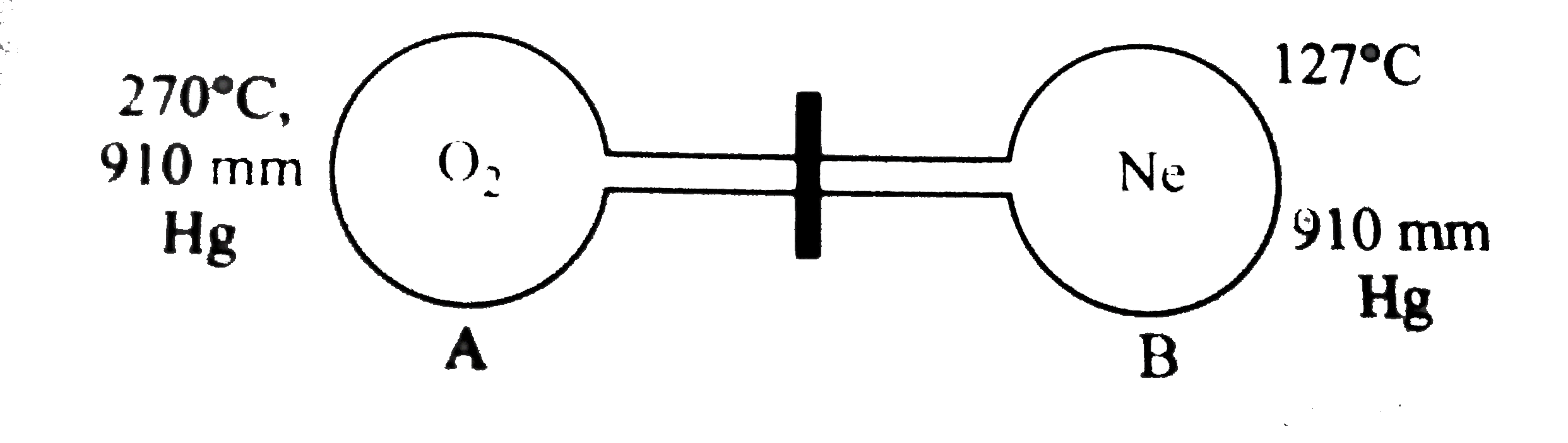
Consider the adjacent diagram. Initially, flask `A` contained oxygen gas at `27^(@)C` and `950 mm` of `Hg`, and flask `B` contained neon gas at `27^(@)C` and `900 mm`. Finally, two flask were joined by means of a narrow tube of negligible volume equipped with a stopcock and gases were allowed to mixup freely. The final pressure in the combined system was found to be `910 mm` of `Hg`.

If flask `B` were heated to `127^(@)C`, maintaining flask `A` at constant temperature of `27^(@)C`, final pressure (in `mm Hg`) in the combined system would have been

A

`1007`

B

`1250`

C

`1137.5`

D

`1990`

Text Solution

Verified by Experts

`n_(total)=Const`.

`implies (950xxV_(A))/(Rxx300)+(900xxV_(B))/(Rxx300)=(PxxV_(A))/(Rxx300)+(PxxV_(B))/(Rxx400)`
`implies 950V_(A)+900xx4V_(A)=PxxV_(A)+(3)/(4)xxPxx(4V_(A))`
`implies P=(950+900xx4)/(1+3)=1137.5 mm Hg`
Promotional Banner

Topper's Solved these Questions

  • STATES OF MATTER

    CENGAGE CHEMISTRY ENGLISH|Exercise Exercises (Multiple Correcttype)|32 Videos
  • STATES OF MATTER

    CENGAGE CHEMISTRY ENGLISH|Exercise Exercises (Single Correct)|85 Videos
  • STATES OF MATTER

    CENGAGE CHEMISTRY ENGLISH|Exercise Linked Comprehensive|2 Videos
  • SOME BASIC CONCEPTS AND MOLE CONCEPT

    CENGAGE CHEMISTRY ENGLISH|Exercise Archives Subjective|11 Videos
  • STOICHIOMETRY

    CENGAGE CHEMISTRY ENGLISH|Exercise Archives Subjective|33 Videos

Similar Questions

Explore conceptually related problems

Consider the adjacent diagram. Initially, flask A contained oxygen gas at 27^(@)C and 950 mm of Hg , and flask B contained neon gas at 27^(@)C and 900 mm . Finally, two flask were joined by means of a narrow tube of negligible volume equipped with a stopcock and gases were allowed to mixup freely. The final pressure in the combined system was found to be 910 mm of Hg . What is the correct relationship between volumes of the two flasks?

Consider the adjacent diagram. Initially, flask A contained oxygen gas at 27^(@)C and 950 mm of Hg , and flask B contained neon gas at 27^(@)C and 900 mm . Finally, two flask were joined by means of a narrow tube of negligible volume equipped with a stopcock and gases were allowed to mixup freely. The final pressure in the combined system was found to be 910 mm of Hg . Which of the following statements concerning oxygen and neon gas is true in the begining, when the stopcock was just opened?

Initially bulb "a" contained oxygen gas at 27^(@)C and 950 mm of Hg and bulb "B" contained neon gas at 27^(@)C and 900 mm of Hg. These bulbs are connected by a narrow tube of negligible volume equipped with a stopcock and gases were allowed to mix-up freely. The pressure obtained in the combined system was found to be 910 mm of Hg. If volume of bulb B was measured to be 10 L, then find the volume of oxygen gas present initially in bulb "A" .

Calculate the volume occupied by 7 g of nitrogen gas at 27^(@)C and 750 mm Hg pressure

2L of SO_(2) gas at 760 mm Hg are transferred to 10 L flask containing oxygen at a particular temperature, the partial pressure of SO_(2) in the flask is

Two flasks of equal volumes have been joined by a narrow tube of negligible volume. Initially both the flasks are 300 K and totally 9 mole of gas is present. One of the flasks is then placed in a thermostat at 600K. How many moles of gas is present in hot bulb.

Calculate RMS velocity of ethane at 27^@ C and 720 mm of Hg pressure.

At constant temperature, a gas is at a pressure of 1080 mm Hg. If the volume is decreased by 40%, find the new pressure of the gas.

A gas occupies a volume of 300 cm^(3) at 27 .^(@)C and 620 mm pressure . The volume of gas at 47 .^(@)C and 640 mm pressure is

A gas occupies a volume of 300 cm^(3) at 27 .^(@)C and 620 mm pressure . The volume of gas at 47 .^(@)C and 640 mm pressure is

CENGAGE CHEMISTRY ENGLISH-STATES OF MATTER-Exercises (Linked Comprehensive)
  1. Two gaseous molecules A and B are traveling towards each other. Let th...

    Text Solution

    |

  2. Two gaseous molecules A and B are traveling towards each other. Let th...

    Text Solution

    |

  3. Two gaseous molecules A and B are traveling towards each other. Let th...

    Text Solution

    |

  4. Two gaseous molecules A and B are traveling towards each other. Let th...

    Text Solution

    |

  5. The constant motion and high velocities of gas particles lead to some ...

    Text Solution

    |

  6. The constant motion and high velocities of gas particles lead to some ...

    Text Solution

    |

  7. The constant motion and high velocities of gas particles lead to some ...

    Text Solution

    |

  8. X mL Hydrogen gas effuses through a hole in a container in 5 s. The ti...

    Text Solution

    |

  9. The constant motion and high velocities of gas particles lead to some ...

    Text Solution

    |

  10. The behaviour of ideal gas is goverened by various gas laws which are ...

    Text Solution

    |

  11. The behaviour of ideal gas is goverened by various gas laws which are ...

    Text Solution

    |

  12. The behaviour of ideal gas is goverened by various gas laws which are ...

    Text Solution

    |

  13. The behaviour of ideal gas is goverened by various gas laws which are ...

    Text Solution

    |

  14. The behaviour of ideal gas is goverened by various gas laws which are ...

    Text Solution

    |

  15. Consider the adjacent diagram. Initially, flask A contained oxygen gas...

    Text Solution

    |

  16. Consider the adjacent diagram. Initially, flask A contained oxygen gas...

    Text Solution

    |

  17. Consider the adjacent diagram. Initially, flask A contained oxygen gas...

    Text Solution

    |

  18. The system shown in the figure is in equilibrium, where A and B are is...

    Text Solution

    |

  19. The system shown in the figure is in equilibrium, where A and B are is...

    Text Solution

    |

  20. The system shown in the figure is in equilibrium, where A and B are is...

    Text Solution

    |