Home
Class 11
CHEMISTRY
For 1 mol of an ideal gas, V(1)gtV(2)gtV...

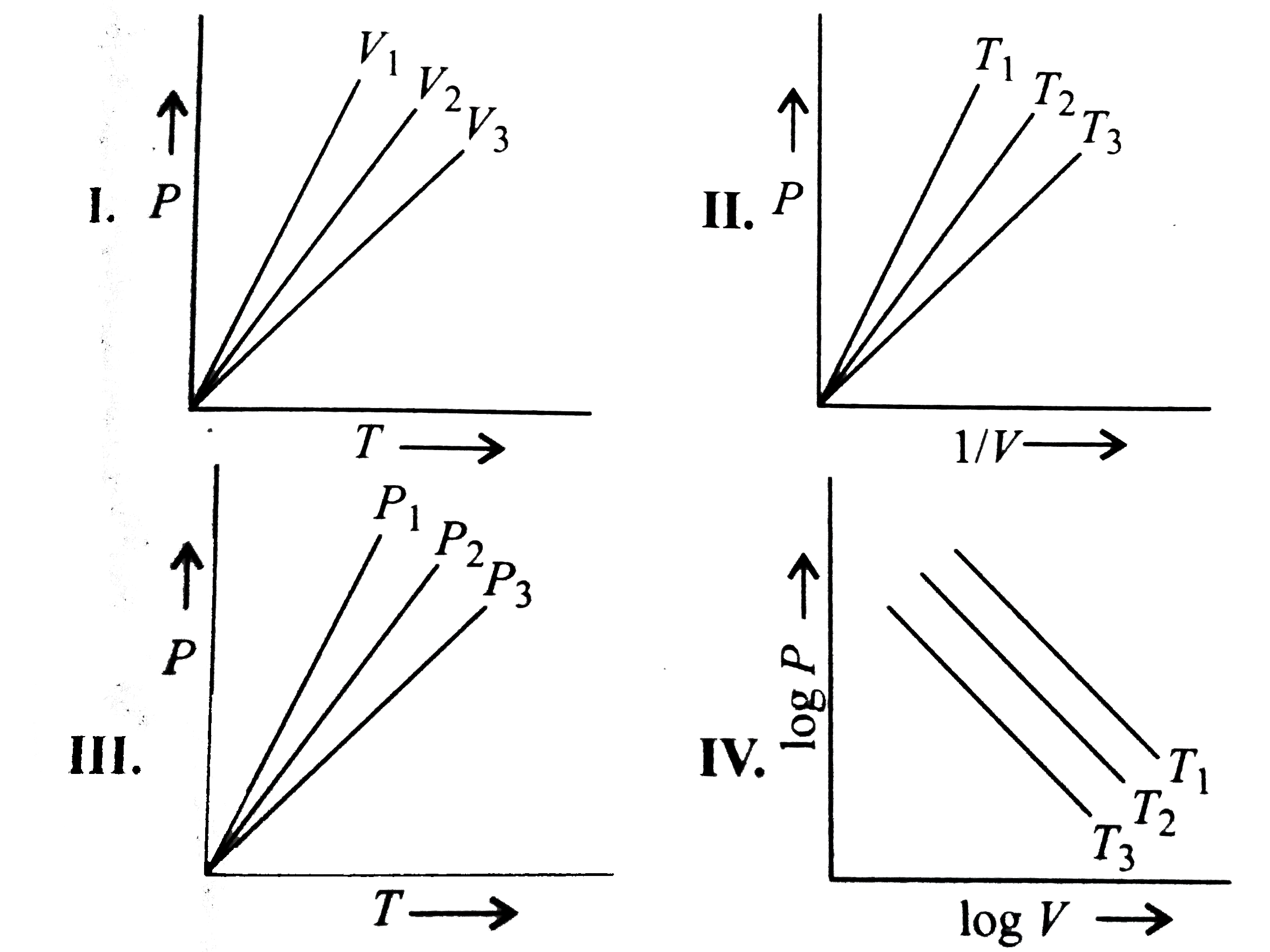
For `1 mol` of an ideal gas, `V_(1)gtV_(2)gtV_(3)` in fig. (`I`),`T_(1)gtT_(2)gtT_(3)` in fig. (`II`), `P_(1)gtP_(2)gtP_(3)` in fig. (`III`), and `T_(1)gtT_(2)gtT_(3)` in fig. (`IV`) , then which curves are correct.

A

`I,II`

B

`I,II,III`

C

`II,IV`

D

`I,III,IV`

Text Solution

Verified by Experts

`PV=RT` if `P_(1) gt P_(2)`, `V_(1) lt V_(2)`.
Also `log P= -log V+ log RT`
Promotional Banner

Topper's Solved these Questions

  • STATES OF MATTER

    CENGAGE CHEMISTRY ENGLISH|Exercise Exercises (Assertion-Reasoning)|24 Videos
  • STATES OF MATTER

    CENGAGE CHEMISTRY ENGLISH|Exercise Exercises (Integer)|10 Videos
  • STATES OF MATTER

    CENGAGE CHEMISTRY ENGLISH|Exercise Exercises (Multiple Correcttype)|32 Videos
  • SOME BASIC CONCEPTS AND MOLE CONCEPT

    CENGAGE CHEMISTRY ENGLISH|Exercise Archives Subjective|11 Videos
  • STOICHIOMETRY

    CENGAGE CHEMISTRY ENGLISH|Exercise Archives Subjective|33 Videos

Similar Questions

Explore conceptually related problems

Examine the following plots and predict whether in (i) P_(1) lt P_(2) "and" T_(1) gt T_(2) , in (ii) T_(1) = T_(2)ltT_(3) , in (iii) V_(1) gt V_(2), "in" (iv) P_(1) gt P_(2) "or" P_(2) gt P_(1)

Let a_(1)gta_(2)gta_(3)gt...gta_(n)gt1. p_(1)gtp_(2)gtp_(3)gt...gtp_(n)gt0" such that "p_(1)+p_(2)+p_(3)+...+p_(n)=1. Also, F(x)=(p_(1)a_(1)^(x)+p_(n)a_(n)^(x))^(1//x) . lim_(xto0^(+)) F(x)" equals "

If for a sequence (T_(n)), (i) S_(n) = 2n^(2)+3n+1 (ii) S_(n) =2 (3^(n)-1) find T_(n) and hence T_(1) and T_(2)

A tank full of water has a small hole at its bottom. Let t_(1) be the time taken to empty first one third of the tank and t_(2) be the time taken to empty second one third of the tank and t_(3) be the time taken to empty rest of the tank then (a). t_(1)=t_(2)=t_(3) (b). t_(1)gtt_(2)gtt_(3) (c). t_(1)ltt_(2)ltt_(3) (d). t_(1)gtt_(2)ltt_(3)

The % yield of ammonia as a function of time in the reaction, N_(2)(g)+3H_(2)(g)hArr2NH_(3)(g)'DeltaHlt0 at (p,T_(1)) is given below If this reaction is conducted at (p,T_(1)) , with T_(2)gtT_(1) the % yield by of ammonia as a function of time is represented by

The activity of a sample of radioactive material is R_(1) at time t_(1)andR_(2)"at time"t_(2)(t_(2)gtt_(1)) . Its mean life is T. Then,

V vs T curves at constant pressure P_(1) and P_(2) for an ideal gas are shown below Which is correct ?

For an ideal gas, an illustratio of three different paths A(B+C) and (D+E) from an initial state P_(1), V_(1), T_(1) to a final state P_(2), V_(2),T_(1) is shown in the given figure. Path A represents a reversible isothermal expansion form P_(1),V_(1) to P_(2),V_(2) , Path (B+C) represents a reversible adiabatic expansion (B) from P_(1),V_(1),T_(1)to P_(3),V_(2),T_(2) followed by reversible heating the gas at constant volume (C) from P_(3),V_(2),T_(2) to P_(2),V_(2),T_(1) . Path (D+E) represents a reversible expansion at constant pressure P_(1)(D) from P_(1),V_(1),T_(1) to P_(1),V_(2),T_(3) followed by a reversible cooling at constant volume V_(2)(E) from P_(1),V_(2),T_(3) to P_(2),V_(2),T_(1) . What is q_(rev) , for path (A) ?

For an ideal gas, an illustratio of three different paths A(B+C) and (D+E) from an initial state P_(1), V_(1), T_(1) to a final state P_(2), V_(2),T_(1) is shown in the given figure. Path A represents a reversible isothermal expansion form P_(1),V_(1) to P_(2),V_(2) , Path (B+C) represents a reversible adiabatic expansion (B) from P_(1),V_(1),T_(1)to P_(3),V_(2),T_(2) followed by reversible heating the gas at constant volume (C) from P_(3),V_(2),T_(2) to P_(2),V_(2),T_(1) . Path (D+E) represents a reversible expansion at constant pressure P_(1)(D) from P_(1),V_(1),T_(1) to P_(1),V_(2),T_(3) followed by a reversible cooling at constant volume V_(2)(E) from P_(1),V_(2),T_(3) to P_(2),V_(2),T_(1) . What is q_(rev) , for path (D+E) ?

For an ideal gas, an illustratio of three different paths A(B+C) and (D+E) from an initial state P_(1), V_(1), T_(1) to a final state P_(2), V_(2),T_(1) is shown in the given figure. Path A represents a reversible isothermal expansion form P_(1),V_(1) to P_(2),V_(2) , Path (B+C) represents a reversible adiabatic expansion (B) from P_(1),V_(1),T_(1)to P_(3),V_(2),T_(2) followed by reversible heating the gas at constant volume (C) from P_(3),V_(2),T_(2) to P_(2),V_(2),T_(1) . Path (D+E) represents a reversible expansion at constant pressure P_(1)(D) from P_(1),V_(1),T_(1) to P_(1),V_(2),T_(3) followed by a reversible cooling at constant volume V_(2)(E) from P_(1),V_(2),T_(3) to P_(2),V_(2),T_(1) . What is DeltaS for path A ?

CENGAGE CHEMISTRY ENGLISH-STATES OF MATTER-Exercises (Single Correct)
  1. At low pressures, van der Waals' equation is written as (P+(a)/(V^(2))...

    Text Solution

    |

  2. Ideal gas equation in terms of KE per unit volume, E, is

    Text Solution

    |

  3. For 1 mol of an ideal gas, V(1)gtV(2)gtV(3) in fig. (I),T(1)gtT(2)gtT(...

    Text Solution

    |

  4. I, II, and III are three istherms, respectively, at T(1), T(2), and T(...

    Text Solution

    |

  5. A quantity of hydrogen gas occupies a volume of 30.0 mL at a certain t...

    Text Solution

    |

  6. A gas in an open container is heated from 27^(@)C to 127^(@)C The frac...

    Text Solution

    |

  7. The density of neon gas will be highest at

    Text Solution

    |

  8. A mixture of SO(2) and O(2) in the molar ratio 16:1 is diffused throug...

    Text Solution

    |

  9. A graph is plotted between log V and log T for 2 mol of gas at constan...

    Text Solution

    |

  10. A gas obeys P(V-b)=RT. Which of the following are correct about this g...

    Text Solution

    |

  11. The pressure of a real gas is less than the pressure of an ideal gas b...

    Text Solution

    |

  12. O(2) gas at STP contained in a flask was replaced by SO(2) under same ...

    Text Solution

    |

  13. At what temperature will hydrogen molecules have the same KE as nitrog...

    Text Solution

    |

  14. Select the correct statements. (I) Greater is humidity, lesser will ...

    Text Solution

    |

  15. The temperature to which a gas must be cooled before it can be liquifi...

    Text Solution

    |

  16. Distribution of molecules with velocity is represented by the curve ...

    Text Solution

    |

  17. The volume of helium is 44.8 L at

    Text Solution

    |

  18. Which gas shows real behaviour?

    Text Solution

    |

  19. For the non-zero volume of the molecules, real gas equation for n mol ...

    Text Solution

    |

  20. Actual graph for the given parameters in (Q.25) will be

    Text Solution

    |

