Home
Class 11
CHEMISTRY
Two moles of a perfect gas undergo the f...

Two moles of a perfect gas undergo the following processes:
a. A reversible isobaric expansion from `(1.0 atm, 20.0L)` to `(1.0 atm, 40.0L)`
b. A reversible isochroic change of state from `(1.0 atm, 40.0L)` to `(0.5 atm, 40.0 L)`
c. A reversible isothermal expansion from `(0.5 atm, 40.0 L) to(1.0 atm, 20.0 L)`
i. Sketch with lables each of the processes on the same `P -V` diagram.
ii. Calculate the total work `(w)` and the total heat change `(q)` involved in the above process.
iii. What will be the values of `DeltaH` for the overall process?

Text Solution

Verified by Experts
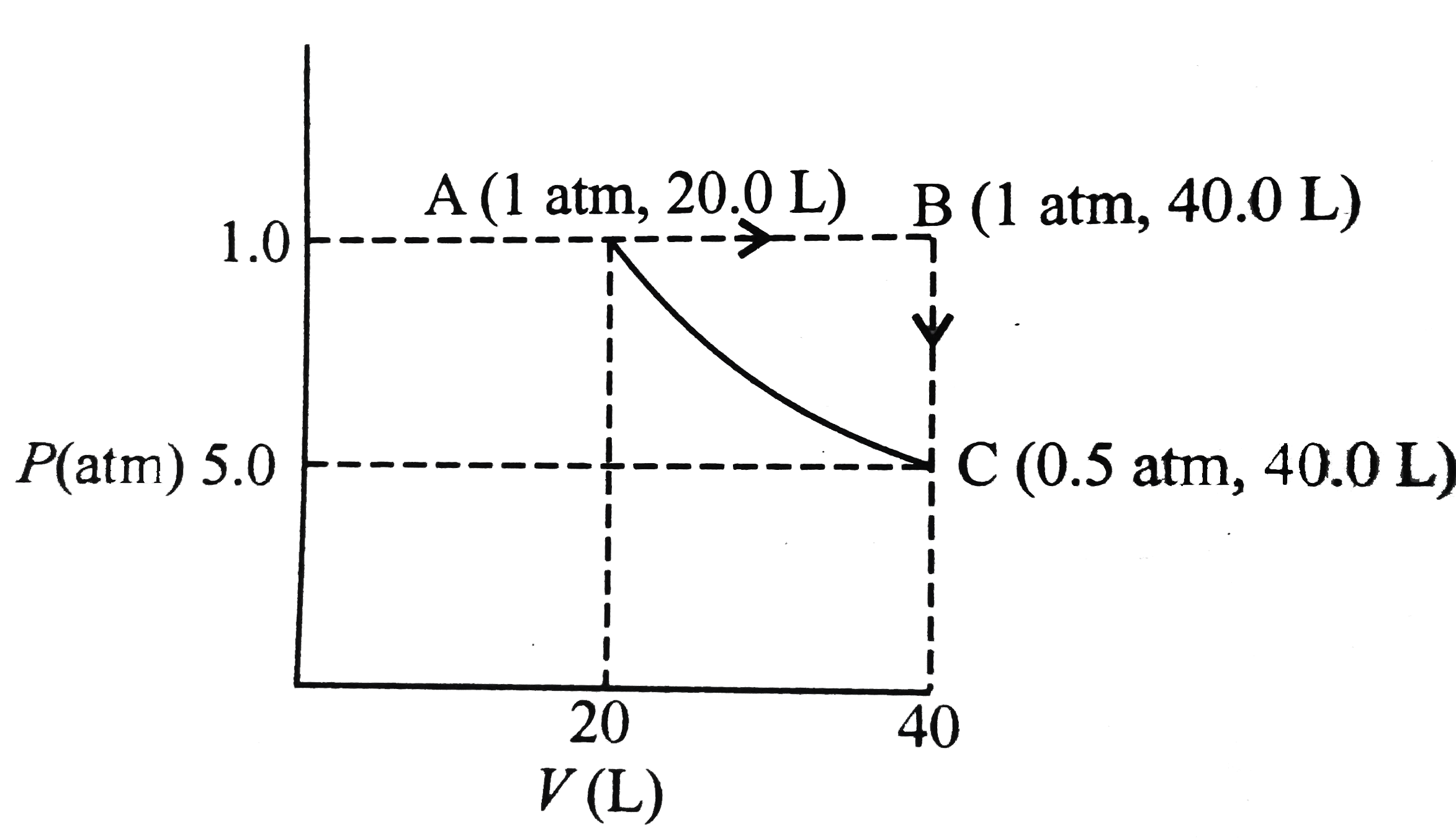
a.
b. Total work done `(w) = w_(1) +w_(2) +w_(3)`
`=- P DeltaV +0 +2.303 nRT log.(V_(1))/(V_(2))`
`=- 1 xx 20 +@.303 xx2xx 0.082 x121.95 log.(40.0)/(20.0)`
(Here `T = (PV)/(nR) =(1xx20)/(2xx0.082) = 121.95K)`
`=- 20 +13.86 =- 6.14 L-atm`
Since the system has returned to its initial state i.e., the process is cyclic, `DeltaU = 0`
But `DeltaU = q +w`
`:.q =- w = 6.14 L-atm = 6.14 xx 101.3 J = 621.0 J`
c. `DeltaH,DeltaH`, are state functions, and the system has returned to the original state.
`DeltaH = 0, DeltaH = 0`
Promotional Banner

Topper's Solved these Questions

  • THERMODYNAMICS

    CENGAGE CHEMISTRY ENGLISH|Exercise Ex 6.3|27 Videos
  • THERMODYNAMICS

    CENGAGE CHEMISTRY ENGLISH|Exercise Ex 6.4|16 Videos
  • THERMODYNAMICS

    CENGAGE CHEMISTRY ENGLISH|Exercise Ex 6.1|26 Videos
  • STOICHIOMETRY

    CENGAGE CHEMISTRY ENGLISH|Exercise Archives Subjective|33 Videos

Similar Questions

Explore conceptually related problems

Two moles of a perfect gas undergo the following processes: a. A reversible isobaric expansion from (1.0 atm, 20.0L) to (1.0 atm, 40.0L) . b. A reversible isochroic change of state from (1.0 atm, 40.0L) to (0.5 atm, 40.0 L) c. A reversible isothermal expansion from (0.5 atm, 40.0 L) to(1.0 atm, 20.0 L) . i. Sketch with lables each of the processes on the same P -V diagram. ii. Calculate the total work (w) and teh total heat change (q) involved in the above process. iii. What will be the values of DeltaG and DeltaH for the overall process?

Two moles of an ideal gas undergo the following process : (a) a reversible isobaric expansion from ( P atm, V L) to ( P atm , 2V L) . (b) a reversible isochoric change of state from ( P atm , 2V,L) to (P//2 atm, 2V L) (c ) a reversible isothermal compression from (P//2 atm, 2V L) to (P atm, V L) . Sketch with labels each of the processes on the same P-V diagram.

A perfect gas undergoes a reversible adiabatic expansion from (300 K, 200 atm) to (90 K, 10 atm). Find the atomicity of gas.

1 mole of an ideal gas undergoes an isothermal reversible expansion form 10 atm to 1 atm at 300 K. What will be the work done ?

One mole of an ideal gas undergoes a change of state (2.0) atm, 3.0 L) to (2.0 atm, 7.0 L) with a change in internal energy (DeltaU) = 30 L-atm. The change in enthalpy (DeltaH) of the process in L-atm :

One mole of non - ideal gas undergoes a change of state (1.0 atm, 3.0L, 200 K ) to (4.0 atm, 5.0L,250 K) with a change in internal energy (DeltaU)=40 L-atm . The change in enthalpy of the process in L-atm ,

One mole of a non-ideal gas undergoes a change of state ( 2.0 atm, 3.0L, 95 K) rarr (4.0 atm, 5.0L, 245 K) with a change in internal energy , Delta U= 30.0 L. atm . Calculate change in enthalpy of the process in L. atm .

Calculate the work done during isothermal reversible expansion expansion of one mol of an ideal gas from 10 atm to 1 atm at 300K.

Calculate the work done during isothermal reversible expansion expansion of one mol of an ideal gas from 10 atm to 1 atm at 300K.

One mole of a non-ideal gas undergoes a change of state from (2,0 atm, 3.0 L, 100 K) to (4.0 atm, 5.0 L, 250 K) with a change in internal energy, DeltaU=30.0 Latm. The change on enthalpy of process in (L - atm) is

CENGAGE CHEMISTRY ENGLISH-THERMODYNAMICS-Ex 6.2
  1. 100mL of a liquid is contained in an insulated container at a pressure...

    Text Solution

    |

  2. The bond enthalpies of H-H and Cl-Cl are 430 and 242 kJ mol^(-1), resp...

    Text Solution

    |

  3. Two moles of a perfect gas undergo the following processes: a. A rev...

    Text Solution

    |

  4. The enthalpy change (DeltaH) for the reaction, N(2(g))+3H(2(g)) rarr 2...

    Text Solution

    |

  5. The difference between the heats of reaction at constant pressure and ...

    Text Solution

    |

  6. A gas present in a cylinder fitted with a frictionless pistion expands...

    Text Solution

    |

  7. Calcualte q, w, DeltaU, and DeltaH for the reversible isothermal expan...

    Text Solution

    |

  8. A swimmer coming out from a pool is covered with a film of water weig...

    Text Solution

    |

  9. Calculate q,w,DeltaU, and DeltaH for this isothermal reversible expans...

    Text Solution

    |

  10. A sample of argon gas at 1atm pressure and 27^(@)C expands reversibly ...

    Text Solution

    |

  11. An insulated contains 1mole of a liquid, molar volume 100mL at 1bar. W...

    Text Solution

    |

  12. 5mol of an ideal gas at 27^(@)C expands isothermally and reversibly fr...

    Text Solution

    |

  13. 10mol of an ideal gas confined to a volume of 10L is released into atm...

    Text Solution

    |

  14. A system absorbs 20kJ heat and also does 10kJ of work. The net interna...

    Text Solution

    |

  15. One moles of an ideal gas which C(V) = 3//2 R is heated at a constant ...

    Text Solution

    |

  16. A cyclic process ABCD is shown in the P-V diagram. Which of the follow...

    Text Solution

    |

  17. A thermodynamic process is shown in the following figure. The process ...

    Text Solution

    |

  18. In which of the following indicator diagrams gives below do AB,BC, and...

    Text Solution

    |

  19. The pressure -temperature (P-T) phase diagram shown below corresponds ...

    Text Solution

    |

  20. An ideal gas undergoes isothermal expansion followed by heat removel a...

    Text Solution

    |

