Home
Class 11
CHEMISTRY
An ideal gas undergoes isothermal expans...

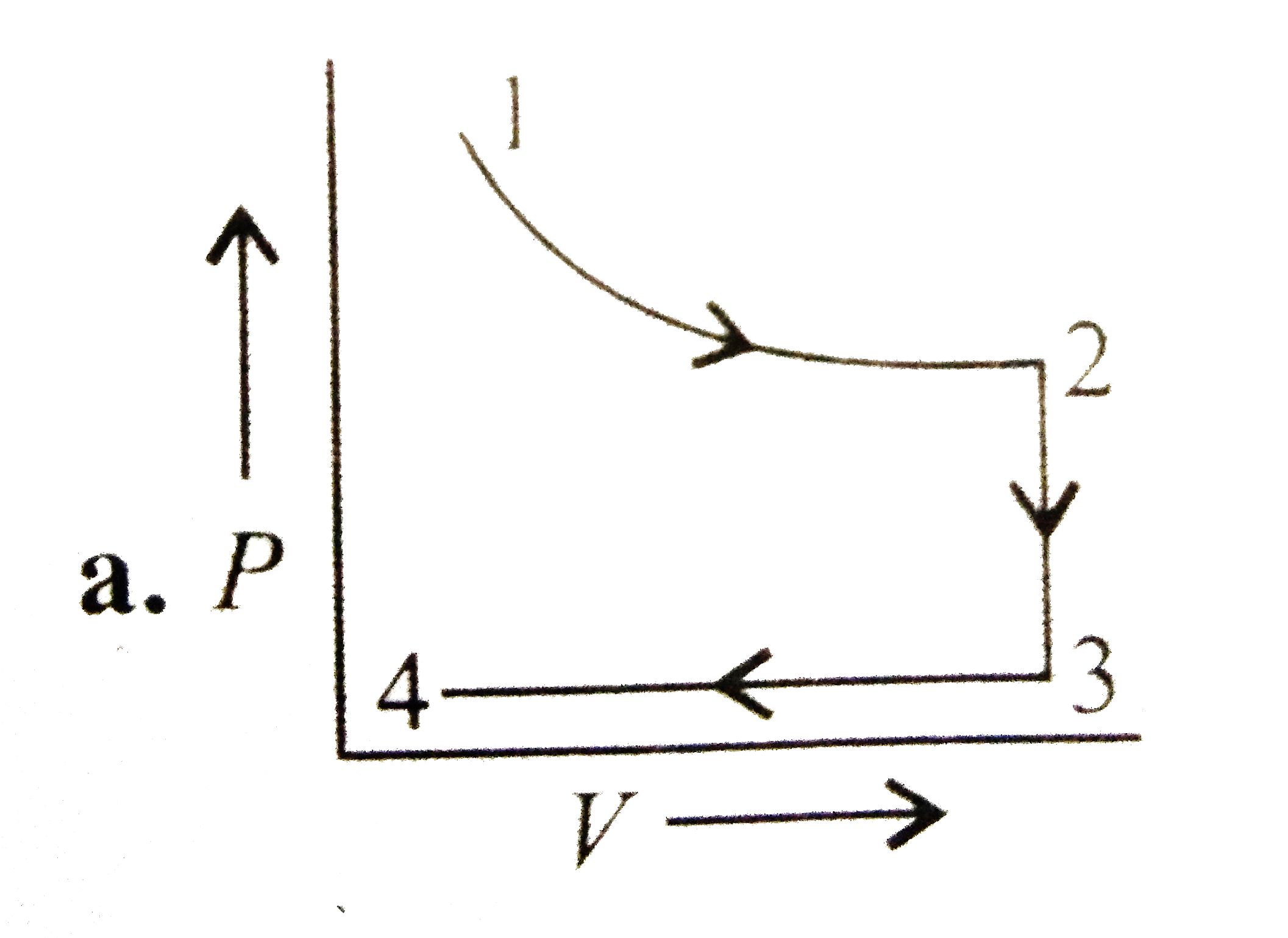
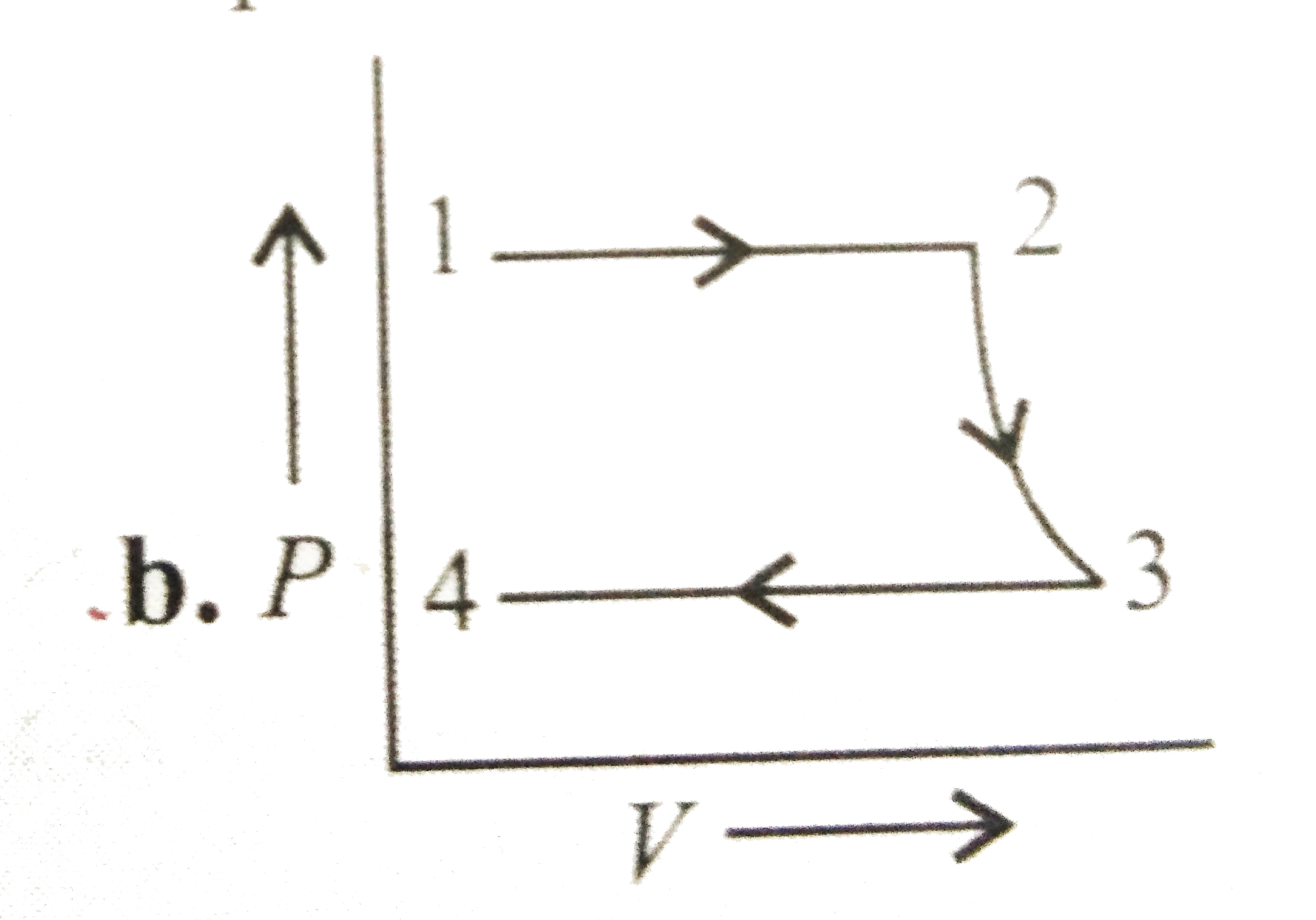
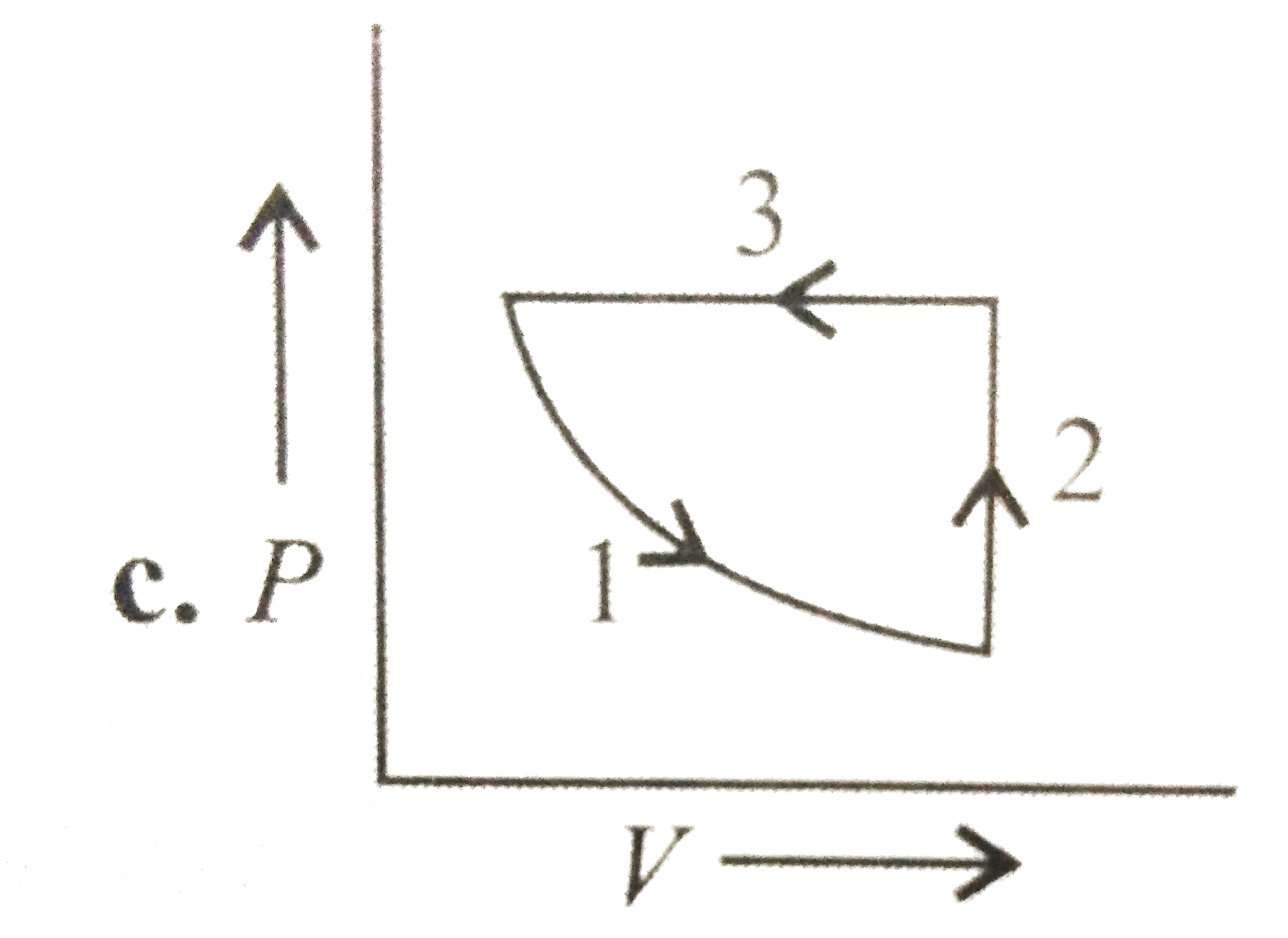
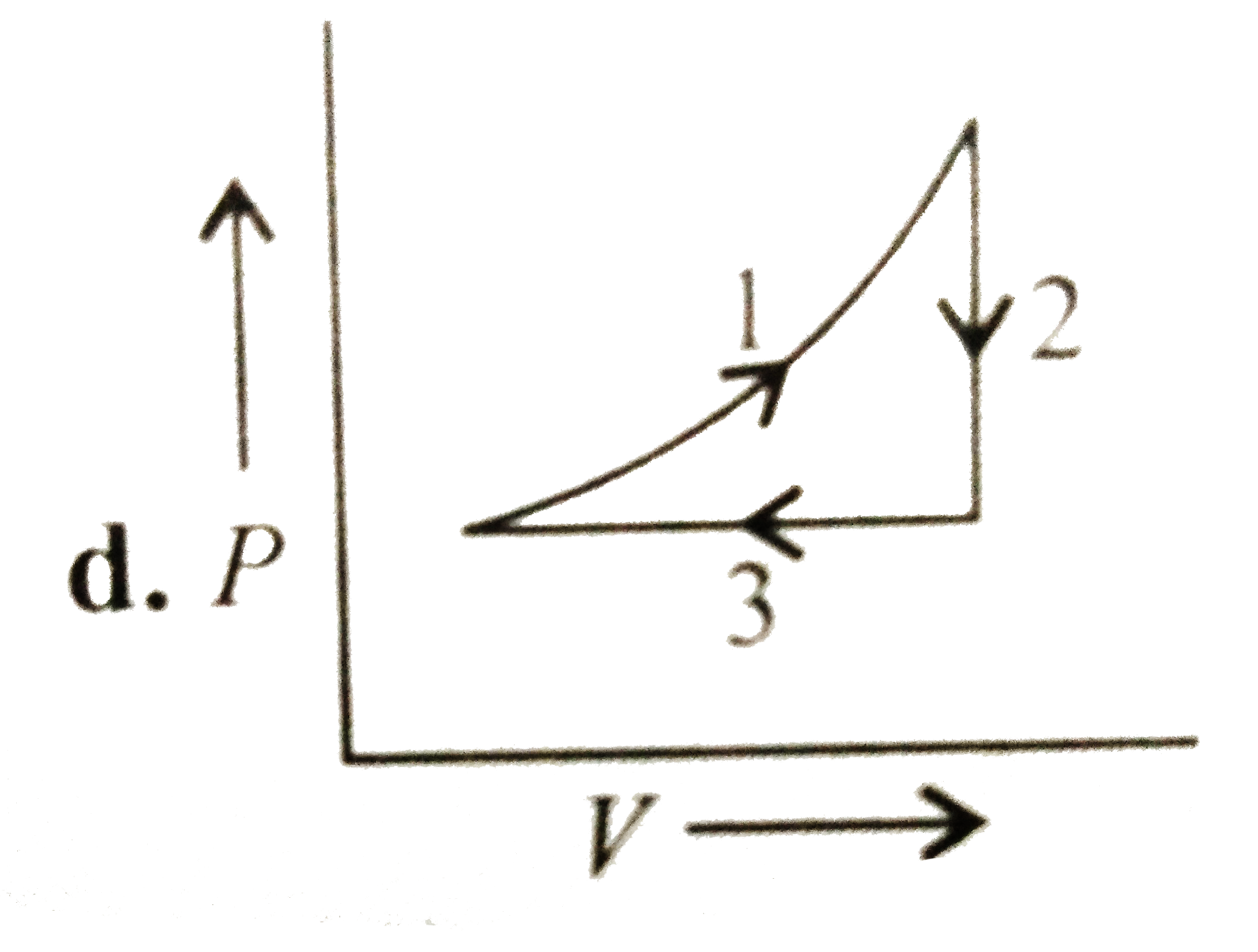
An ideal gas undergoes isothermal expansion followed by heat removel at constant volume and they by heat removal at constant pressure to the initial volume. The correct descripion of these steps is indicated by

A

B

C

D

Text Solution

AI Generated Solution

The correct Answer is:

To solve the problem of an ideal gas undergoing isothermal expansion followed by heat removal at constant volume and then heat removal at constant pressure back to the initial volume, we can break down the process into three steps and analyze each one. ### Step-by-Step Solution: **Step 1: Isothermal Expansion** - In this step, the gas expands isothermally. For an ideal gas, during an isothermal process, the temperature (T) remains constant. According to the ideal gas law (PV = nRT), if the temperature is constant and the volume increases, the pressure must decrease. - The relationship between pressure (P) and volume (V) during this process can be represented as a hyperbola on a PV diagram. This means that as the volume increases, the pressure decreases, maintaining the product PV constant. **Step 2: Heat Removal at Constant Volume** - In this step, heat is removed from the gas while keeping the volume constant. Since the volume does not change, the work done (W) is zero (W = PΔV = 0). - However, when heat is removed, the internal energy of the gas decreases, which leads to a decrease in temperature. According to the ideal gas law, if the temperature decreases while the volume remains constant, the pressure must also decrease. **Step 3: Heat Removal at Constant Pressure** - In the final step, heat is removed from the gas at constant pressure. When heat is removed at constant pressure, the volume of the gas will decrease as the temperature decreases (since P is constant). - This means that the process will show a linear relationship on a PV diagram, where the pressure remains constant while the volume decreases. ### Summary of the Steps: 1. **Isothermal Expansion**: Pressure decreases as volume increases (hyperbolic curve). 2. **Heat Removal at Constant Volume**: Pressure decreases as temperature decreases (vertical line downwards). 3. **Heat Removal at Constant Pressure**: Volume decreases as temperature decreases (horizontal line leftwards). ### Conclusion: The correct description of these steps can be represented graphically on a PV diagram, where the first step is a hyperbola, the second step is a vertical line (constant volume), and the third step is a horizontal line (constant pressure). The correct option that matches this description is **Option A**.
Promotional Banner

Topper's Solved these Questions

  • THERMODYNAMICS

    CENGAGE CHEMISTRY ENGLISH|Exercise Ex 6.3|27 Videos
  • THERMODYNAMICS

    CENGAGE CHEMISTRY ENGLISH|Exercise Ex 6.4|16 Videos
  • THERMODYNAMICS

    CENGAGE CHEMISTRY ENGLISH|Exercise Ex 6.1|26 Videos
  • STOICHIOMETRY

    CENGAGE CHEMISTRY ENGLISH|Exercise Archives Subjective|33 Videos

Similar Questions

Explore conceptually related problems

If an ideal gas is heated at constant pressure :

An ideal gas undergoes isothermal expansion at constant pressure . During the process.

For an ideal gas, the heat of reaction at constant pressure and constant volume are related as

Heat supplied to an ideal gas sample at constant Pressure :

The ratio of the molar heat capacities of a diatomic gas at constant pressure to that at constant volume is

An ideal gas having molar specific heat capaicty at constatnt volume is 3/2 R, the molar specific heat capacities at constant pressure is

If a gas is heated at constant pressure, its isothermal compressibility

A perfect gas at 27^(@)C is heated at constant pressure so as to triple its volume. The tmemperature of th gas will be

A perfect gas at 27^(@)C is heated at constant pressure so as to triple its volume. The tmemperature of th gas will be

A perfect gas at 27^(@)C is heated at constant pressure so as to duble its volume. The tmemperature of th gas will be

CENGAGE CHEMISTRY ENGLISH-THERMODYNAMICS-Ex 6.2
  1. The bond enthalpies of H-H and Cl-Cl are 430 and 242 kJ mol^(-1), resp...

    Text Solution

    |

  2. Two moles of a perfect gas undergo the following processes: a. A rev...

    Text Solution

    |

  3. The enthalpy change (DeltaH) for the reaction, N(2(g))+3H(2(g)) rarr 2...

    Text Solution

    |

  4. The difference between the heats of reaction at constant pressure and ...

    Text Solution

    |

  5. A gas present in a cylinder fitted with a frictionless pistion expands...

    Text Solution

    |

  6. Calcualte q, w, DeltaU, and DeltaH for the reversible isothermal expan...

    Text Solution

    |

  7. A swimmer coming out from a pool is covered with a film of water weig...

    Text Solution

    |

  8. Calculate q,w,DeltaU, and DeltaH for this isothermal reversible expans...

    Text Solution

    |

  9. A sample of argon gas at 1atm pressure and 27^(@)C expands reversibly ...

    Text Solution

    |

  10. An insulated contains 1mole of a liquid, molar volume 100mL at 1bar. W...

    Text Solution

    |

  11. 5mol of an ideal gas at 27^(@)C expands isothermally and reversibly fr...

    Text Solution

    |

  12. 10mol of an ideal gas confined to a volume of 10L is released into atm...

    Text Solution

    |

  13. A system absorbs 20kJ heat and also does 10kJ of work. The net interna...

    Text Solution

    |

  14. One moles of an ideal gas which C(V) = 3//2 R is heated at a constant ...

    Text Solution

    |

  15. A cyclic process ABCD is shown in the P-V diagram. Which of the follow...

    Text Solution

    |

  16. A thermodynamic process is shown in the following figure. The process ...

    Text Solution

    |

  17. In which of the following indicator diagrams gives below do AB,BC, and...

    Text Solution

    |

  18. The pressure -temperature (P-T) phase diagram shown below corresponds ...

    Text Solution

    |

  19. An ideal gas undergoes isothermal expansion followed by heat removel a...

    Text Solution

    |

  20. Four curves A, B, C and D are drawn in the figure for a given amount o...

    Text Solution

    |
