Home
Class 11
CHEMISTRY
The state of a mole of an ideal gas chan...

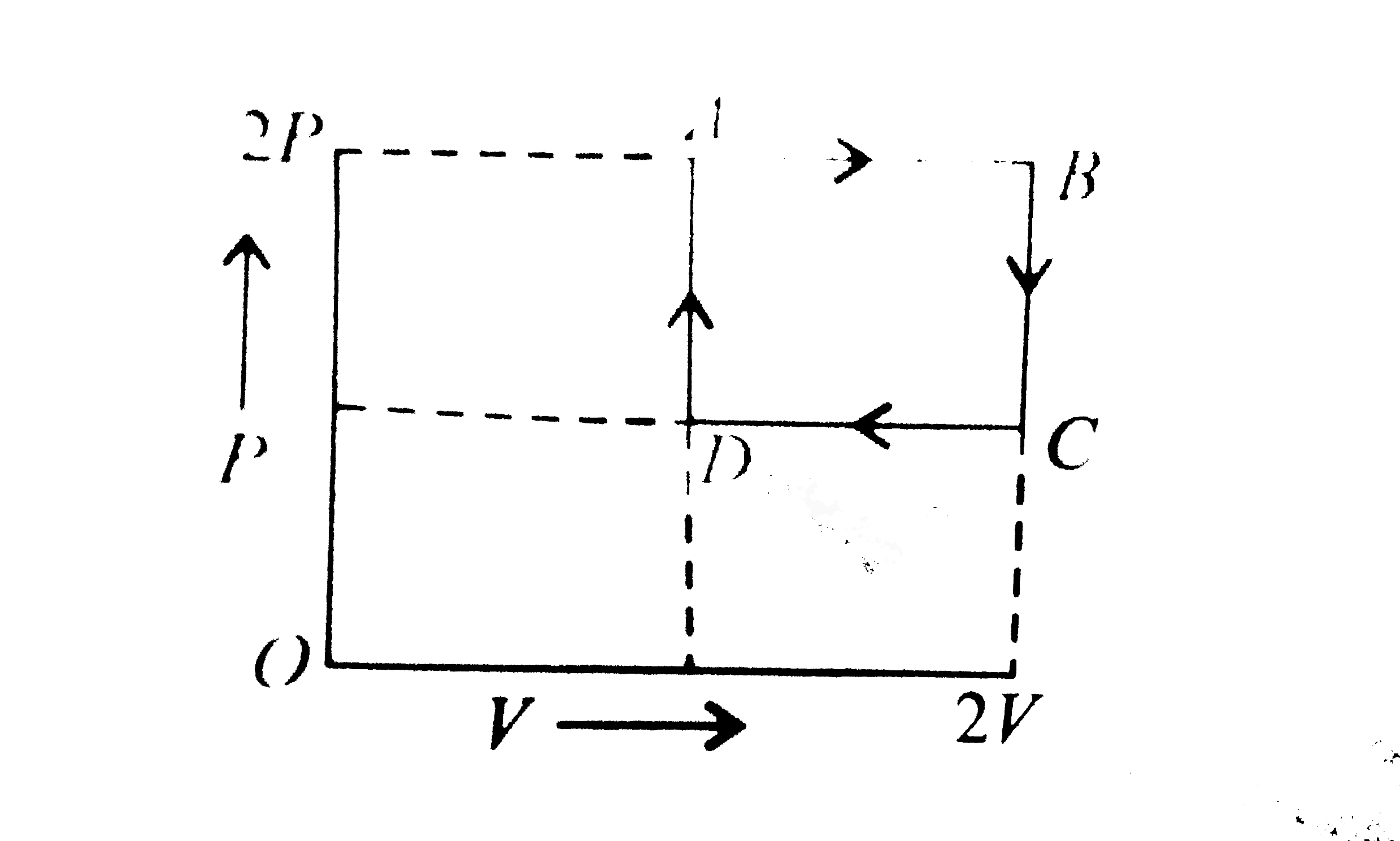
The state of a mole of an ideal gas changed from state `A` at pressure `2P` and volume `V` follows four different processes and finally returns to initial state `A` reversibly as shown below in the graph. By interpreting the graph, answer the following questions.

What would be the heat obsorbed by the system in this cyclic process?

A

`-2PV`

B

Zero

C

`2PV`

D

`PV`

Text Solution

Verified by Experts

`q =- w`
`:. Q = PV`
Promotional Banner

Topper's Solved these Questions

  • THERMODYNAMICS

    CENGAGE CHEMISTRY ENGLISH|Exercise Exercises (Multiple Correct)|50 Videos
  • THERMODYNAMICS

    CENGAGE CHEMISTRY ENGLISH|Exercise Multiple correct Answer Type|2 Videos
  • THERMODYNAMICS

    CENGAGE CHEMISTRY ENGLISH|Exercise Paragraph for Problem|1 Videos
  • STOICHIOMETRY

    CENGAGE CHEMISTRY ENGLISH|Exercise Archives Subjective|33 Videos

Similar Questions

Explore conceptually related problems

The state of a mole of an ideal gas changed from state A at pressure 2P and volume V follows four different processes and finally returns to initial state A reversibly as shown below in the graph. By interpreting the graph, answer the following questions. What would be the work done in state B to C ?

The state of a mole of an ideal gas changed from state A at pressure 2P and volume V follows four different processes and finally returns to initial state A reversibly as shown below in the graph. By interpreting the graph, answer the following questions. What would be the work done in state B to C ?

The state of a mole of an ideal gas changed from state A at pressure 2P and volume V follows four different processes and finally returns to initial state A reversibly as shown below in the graph. By interpreting the graph, answer the following questions. what would the be total done by the gas?

The state of a mole of an ideal gas changed from state A at pressure 2P and volume V follows four different processes and finally returns to initial state A reversibly as shown below in the graph. By interpreting the graph, answer the following questions. what would the be total work done by the gas?

The state of a mole of an ideal gas changed from state A at pressure 2P and volume V follows four different processes and finally returns to initial state A reversibly as shown below in the graph. By interpreting the graph, answer the following questions. In state D to state A , what kind of process is followed?

The state of a mole of an ideal gas changed from state A at pressure 2P and volume V follows four different processes and finally returns to initial state A reversibly as shown below in the graph. By interpreting the graph, answer the following questions. In state D to state A , what kind of process is followed?

The state of a mole of an ideal gas changed from state A at pressure 2P and volume V follows four different processes and finally returns to initial state A reversibly as shown below in the graph. By interpreting the graph, answer the following questions. Which is the kind of process followed from state A to state, B ?

The state of a mole of an ideal gas changed from state A at pressure 2P and volume V follows four different processes and finally returns to initial state A reversibly as shown below in the graph. By interpreting the graph, answer the following questions. Which is the kind of process followed from state A to state, B ?

An ideal gas change from state a to state b as shown in Fig. what is the work done by the gas in the process?

One mole of an ideal gas is taken from state A to state B by three different processes (a) ACB , (b) ADB and (c ) AEB as shown in the P - V diagram. The heat absorbed by the gas is

CENGAGE CHEMISTRY ENGLISH-THERMODYNAMICS-Exercises (Linked Comprehension)
  1. The state of a mole of an ideal gas changed from state A at pressure 2...

    Text Solution

    |

  2. The state of a mole of an ideal gas changed from state A at pressure 2...

    Text Solution

    |

  3. The state of a mole of an ideal gas changed from state A at pressure 2...

    Text Solution

    |

  4. The second law of thermodynamics is a fundamental law of science. In t...

    Text Solution

    |

  5. The second law of thermodynamics is a fundamental law of science. In t...

    Text Solution

    |

  6. The second law of thermodynamics is a fundamental law of science. In t...

    Text Solution

    |

  7. A sample consisting of 1mol of a mono-atomic perfect gas (C(V) = (3)/(...

    Text Solution

    |

  8. A sample consisting of 1mol of a mono-atomic perfect gas (C(V) = (3)/(...

    Text Solution

    |

  9. A sample consisting of 1mol of a mono-atomic perfect gas (C(V) = (3)/(...

    Text Solution

    |

  10. A sample consisting of 1mol of a mono-atomic perfect gas (C(V) = (3)/(...

    Text Solution

    |

  11. Chemical reactions are invariably associated with the transfter of ene...

    Text Solution

    |

  12. Chemical reactions are invariably associated with the transfter of ene...

    Text Solution

    |

  13. Chemical reactions are invariably associated with the transfter of ene...

    Text Solution

    |

  14. Chemical reactions are invariably associated with the transfter of ene...

    Text Solution

    |

  15. Bond energies can be obtained by using the following relation: DeltaH ...

    Text Solution

    |

  16. Bond energies can be obtained by using the following relation: DeltaH ...

    Text Solution

    |

  17. Bond energies can be obtained by using the following relation: DeltaH ...

    Text Solution

    |

  18. Bond energies can be obtained by using the following relation: DeltaH ...

    Text Solution

    |

  19. Bond energies can be obtained by using the following relation: DeltaH ...

    Text Solution

    |

  20. Bond energies can be obtained by using the following relation: DeltaH ...

    Text Solution

    |

