Home
Class 11
CHEMISTRY
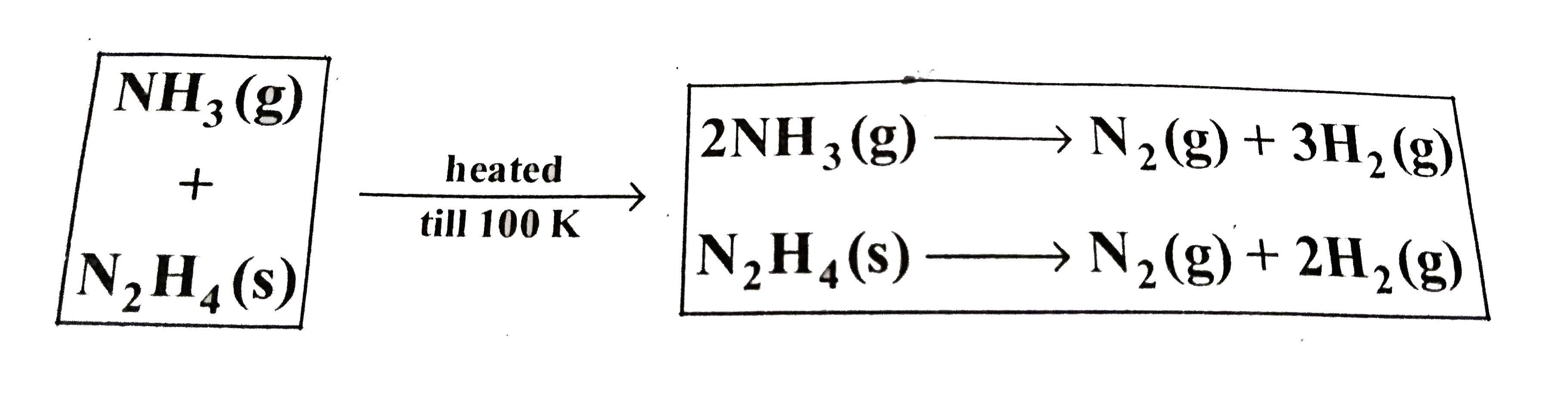
At Assuming complete decomposition ...

At

Assuming complete decomposition of `NH_(3)` and `N(2)H_(4)`
`P=0.3 atm, P=2.7 atm`
`T=300K, T=200K`
`VL, VL`
mole `%` of `NH_(3)` in original mixture is (assume both concentration same volume)

A

`25%`

B

`20%`

C

`75%`

D

`37.5%`

Text Solution

Verified by Experts

The correct Answer is:

C

Using equation
`PV=nRT`
`n_(1)`= moles of `NH_(3)`
`n_(2)`= moles of `N_(2)H_(4)`
`0.3xxV=(n_(1)+n_(2))xxRxx300`
`2.7xxV=(2n_(1)+3n_(2))xxRxx1200`
`(2n_(1)+3n_(2))/(n_(1)+n_(2))=(9/4)`
`n_(1)/n_(2)=(1/3)`
`n_(1)/n_(2)=75%`
Promotional Banner

Topper's Solved these Questions

  • CHEMICAL EQUILIBRIUM

    CENGAGE CHEMISTRY ENGLISH|Exercise Concept Applicationexercise 7.1|53 Videos
  • CHEMICAL EQUILIBRIUM

    CENGAGE CHEMISTRY ENGLISH|Exercise Ex 7.2|40 Videos
  • CHEMICAL BONDING AND MOLECULAR STRUCTURE

    CENGAGE CHEMISTRY ENGLISH|Exercise Archives Subjective|15 Videos
  • CLASSIFICATION AND NOMENCLATURE OF ORGANIC COMPOUNDS

    CENGAGE CHEMISTRY ENGLISH|Exercise Analytical and Descriptive Type|3 Videos

Similar Questions

Explore conceptually related problems

A reaction carried out by 1 mol of N_(2) and 3 mol of H_(2) shows at equilibrium the mole fraction of NH_(3) as 0.012 at 500^(@)C and 10 atm pressure. Calculate K_(p) Also report the pressure at which "mole" % of NH_(3) in equilibrium mixture is increased to 10.4 .

In a mixture of N_(2) and H_(2) in the ratio 1:3 at 30 atm and 300^(@)C , the % of NH_(3) at equilibrium is 17.8 . Calculate K_(p) for N_(2)+3H_(2) hArr 2NH_(3) .

One "mole" of NH_(4)HS(s) was allowed to decompose in a 1-L container at 200^(@)C . It decomposes reversibly to NH_(3)(g) and H_(2)S(g). NH_(3)(g) further undergoes decomposition to form N_(2)(g) and H_(2)(g) . Finally, when equilibrium was set up, the ratio between the number of moles of NH_(3)(g) and H_(2)(g) was found to be 3 . NH_(4)HS(s) hArr NH_(3)(g)+H_(2)S(g), K_(c)=8.91xx10^(-2) M^(2) 2NH_(3)(g) hArr N_(2)(g)+3H_(2)(g), K_(c)=3xx10^(-4) M^(2) Answer the following: To attain equilibrium, how much % by weight of folid NH_(4)HS got dissociated?

the volume of gases NH_(3) , CO_(2) and H_(2) adsorbed by one gram of characoal at 300 K are in order of :

One "mole" of NH_(4)HS(s) was allowed to decompose in a 1-L container at 200^(@)C . It decomposes reversibly to NH_(3)(g) and H_(2)S(g). NH_(3)(g) further undergoes decomposition to form N_(2)(g) and H_(2)(g) . Finally, when equilibrium was set up, the ratio between the number of moles of NH_(3)(g) and H_(2)(g) was found to be 3 . NH_(4)HS(s) hArr NH_(3)(g)+H_(2)S(g), K_(c)=8.91xx10^(-2) M^(2) 2NH_(3)(g) hArr N_(2)(g)+3H_(2)(g), K_(c)=3xx10^(-4) M^(2) Answer the following: What is the "mole" fraction of hydrogen gas in the equilibrium mixture in the gas phase?

Calculate the change in pH of 1 litre buffer solution containing 0.1 mole each of NH_(3) and NH_(4)CI upon addition of: (i) 0.02 mole of dissolved gasous HCI. Assume no change in volume. K_(NH_(3))=1.8xx10^(-5)

Calculate the change in pH of 1 litre buffer solution containing 0.1 mole each of NH_(3) and NH_(4)CI upon addition of: (i) 0.02 mole of dissolved NaOH. Assume no change in volume. K_(NH_(3))=1.8xx10^(-5)

In a reaction mixture containing H_(2),N_(2) and NH_(3) at partial pressure of 2 atm, 1 atm and 3 atm respectively, the value of K_(p) at 725K is 4.28xx10^(-5)atm^(-2) . In which direction the net reaction will go ? N_(2)(g)+3H_(2)(g)hArr 2NH_(3)(g)

Consider the decomposition of solid NH_(4)HS in a flask containing NH_(3)(g) at a pressure of 2 atm. What will be the partial pressure of NH_(3)(g) "and" H_(2)S(g) after the equilibrium has been attained? K_(p) for the reaction is 3 .

A flask of 4.48 L capacity contains a mixture of N_(2) and H_(2) at 0^(@)C and 1 atm pressure. If thed mixture is made to react to form NH_(3) gas at the same temperature, the pressure in the flask reduces to 0.75 atm . Select statement(s) :
