Home
Class 11
CHEMISTRY
Given that K(c ) for equation (i) given ...

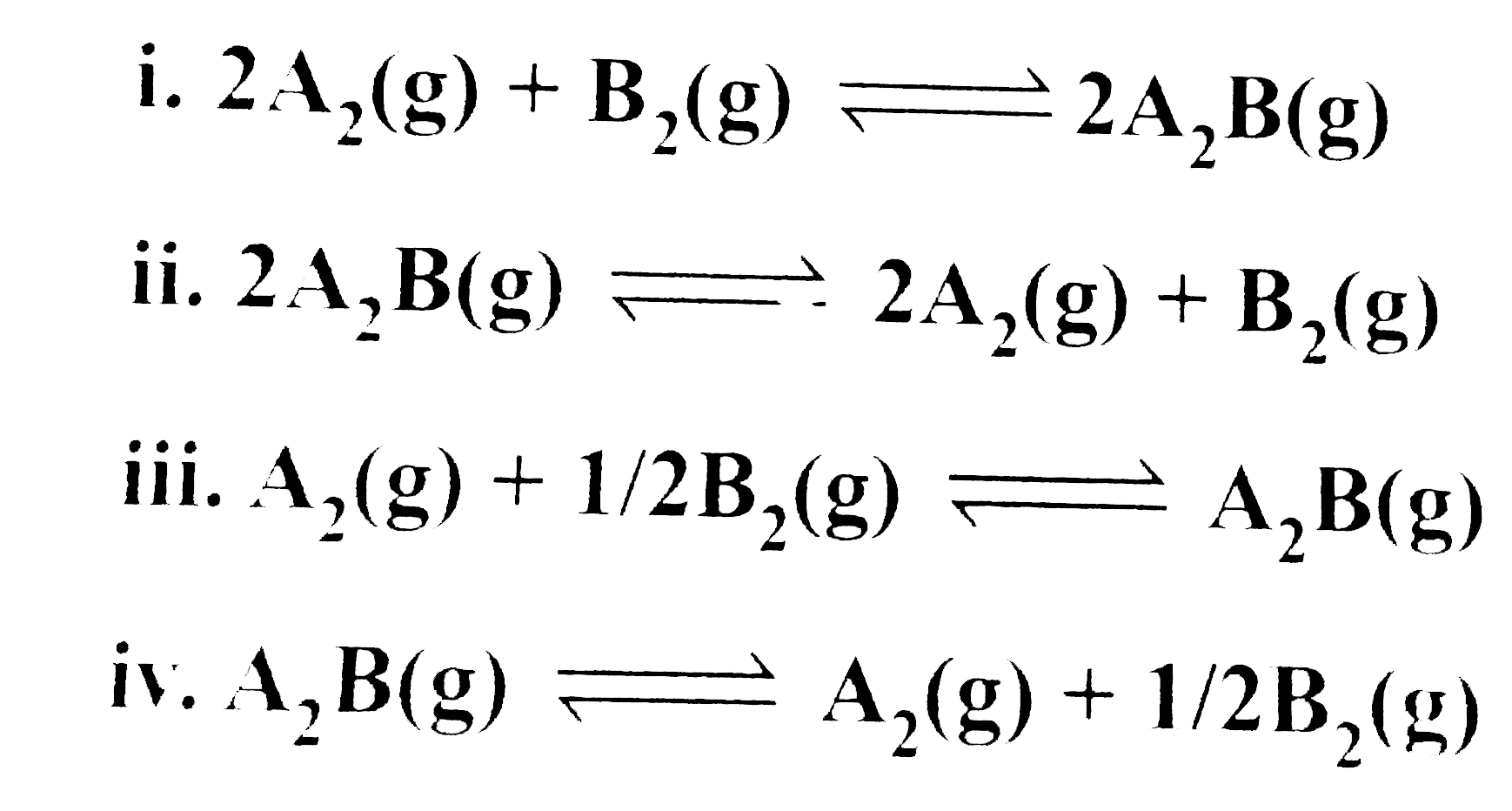
Given that `K_(c )` for equation (i) given below has a value of `256` at `1000 K`. Calculate the numerical values of `K_(c )` for other reactions `(ii), (iii),` and `(iv)`.
i.

Text Solution

Verified by Experts

ii. `1/256`, iii. `16`, iv. `1/16`
Promotional Banner

Topper's Solved these Questions

  • CHEMICAL EQUILIBRIUM

    CENGAGE CHEMISTRY ENGLISH|Exercise Concept Applicationexercise 7.1|53 Videos
  • CHEMICAL EQUILIBRIUM

    CENGAGE CHEMISTRY ENGLISH|Exercise Ex 7.2|40 Videos
  • CHEMICAL BONDING AND MOLECULAR STRUCTURE

    CENGAGE CHEMISTRY ENGLISH|Exercise Archives Subjective|15 Videos
  • CLASSIFICATION AND NOMENCLATURE OF ORGANIC COMPOUNDS

    CENGAGE CHEMISTRY ENGLISH|Exercise Analytical and Descriptive Type|3 Videos

Similar Questions

Explore conceptually related problems

At 1000K, the pressure of iodine gas is found to be 0.112 atm due to partial dissociation of I_(2)(g) into I(g). Had there been no dissociation, the pressure would have been 0.074 atm. Calculate the value of K_(p) for the reaction: I_(2)(g) hArr 2I(g) .

Write the value of : Standard temperature in (i) ""^@C (ii)K

At 1000K , the pressure of iodine gas is found to be 0.1 atm due to partial dissociation of I_(2)(g) into I(g) . Had there been no dissociation, the pressure would have been 0.07 atm . Calculate the value of K_(p) for the reaction: I_(2)(g)hArr2I(g) .

Find the values of k for which the given equation has real roots: 5x^2-k x+1=0

K_(p) for the reaction given below is 1.36 "at" 499K . Which of the following equations can be used to calculate K_(c) for this reaction? N_(2)O_(5(g))rarrNO_(2(g))+NO_(3(g))

The line given by the equation 2x - y/3 = 7 passes through the point (k, 6) , calculate the value of k.

The value of DeltaG^(@) for a reaction in aqueous phase having K_(c)=1, would be :

For the following reaction : NO_((g))+O_(3(g))hArrNO_(2(g))+O_(2(g)) The value of K_(c) is 8.2xx10^(4) . What will be the value of K_(c) for the reverse reaction ?

The value K_(c) of a reaction has a higher value at higher temperature. The reaction is exothermic in nature.

Find the values of k for which the given equation has real roots: k x^2-6x-2=0
