Home
Class 11
CHEMISTRY
The degree of dissociation of I(2) molec...

The degree of dissociation of `I_(2)` molecule of `1000^(@)C` and underatmosperic is 40% by volume .if the disscoiation is reduced to 20% at he same temp ., total equilibrium pressure on the gas is:

A

`1.57 atm`

B

`2.57 atm`

C

`3.57 atm`

D

`4.57 atm`

Text Solution

Verified by Experts

The correct Answer is:
D

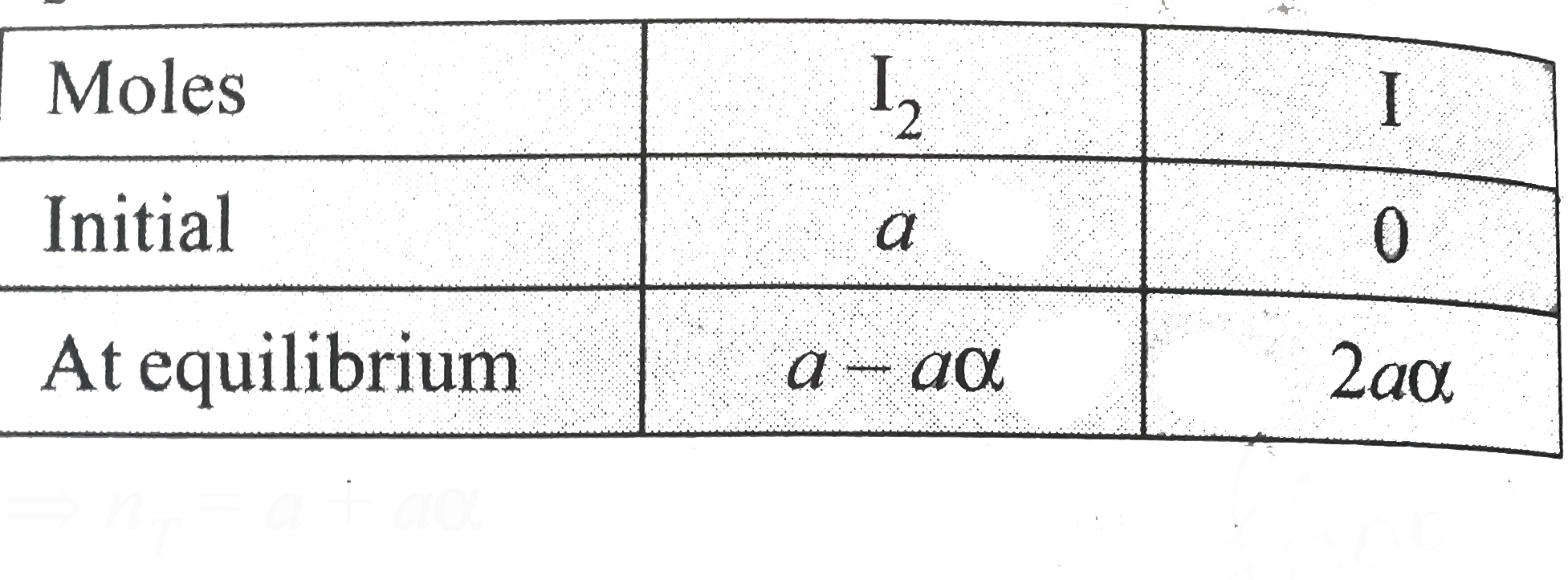
`I_(2)(g)hArr2I(g)`

`rArr n_(T)=a+aalpha`
`K_(p)=P_(1)^(2)/p_(I_(2))=(((2alpha)/(1+alpha)P)^(2))/((1-alpha)/(1+alpha)p)=(4alpha^(2)P)/((1-alpha^(2)))`
Given: `alpha=0.4` at `P=1.0 "atm"`
Let `P_("new")` be the pressure when `alpha=0.2`
`rArr K_(p)=(4xx0.16)/0.84=(4xx0.04)/0.96P_("new")`
`rArr P_("new")=(4xx0.96)/0.84=4.57 "atm"`
Promotional Banner

Topper's Solved these Questions

  • CHEMICAL EQUILIBRIUM

    CENGAGE CHEMISTRY ENGLISH|Exercise Concept Applicationexercise 7.1|53 Videos
  • CHEMICAL EQUILIBRIUM

    CENGAGE CHEMISTRY ENGLISH|Exercise Ex 7.2|40 Videos
  • CHEMICAL BONDING AND MOLECULAR STRUCTURE

    CENGAGE CHEMISTRY ENGLISH|Exercise Archives Subjective|15 Videos
  • CLASSIFICATION AND NOMENCLATURE OF ORGANIC COMPOUNDS

    CENGAGE CHEMISTRY ENGLISH|Exercise Analytical and Descriptive Type|3 Videos

Similar Questions

Explore conceptually related problems

The degree of dissociation of I_(2) "mole"cule at 1000^(@)C and under 1.0 atm is 40% by volume. If the dissociation is reduced to 20% at the same temperature, the total equilibrium pressure on the gas will be:

The degree of dissociation of I_(2) "mole"cule at 1000^(@)C and under 1.0 atm is 40% by volume. If the dissociation is reduced to 20% at the same temperature, the total equilibrium pressure on the gas will be:

The degree of dissociation of PCl_(5) at 1 atm pressure is 0.2 . Calculate the pressure at which PCl_(5) is dissociated to 50% ?

Degree of dissociation of three binary electrolytes AB, CD and EF are 60%.20% and 100% in the solution having same mole fraction of water.Ratio of lowering in vapour pressure of their solution is

Find the percentage dissociation of ammonia into N_(2) "and' H_(2) if the dissociation is carried out at constant pressure and the volume at equilibrium is 20% greater than initial volume. (Initially. Equal moles of NH_(3) "and" N_(2) are present with no hydrogen)

K_(p) for the reaction PCl_(5)(g)ghArrPCl_(3)(g)+Cl_(2)(g) at 250^(@)C is 0.82 . Calculate the degree of dissociation at given temperature under a total pressure of 5 atm . What will be the degree of dissociation if the equilibrium pressure is 10 atm , at same temperature.

3.2 moles of HI were heated in a sealed bulb at 444^(@)C till the equilibrium was reached. Its degree of dissociation was found to be 20% . Calculate the number of moles of hydrogen iodide, hydrogen and iodine present at the equilibrium point and determine the value of equilibrium constant.

A gas occupies 100.0 mL at 50^(@)C and I atm pressure. The gas is cooled at constant pressure so that its volume is reduced to 50.0 mL. what is the final temperautre?

A sample of gas occupies of 10 L at 127^(@)C and I bar Pressure. The gas is cooled to - 73^(@)C at the same pressure. What will be the volume of the gas?

At 250^(@)C and one atmosphere PCl_(5) is 40% dissociated The equilibrium constant (K_(c)) for dissociation of PCl_(5) is

