Home
Class 12
CHEMISTRY
The arrangement of X^(ɵ) ions around A^(...

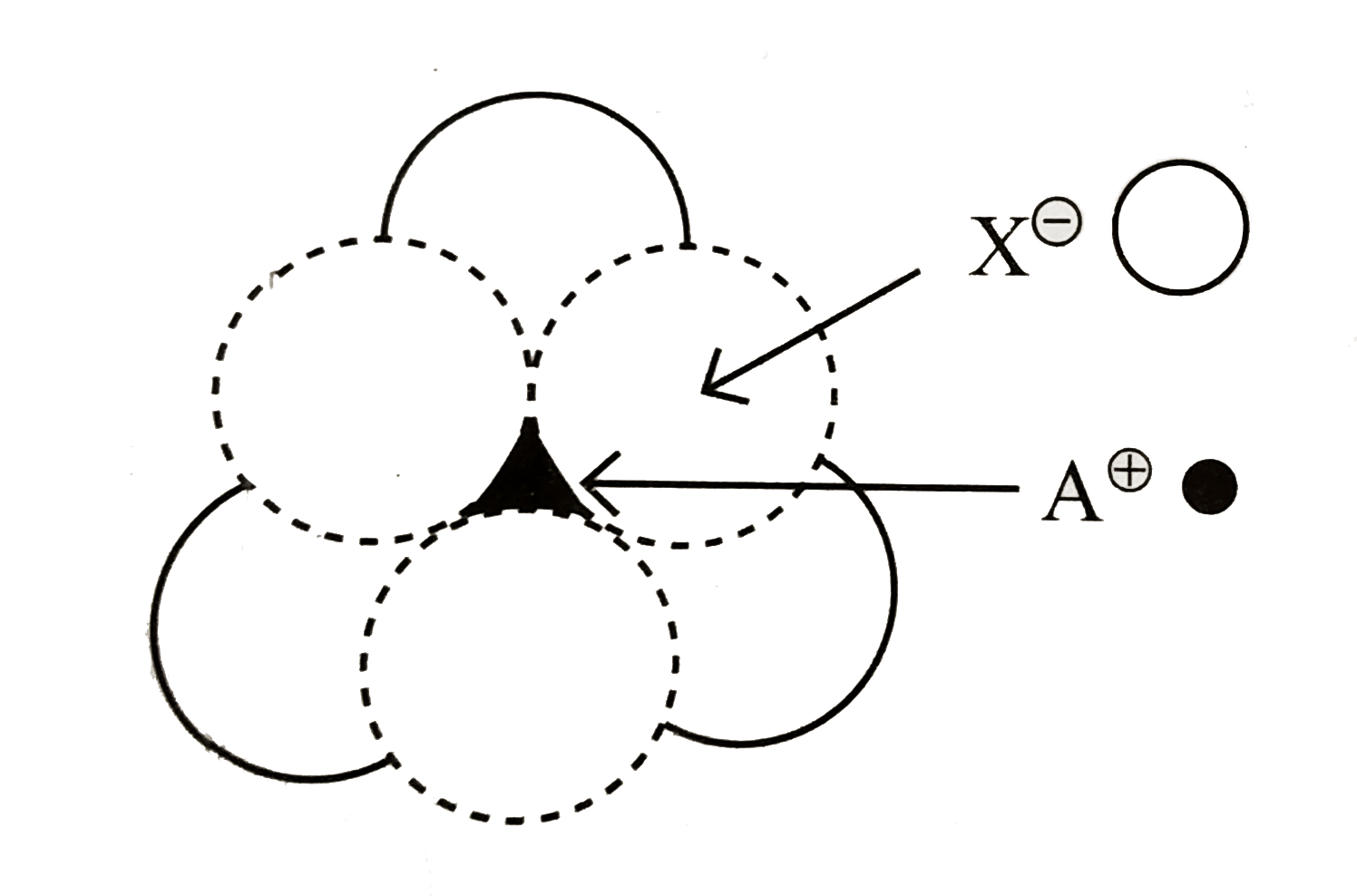
The arrangement of `X^(ɵ)` ions around `A^(o+)` ion in solid `AX` is given in the figure (not drawn to scale). If the radius of `X^(ɵ)` is `250 pm`, the radius of `A^(o+)` is

A

`104 pm`

B

`125 pm`

C

`183 pm`

D

`57 pm`

Text Solution

Verified by Experts

The correct Answer is:

A

According to the given figure, `A^(o+)` is present in the octahedral void of `X^(ɵ)`. The limiting radius in octahedral void related to the radius of sphere as
`r_("void") = 0.414 r_("sphere")`
`r_(A^(o+)) = 0.414 r_(x^(ɵ))`
`= 0.414 xx 250 "pm"`
`= 103.5 approx 104 "pm"`
Hence (a) is correct.
Promotional Banner

Topper's Solved these Questions

  • SOLID STATE

    CENGAGE CHEMISTRY ENGLISH|Exercise Exercises (Archives ) Assertion-Reasoning|1 Videos
  • SOLID STATE

    CENGAGE CHEMISTRY ENGLISH|Exercise Exercises (Archives ) Interger|1 Videos
  • SOLID STATE

    CENGAGE CHEMISTRY ENGLISH|Exercise Exercises (Archives ) Multiple Correct|2 Videos
  • REDUCTION AND OXIDATION REACTION OF ORGANIC COMPOUNDS

    CENGAGE CHEMISTRY ENGLISH|Exercise SUBJECTIVE TYPE|4 Videos
  • SOLUTIONS

    CENGAGE CHEMISTRY ENGLISH|Exercise Ex 2.3 (Objective)|9 Videos

Similar Questions

Explore conceptually related problems

The arrangement of X^(ɵ) ions around A^(o+) ion in solid AX is given in the figure (not drawn to scale). If the radius of X^(ɵ) is 180 pm , the radius of A^(o+) is

A solid XY has NaCl structure. If radius of X^(+) is 100 p m . What is the radius of Y^(-) ion ?

NH_(4) X1 crystallizes in bcc lattice with edge length 383 pm. If the radius of NH_(4)^(+) ion is 154 pm ,calculate the radius of halide (X^(-) ) .

An ionic solid A^(o+)B^(Θ) crystallizes as an fcc structure. If the edge length of cell is 508 pm and the radius of anion is 144 pm , the radius of cation is

A solid AB has ZnS-type structure. The edge lenth of unit cell is 400 pm abd the radius of 'B^-' ion is 0.130 nm. Then the radius of 'A^+' ion is

In the given figure, O is the centre of the circle with radius 14 cm. Find the area of the shared portion

Cesium chloride forms a body-centred cubic lattice. Cesiumm and chloride ions are in contact along the body diagoanl of a cell. The length of the side of the unit cell is 412 pm and Cl^(Θ) ion has a radius of 181 pm. Calculate the radius of Cs^(o+) ion.

Casium may be considered to form interpentrating simple primitice cubic crystal. The edge length of unit cell is 412 pm. Determine a. The density of CsCl . b. The inoic radius of Cs^(o+) if the ionic radius of Cl^(Θ) is 181 pm. Given: Aw (Cs) = 133 g mol^(-1)

The "OLIVINE" series of minerals consists of crystal in which Fe^(2+) and Mg^(2+) ions may substitute for each other causing susbstitutional impurity defects without changing the volume of unit cell. In "OLIVINE" series of minerals, O^(2-) ions exist as fcc with Si^(4+) occupying one-fourth of OVs and divalent metal ions occupying one-fourth of OVs and divalent metal ions occupying one-fourth of TVs . The density of "forsterite" (magnesium silicate) is 3.21 g cm^(-3) land that of "fayalite" (ferrous silicate) is 4.34 g cm^(-3) . If in "forsterite mineral" bivalent Mg^(2+) ions are to be replaced by unipositive Na^(o+) ions, and if Na^(o+) ions are occupying half of TV_(s) in fcc lattice, the arrangement of rest of the constituents is kept same, then the formula of the new solid is:

In an LiI crystal, I^(ɵ) ions from a cubical close-packed arrangement, a nd Li^(o+) ion occupy octahedral holes. What is the relationship between the edge length of the unit cells and radii of the I^(ɵ) ions if a = 60 "pm".
