Home
Class 12
CHEMISTRY
FeCl(3) on reaction with K(4)[Fe(CN)(6)]...

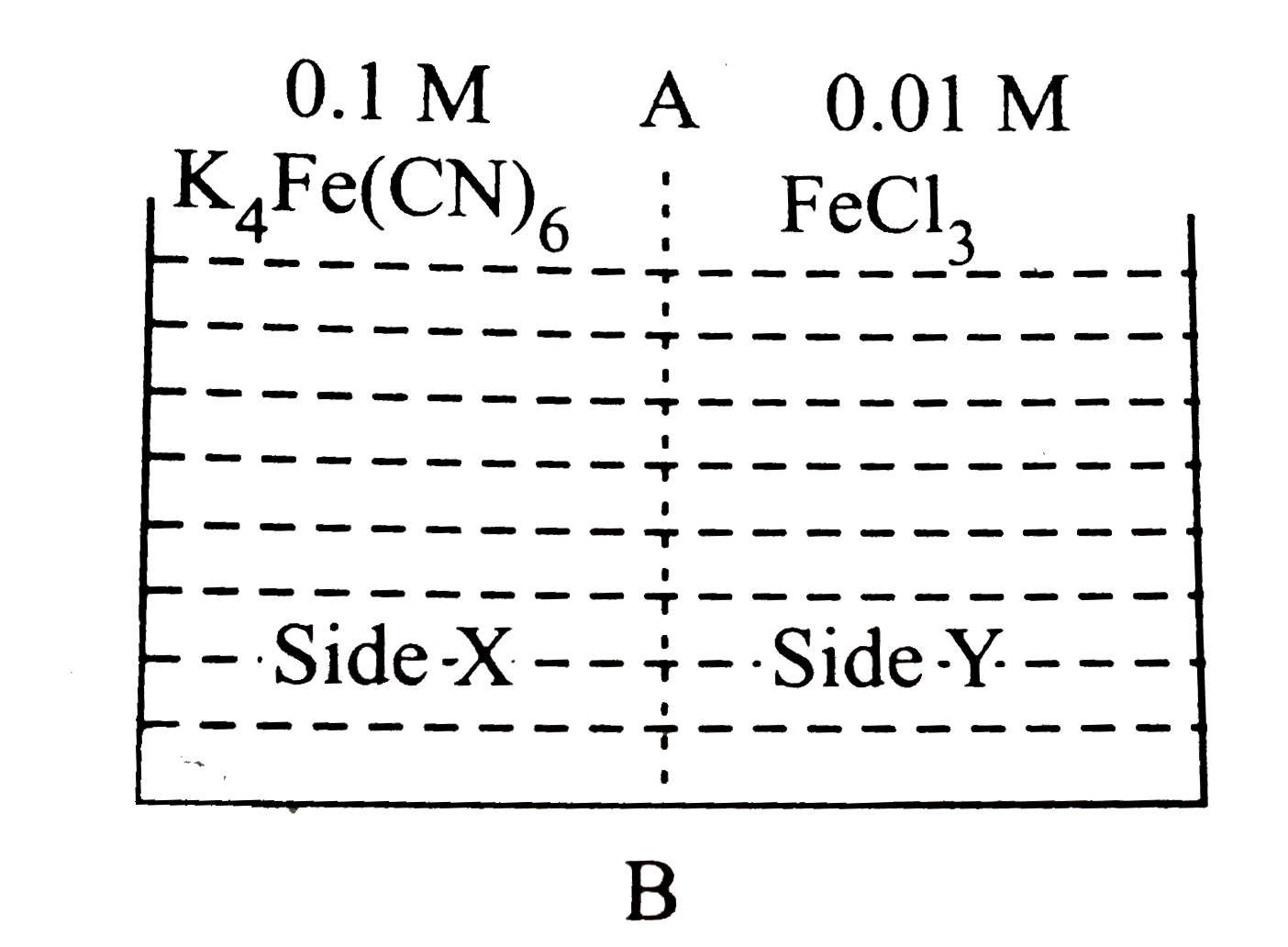
`FeCl_(3)` on reaction with `K_(4)[Fe(CN)_(6)]` in aqueous solution gives blue colour. These are separated by a semi-permeable membrane `AB` as shown. Due to osmosis, there is

A

Blue colour formation in side `X`.

B

Blue colour formation in side `Y`.

C

Blue colour formation in both of side `X` and `Y`.

D

No blue colour formation.

Text Solution

Verified by Experts

The correct Answer is:

D

Osmosis of water and not of ion takes place.
Promotional Banner

Topper's Solved these Questions

  • SOLUTIONS

    CENGAGE CHEMISTRY ENGLISH|Exercise Exercise (Assertion-Reasoning)|18 Videos
  • SOLUTIONS

    CENGAGE CHEMISTRY ENGLISH|Exercise Exercise (Interger)|8 Videos
  • SOLUTIONS

    CENGAGE CHEMISTRY ENGLISH|Exercise Exercises (Multiple Correct)|25 Videos
  • SOLID STATE

    CENGAGE CHEMISTRY ENGLISH|Exercise Ex 1.2 (Objective)|9 Videos
  • SURFACE CHEMISTRY

    CENGAGE CHEMISTRY ENGLISH|Exercise Archives Subjective|2 Videos

Similar Questions

Explore conceptually related problems

FeCl_(3) on reaction with K_(4)[Fe(CN)_(6)] in aqueous solution gives blue colour. These are separated by a semipermeable membrane AB as shown. Due to osmosis there is:

FeCI_(3) on reaction with K_(4)[Fe(CN)_(6)] in aqueous solution gives blue colour. These are separated by a semipermeable membrane AB as shown. Due to osmosis there is:

FeCI_(3) on reaction with K_(4)[Fe(CN)_(6)] in aqueous solution gives blue colour. These are separated by a semipermeable membrane AB as shown. Due to osmosis there is:

X_(3)Y_(2)(i=5) when reacted with A_(2)B_(3)(i=5 in aqueous solution gives brown colour. These are separated by a semipermeable membrane AB as shown. Due to oxmosis there is : a.brown colour formation in side X b.brown colour formation in side Y c.formation in both of the sides X and Y d.no brown colour formation

Addition of K_(4)[Fe(CN)_(6)] solution to FeCl_(3) solution gives

K_(4)[Fe(CN)_(6)] reacts with ozone is give:

Fe^(2+) does not give blue colour with K_(4)[Fe(CN)_(6)] but on its reaction with (X) ,blue colour oppears (X) can be

When K_(4)[Fe(CN)_(6)] is added to FeCl_(3) ,the complex compound formed is:

When K_(4)[Fe(CN)_(6)] is treated with FeCI_(3) a blue colour is obtained It is due to the formation of .

A light bluish-green crystalline compound responds to the following tests: (i). Its aqueous solution gives a brown precipitate on reaction with alkaline K_2[HgI_4] solution. (ii). Its aqueous solution gives a blue colour with K_3[Fe(CN)_6] solution. (iii). Its solution in hydrochloric acid gives a white precipitate with BaCl_2 solution. Identify the ions present and suggest the formula of the compound.

CENGAGE CHEMISTRY ENGLISH-SOLUTIONS-Exercises (Single Correct)
  1. Total Vapour pressure of mixture of 1molA(p(A)^(0)=150 "torr")and 2mol...

    Text Solution

    |

  2. The vapour pressure of pure benzene C(6)H(6) at 50^(@)C is 268 "torr"....

    Text Solution

    |

  3. Osmotic pressure of blood is 7.40 atm, at 27^(@)C. Number of moles of ...

    Text Solution

    |

  4. PtCl(4).6H(2)O can exist as a hydrated complex. 1 m aqueous solution h...

    Text Solution

    |

  5. For 1 molal solution of each compound maximum freezing point will be ...

    Text Solution

    |

  6. The depression in freezing point of 0.01 m aqueous CH(3)CooH solution ...

    Text Solution

    |

  7. pH of 0.1 M monobasic acid is found to be 2 . Hence its osmotic pressu...

    Text Solution

    |

  8. The lowering of vapour pressure due to a solute in a 1 m aqueous solut...

    Text Solution

    |

  9. The most likely of the following mixtures to be an ideal solution is

    Text Solution

    |

  10. Mole fraction of component A in vapour phase is chi(1) and that of com...

    Text Solution

    |

  11. Which has the maximum osmotic pressure at temperature T?

    Text Solution

    |

  12. The relative decreases in the vapour pressure of an aqueous solution c...

    Text Solution

    |

  13. Mixture of volatile components A and B has a total vapour pressure (in...

    Text Solution

    |

  14. FeCl(3) on reaction with K(4)[Fe(CN)(6)] in aqueous solution gives blu...

    Text Solution

    |

  15. 12.2 g of benzoic acid (Mw=122) in 100 g benzene has depression in fre...

    Text Solution

    |

  16. 25 mL of an aqueous solution of KCl was found to requires 20 mL of 1M ...

    Text Solution

    |

  17. Based on the given diagram, which of the following statements regardin...

    Text Solution

    |

  18. Following questions are based on the following activites (A) with obse...

    Text Solution

    |

  19. Following questions are based on the following activites (A) with obse...

    Text Solution

    |

  20. Following questions are based on the following activites (A) with obse...

    Text Solution

    |
