
Home
Class 12
CHEMISTRY
The electricity conductivity of a soluti...

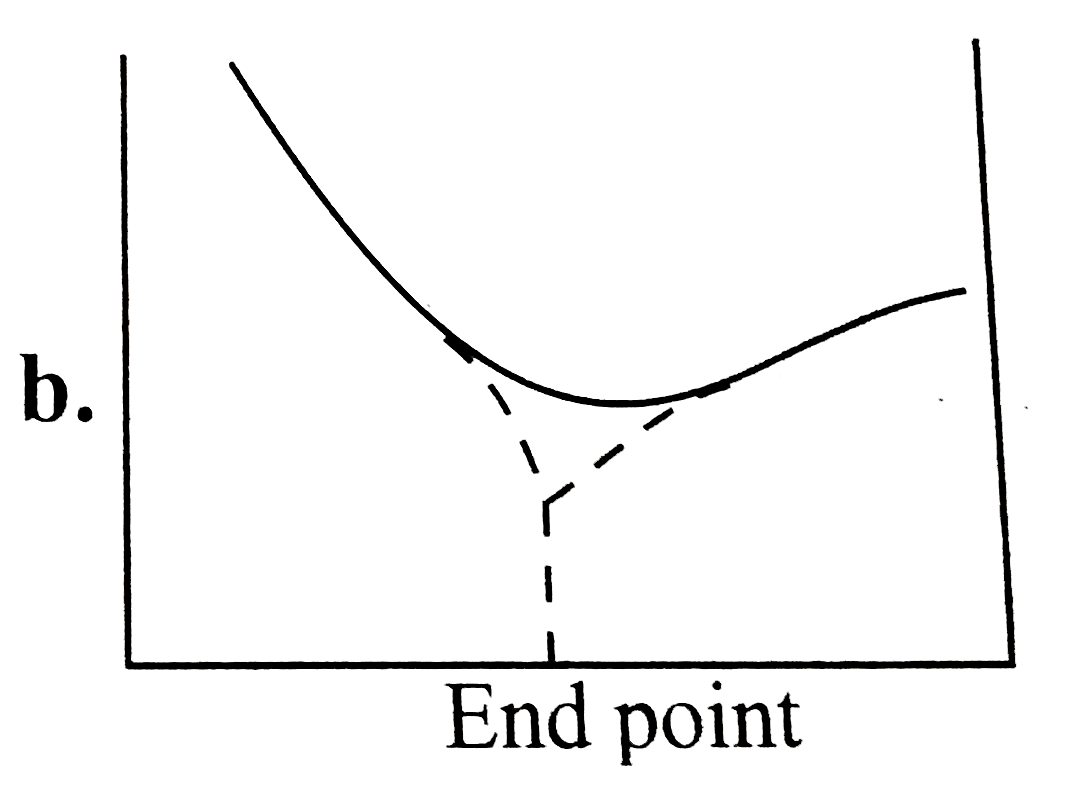
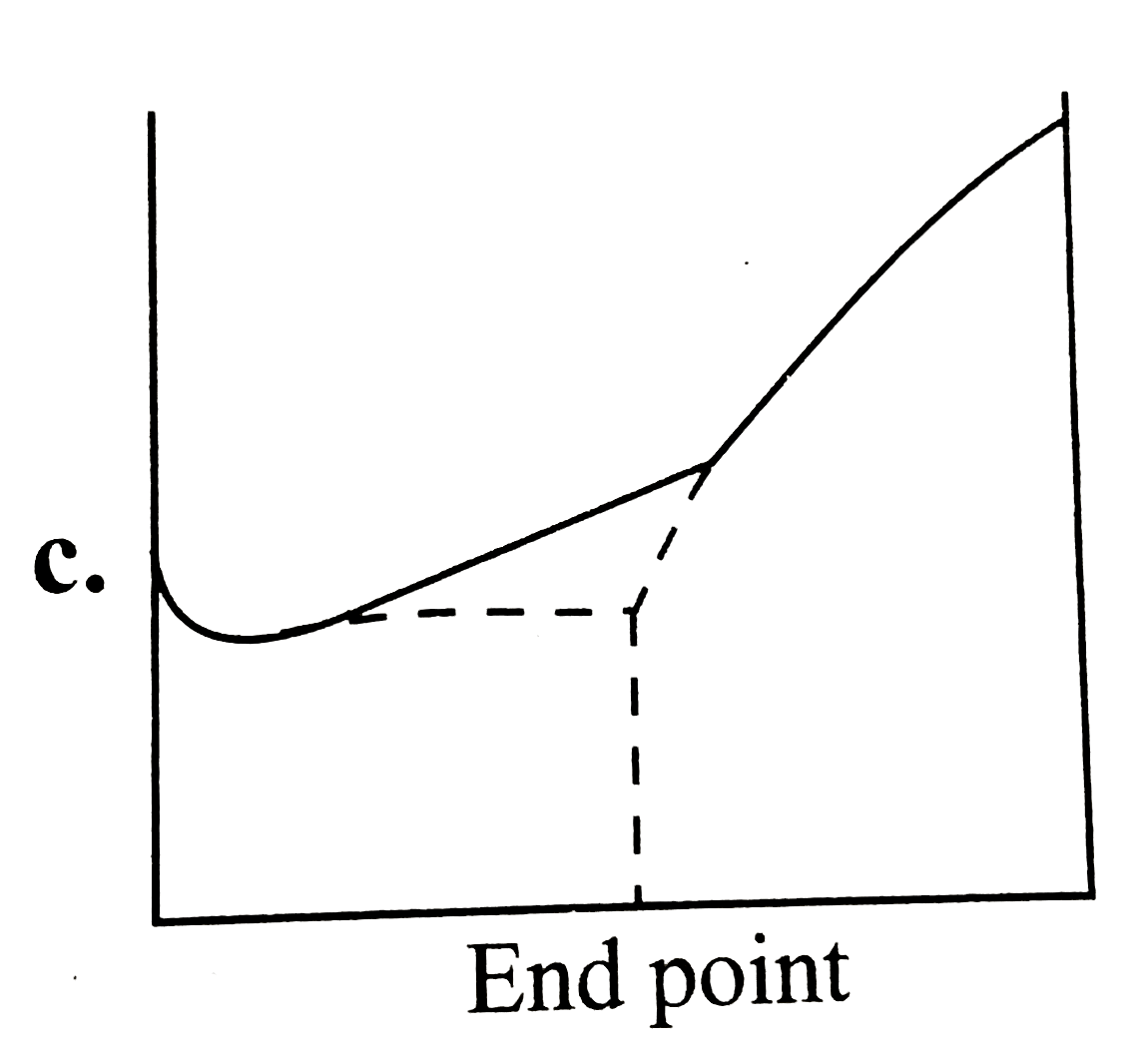
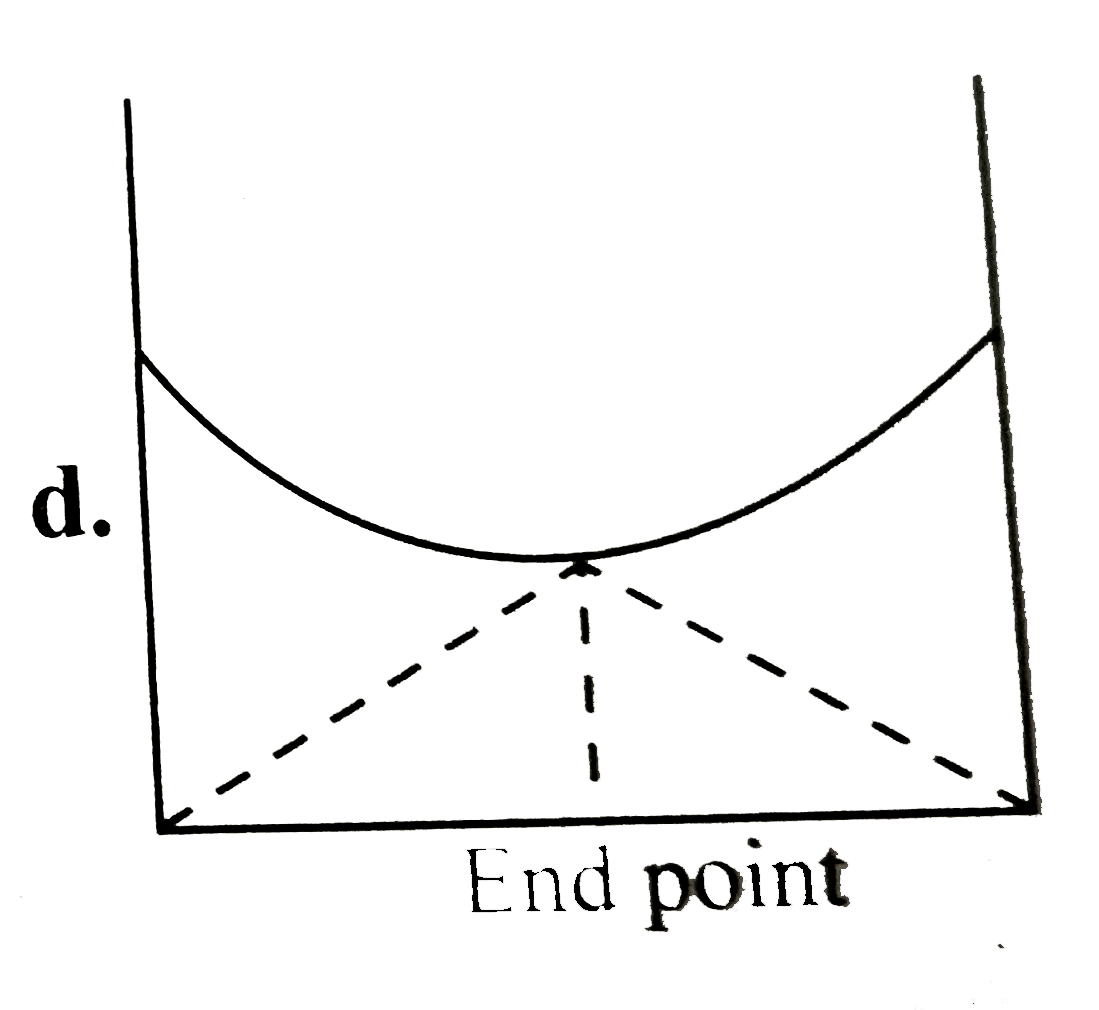
The electricity conductivity of a solution serves as a means of determing the end point in a chemical reaction, involved in the titration of acids, bases, or precipitation. Which of the following conductometric titrations represent the curve of `HCl vs NaOH`
`x-` axis `implies` Volume of alkali added
`y-` axis`implies` Conductivity
(a)
(b)
(c)
(d)

A

B

C

D

Text Solution

Verified by Experts

The correct Answer is:

b

Refer Section
Promotional Banner

Topper's Solved these Questions

  • ELECTROCHEMISTRY

    CENGAGE CHEMISTRY ENGLISH|Exercise Exerciseassertion -Reasoning|25 Videos
  • ELECTROCHEMISTRY

    CENGAGE CHEMISTRY ENGLISH|Exercise Exerciseinterger|8 Videos
  • ELECTROCHEMISTRY

    CENGAGE CHEMISTRY ENGLISH|Exercise Exercisemultiple Correct Ansers|53 Videos
  • D AND F BLOCK ELEMENTS

    CENGAGE CHEMISTRY ENGLISH|Exercise Archives Subjective|29 Videos
  • GENERAL PRINCIPLES AND PROCESS OF ISOLATION OF ELEMENTS

    CENGAGE CHEMISTRY ENGLISH|Exercise Archives (Subjective)|14 Videos

Similar Questions

Explore conceptually related problems

Conductance measurements and be used to detect the end point of acid-base titrations. Which of the following plots correctly represents the end point of the titration of strong acid and a strong base?

Which of the following curve will represent the variation of conductance C during titration of CH_(3)COOH by gradual addition of NaOH solution (V)

Strong acid versus strong base: The principle of conductometric titrations is based on the fact that during the titration, one of the ions is replaced by the other and invariable these two ions differ in the ionic conductivity with the result that thhe conductivity of the solution varies during the course of the titration. take, for example, the titration between a strong acid, say HCl, and a string base, say NaOH before NaOH is added, the conductance of HCl solution has a high value due to the presence of highly mobile hydrogen ions. As NaOH is added, H^(+) ions are replaced by relatively slower moving Na^(+) ions. consequently the conductance of the solution decreases and this continues right upto the equivalence point where the solution contains only NaCl. Beyond the equivalence point, if more of NaOH is added, then the solution contains a excess of the fast moving OH^(-) ions with the result that its conductance is increased ad it condinues to increase as more and more of NaOH is added. If we plot the conductance value versus the amount of NaOH added, we get a curve of the type shown in Fig. The descending portion AB represents the conductances before the equivalence point (solution contains a mixture of acid HCl and the salt NaCl) and the ascending portion CD represents the conductances after the equivalence point (solution contains the salt NaCl and the excess of NaOH). The point E which represent the minium conductance is due to the solution containing only NaCl with no free acid or alkali and thus represents the equivalence point. this point can, however, be obtained by the extrapolation of the lines AB and DC, and therefore, one is not very particular in locating this point expermentally as it is in the case of ordinary acid-base titrations involving the acid-base indicators. Weak acid versus strong base: Let us take specific example of acetic acid being titrated against NaOH . Before the addition of alkali, the solution shows poor conductance due to feeble ionization of acetic acid. Initially the addition of alkali causes not only the replacement of H^(+) by Na^(+) but also suppresses the dissociation of acetic acid due to the common ion Ac^(-) and thus the conductance of the solution decreases in the beginning. but very soon the conductance start increasing as addition of NaOH neutralizes the undissociated HAc to Na^(+)Ac^(-) thus causing the replacement of non-conducting HAc with Strong-conducting electrolyte Na^(+)Ac^(-) . the increase in conductance continuous right up to the equivalence point. Beyond this point conductance increases more rapidly with the addition of NaOH due to the highly conducting OH^(-) ions, the graph near the equivalence point is curved due to the hydrolysis of the salt NaAc . The actual equivalence point can, as usual, be obtained by the extrapolation method. In all these graphs it has been assumed that the volume change due addition of solution from burrette is negnigible, hence volume change of the solution in beaker the conductance of which is measured is almost constant throughout the measurement. Q. The nature of curve obtained for the titration between weak acid versus strong base as described in the above passage will be:

In acid-base titration react rapidly to neutralise each other. Equivalence point is a point at which the acid and the base (or oxidising agent and reducing agent) have beem added in equivalent quantities. The end point in the point at which the titration stops. since the purpose of the indicator is to stop the titration close to the point at which the acid and base were added in equivalent quantities, it is important that the equivalent point and the end point be as close as must change colour at a pH close to that of a solution of the salt of the acid base. Singificantly, the pH changes most rapidly near the equivalent point. The exact shape of a titration curve depends on K_(a) and K_(b) of acid and base. The following curve represents titration curve of HCI against KOH . The pH at equivalent point is Examine the titration curve below and answer the question.

In acid-base titration react rapidly to neutralise each other. Equivalence point is a point at which the acid and the base (or oxidising agent and reducing agent) have beem added in equivalent quantities. The end point in the point at which the titration stops. since the purpose of the indicator is to stop the titration close to the point at which the acid and base were added in equivalent quantities, it is important that the equivalent point and the end point be as close as must change colour at a pH close to that of a solution of the salt of the acid base. Singificantly, the pH changes most rapidly near the equivalent point. The exact shape of a titration curve depends on K_(a) and K_(b) of acid and base. Which of the following curves indicates the titration of a weak diprotic acid by KOH of equivalent strength?

40 mL 0.05 M solution of sodium sesquicarbonate dehydrate (Na_(2)CO_(3).NaHCO_(3).2H_(2)O) is titrated against 0.05 M HCl solution, x mL of acid is required to reach the phenolphthalein end point while mL of same acid were required when methyl organe indicator was used in a separate titration. Which of the following is (are) correct statements? a. y-x = 80 mL b. y+x = 160 mL c. If the titration is started with phenolphthalein indicator and methyl orange is added at the end point, 2 x mL of HCl would be required further to reach the end point d. If the same volume of same solution is titrated against 0.10 M NaOH, x//2 mL of base would be required

In acid-base titration react rapidly to neutralise each other. Equivalence point is a point at which the acid and the base (or oxidising agent and reducing agent) have beem added in equivalent quantities. The end point in the point at which the titration stops. since the purpose of the indicator is to stop the titration close to the point at which the acid and base were added in equivalent quantities, it is important that the equivalent point and the end point be as close as must change colour at a pH close to that of a solution of the salt of the acid base. Singificantly, the pH changes most rapidly near the equivalent point. The exact shape of a titration curve depends on K_(a) and K_(b) of acid and base. The curve represents the titration of

In acid-base titration react rapidly to neutralise each other. Equivalence point is a point at which the acid and the base (or oxidising agent and reducing agent) have beem added in equivalent quantities. The end point in the point at which the titration stops. since the purpose of the indicator is to stop the titration close to the point at which the acid and base were added in equivalent quantities, it is important that the equivalent point and the end point be as close as must change colour at a pH close to that of a solution of the salt of the acid base. Singificantly, the pH changes most rapidly near the equivalent point. The exact shape of a titration curve depends on K_(a) and K_(b) of acid and base. The pH at equivalence point is

The curve in the first quadrant for which the normal at any point (x , y) and the line joining the origin to that point form an isosceles triangle with the x-axis as base is (a) an ellipse (b) a rectangular hyperbola (c) a circle (d) None of these

There are three acid-base indicators. Methyl orange (end point at pH=4 ), bromothymol blue (end point at pH-7 ), phenolphthalein (end point at pH=9 ). Which is the most suitable indicator for the following titrations? (a). H_2SO_4 with KOH (b). KCn with HCl (c). NH_3 with HNO_3 (d). HF with NaOH

CENGAGE CHEMISTRY ENGLISH-ELECTROCHEMISTRY-Exercises Ingle Correct
  1. Which of the following does not evolve oxygen at anode when the elect...

    Text Solution

    |

  2. Calculate the potential of the following cell : Pt|underset((2.0M)(...

    Text Solution

    |

  3. The electricity conductivity of a solution serves as a means of determ...

    Text Solution

    |

  4. A constant current was passed through a solution of AuCl(4)^(c-) ion b...

    Text Solution

    |

  5. E^(c-) for FeY^(c-)+e^(c-) rarr FeY^(2-) given: Fe+3/+2=0.77V (a)0.13...

    Text Solution

    |

  6. Calculate E^(c-) for the reactions : ZnY^(2-)hArrZn(s)+Y^(4-) where...

    Text Solution

    |

  7. The solubility product of Pb(3)(AsO(4))(2) is 4.1xx10^(-36). E^(c-) fo...

    Text Solution

    |

  8. A cell is to be constructed to show a redox change : Cr+2Cr^(3+)hArr...

    Text Solution

    |

  9. E^(c-) for Cr^(3+)+3e^(-) rarr Cr and Cr^(3+)+e^(-) rarr Cr^(2+) are -...

    Text Solution

    |

  10. The efficiency of a fuel cell si 80% and the standard heat of reaction...

    Text Solution

    |

  11. The E(cell) for a given cell is 1.2346 and 1.2340V at 300K and 310K, ...

    Text Solution

    |

  12. A curent of 3A was passed for 1 hour through an electrolyte solution o...

    Text Solution

    |

  13. The E^(c-) for Cu^(2+)//Cu^(o+),Cu^(o+)//Cu,Cu^(2+)//Cu, are 0.15V,0.5...

    Text Solution

    |

  14. Total charge required to convert three moles of Mn(2)O(4) to MnO(4)^(c...

    Text Solution

    |

  15. A current of 965A is passed for 1 s through 1L solution of 0.02N NiSO(...

    Text Solution

    |

  16. For the given cell Pt(D(2)|D^(o+))||H^(o+)|Pt(H(2)), if E^(c-).(D(2)|D...

    Text Solution

    |

  17. What is E^(c).(red) for the reaction: Cu^(2+)+2e^(-) rarr Cu in the ha...

    Text Solution

    |

  18. The combustion of butane in O(2) at 1 bar and 298K shows a decrease in...

    Text Solution

    |

  19. A half cell reaction Ag(2)S(s)+2e^(-) rarr 3Ag(s)+S^(2-) is carried ou...

    Text Solution

    |

  20. Which one is wrong if electrolysis of CH(3)COONa(aq) is made using Pt ...

    Text Solution

    |
