Home
Class 12
CHEMISTRY
E^(c-) for FeY^(c-)+e^(c-) rarr FeY^(2-)...


`E^(c-)` for `FeY^(c-)+e^(c-) rarr FeY^(2-)`
given: Fe+3/+2=0.77V
(a)`0.13V`
(b)`-0.636V`
(c)`+0.636V`
(d)`1.41V`

A

`0.13V`

B

`-0.636V`

C

`+0.636V`

D

`1.41V`

Text Solution

Verified by Experts

The correct Answer is:

a

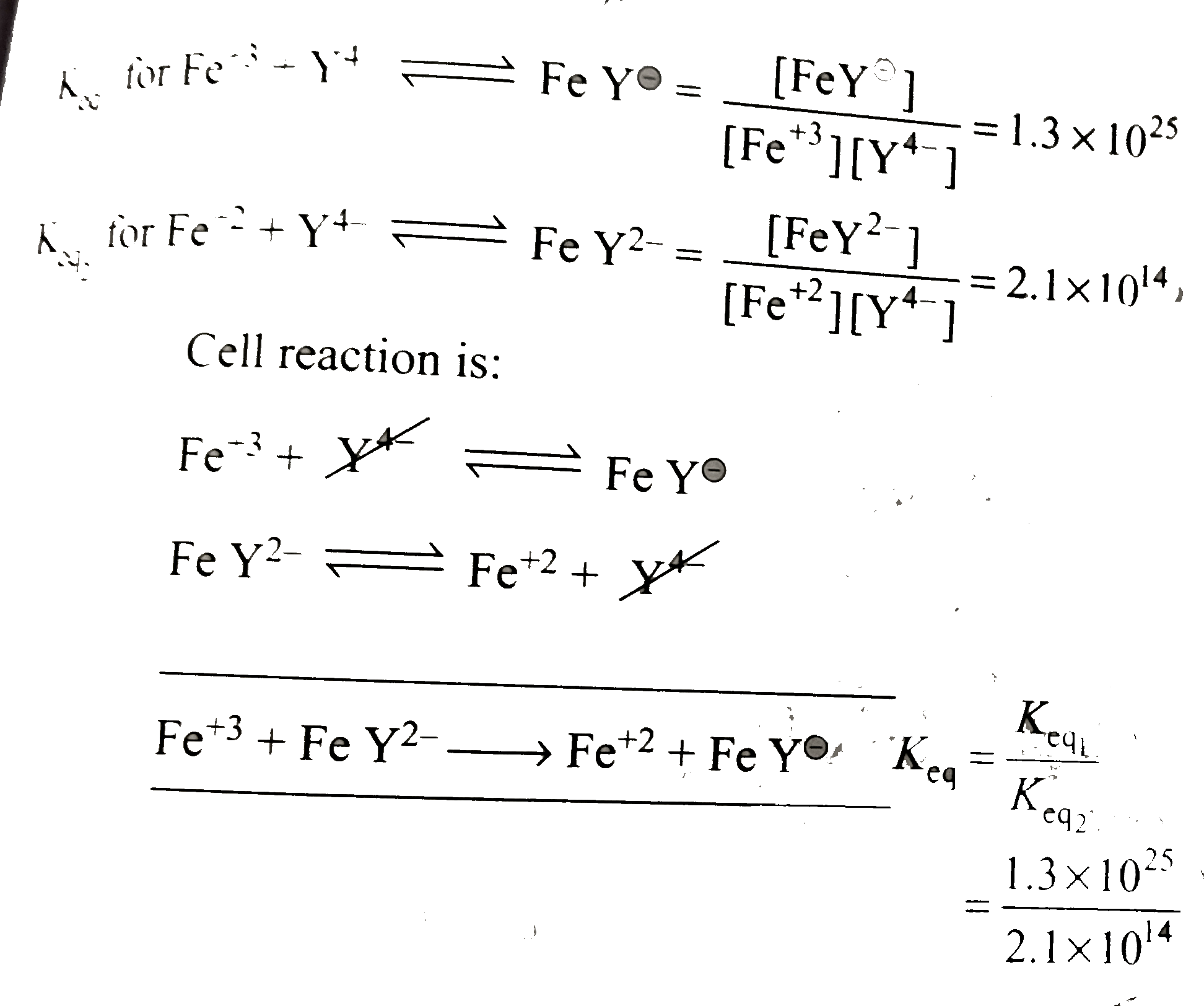
For `underset((Fe^(+3)+e^(-) rarr Fe^(+2)))(FeY^(c-)+e^(-) rarr FeY^(2-)), ` the change is

`E^(c-)._(Fe^(+3),FeY^(c-)|Fe^(+2),FeY^(2-))`
`=E_(Fe^(+3)|Fe^(+2))^(c-)-(0.059)/(1)log.(K_(eq1))/(K_(eq2))`
`=0.77-(0.059)/(1)log.(1.3xx10^(25))/(2.1xx10^(14))=0.77-0.64=0.13V`.
Promotional Banner

Topper's Solved these Questions

  • ELECTROCHEMISTRY

    CENGAGE CHEMISTRY ENGLISH|Exercise Exerciseassertion -Reasoning|25 Videos
  • ELECTROCHEMISTRY

    CENGAGE CHEMISTRY ENGLISH|Exercise Exerciseinterger|8 Videos
  • ELECTROCHEMISTRY

    CENGAGE CHEMISTRY ENGLISH|Exercise Exercisemultiple Correct Ansers|53 Videos
  • D AND F BLOCK ELEMENTS

    CENGAGE CHEMISTRY ENGLISH|Exercise Archives Subjective|29 Videos
  • GENERAL PRINCIPLES AND PROCESS OF ISOLATION OF ELEMENTS

    CENGAGE CHEMISTRY ENGLISH|Exercise Archives (Subjective)|14 Videos

Similar Questions

Explore conceptually related problems

Calculate E^(c-) for the reactions : ZnY^(2-)hArrZn(s)+Y^(4-) where Y^(4-) is the completely deprotonated anion of EDTA. The formation constant for ZnY^(2-) is 3.2xx10^(16) and E^(c-) for Zn rarr Zn^(2+)+2e^(-) is 0.76V . (a) -1.25V (b) 0.48V (c) +0.68V (d) -0.27V

Consider the following E^@ values . E_(Fe^(3+)//Fe^(2+)^@ = + 0.77 V , E_(Sn^(2+)//Sn)^@=- 0.14 V The E_(cell)^@ for the reaction , Sn (s) + 2Fe^(3+)(aq) rarr 2 Fe^(2+)(aq)+ Sn^(2+)(aq) is ? (a) -0.58 V (b) -0.30 V (c) +0.30V (d) +0.58 V

Two electrochemical cells are assembled in which the following reactions occur : V^(2)=VO^(2+)+2H^(o+)rarr 2V^(3+)+H_(2)O V^(3+)+Ag^(o+)+H_(2)O rarr VO^(2+)+2H^(o+)+Ag(s) Calculate E^(c-) for half reaction V^(3+)+e^(-)rarr V^(2+) Given : E^(c-)._((Ag^(o+)|Ag))=0.799 E^(c-)=E^(c-)._(V^(4+)|V^(3+))-E^(c-)._(V^(3+)|V^(2+))=0.616V E^(c-)=E^(c-)._(Ag^(o+)|Ag)-E^(c-)._(V^(4+)|V_(3+))=0.439V

For the reduction of NO_(3)^(c-) ion in an aqueous solution, E^(c-) is +0.96V , the values of E^(c-) for some metal ions are given below : i.V^(2+)(aq)+2e^(-)rarr V, " "E^(c-)=-1.19V ii. Fe^(3+)(aq)+3e^(-) rarr Fe, " "E^(c-)=-0.04V iii. Au^(3+)(aq)+3e^(-) rarr Au, " "E^(c-)=+1.40V iv. Hg^(2+)(aq)+2e^(-) rarr Hg, " "E^(c-)=+0.86V The pair (s) of metals that is // are oxidized by NO_(3)^(c-) in aqueous solution is // are

For the reduction of NO_(3)^(c-) ion in an aqueous solution, E^(c-) is +0.96V , the values of E^(c-) for some metal ions are given below : i.V^(2+)(aq)+2e^(-)rarr V, " "E^(c-)=-1.19V ii. Fe^(3+)(aq)+3e^(-) rarr Fe, " "E^(c-)=-0.04V iii. Au^(3+)(aq)+3e^(-) rarr Au, " "E^(c-)=+1.40V iv. Hg^(2+)(aq)+2e^(-) rarr Hg, " "E^(c-)=+0.86V The pair (s) of metals that is // are oxidized by NO_(3)^(c-) in aqueous solution is // are

The solubility product of Pb_(3)(AsO_(4))_(2) is 4.1xx10^(-36). E^(c-) for the reaction : Pb_(3)(AsO_(4))_(2)(s)+6e^(-)hArr3Pb(s)+2AsO_(4)^(2-) E_((Pb)2^(+)|Pb)^(Θ)=-0.13V (a) +0.478V (b) -0.13V (c) -0.478V (d) +0.13V

Given electrode potentials asre Fe^(3+)+e^(-) rarr Fe^(2+)," "E^(c-)=0.771V I_(2)+2e^(-) rarr 2I^(c-)," "E^(c-)=0.536V E^(c-)._(cell) for the cell reaction, Fe^(3+)+2I^(c-) rarr Fe^(2+)+I_(2) is

Given standard E^(c-): Fe^(3+)+3e^(-)rarrFe," "E^(c-)=-0.036 Fe^(2+)+2e^(-)rarr Fe," "E^(c-)=-0.440V The E^(c-) of Fe^(3+)+e^(-) rarr Fe^(2+) is

The potential the cell at 25^(@)C is Given pK_(b) of NH_(4)OH=4.74 (a) 0.05V (b) -0.05V (c) -0.28V (d) 0.28V

The magnitude ( but not the sign ) of the standard reduction potentials of two metals X and Y are : Y^(2)+2e^(-) rarr Y |E_(1)^(c-)|=0.34V X^(2)+2e^(-) rarr X |E_(2)^(c-)|=0.25V When the two half cells of X and Y are connected to construct a cell, electrons flow from X to Y . When X is connected to a standard hydrogen electrode (SHE) ,electrons flow from X to SHE . If standard emf (E^(c-)) of a half cell Y^(2)|Y^(o+) is 0.15V , the standard emf of the half cell Y^(o+)|Y will be (a) 0.19V (b) 0.53V (c) 0.49V (d) 0.64V

CENGAGE CHEMISTRY ENGLISH-ELECTROCHEMISTRY-Exercises Ingle Correct
  1. The electricity conductivity of a solution serves as a means of determ...

    Text Solution

    |

  2. A constant current was passed through a solution of AuCl(4)^(c-) ion b...

    Text Solution

    |

  3. E^(c-) for FeY^(c-)+e^(c-) rarr FeY^(2-) given: Fe+3/+2=0.77V (a)0.13...

    Text Solution

    |

  4. Calculate E^(c-) for the reactions : ZnY^(2-)hArrZn(s)+Y^(4-) where...

    Text Solution

    |

  5. The solubility product of Pb(3)(AsO(4))(2) is 4.1xx10^(-36). E^(c-) fo...

    Text Solution

    |

  6. A cell is to be constructed to show a redox change : Cr+2Cr^(3+)hArr...

    Text Solution

    |

  7. E^(c-) for Cr^(3+)+3e^(-) rarr Cr and Cr^(3+)+e^(-) rarr Cr^(2+) are -...

    Text Solution

    |

  8. The efficiency of a fuel cell si 80% and the standard heat of reaction...

    Text Solution

    |

  9. The E(cell) for a given cell is 1.2346 and 1.2340V at 300K and 310K, ...

    Text Solution

    |

  10. A curent of 3A was passed for 1 hour through an electrolyte solution o...

    Text Solution

    |

  11. The E^(c-) for Cu^(2+)//Cu^(o+),Cu^(o+)//Cu,Cu^(2+)//Cu, are 0.15V,0.5...

    Text Solution

    |

  12. Total charge required to convert three moles of Mn(2)O(4) to MnO(4)^(c...

    Text Solution

    |

  13. A current of 965A is passed for 1 s through 1L solution of 0.02N NiSO(...

    Text Solution

    |

  14. For the given cell Pt(D(2)|D^(o+))||H^(o+)|Pt(H(2)), if E^(c-).(D(2)|D...

    Text Solution

    |

  15. What is E^(c).(red) for the reaction: Cu^(2+)+2e^(-) rarr Cu in the ha...

    Text Solution

    |

  16. The combustion of butane in O(2) at 1 bar and 298K shows a decrease in...

    Text Solution

    |

  17. A half cell reaction Ag(2)S(s)+2e^(-) rarr 3Ag(s)+S^(2-) is carried ou...

    Text Solution

    |

  18. Which one is wrong if electrolysis of CH(3)COONa(aq) is made using Pt ...

    Text Solution

    |

  19. The calomel and quinhydrone electrodes are reversible with respect to ...

    Text Solution

    |

  20. The EMF of Ni-Cad battery is dependent of :

    Text Solution

    |
