Home
Class 12
CHEMISTRY
Which of the following graphs represents...

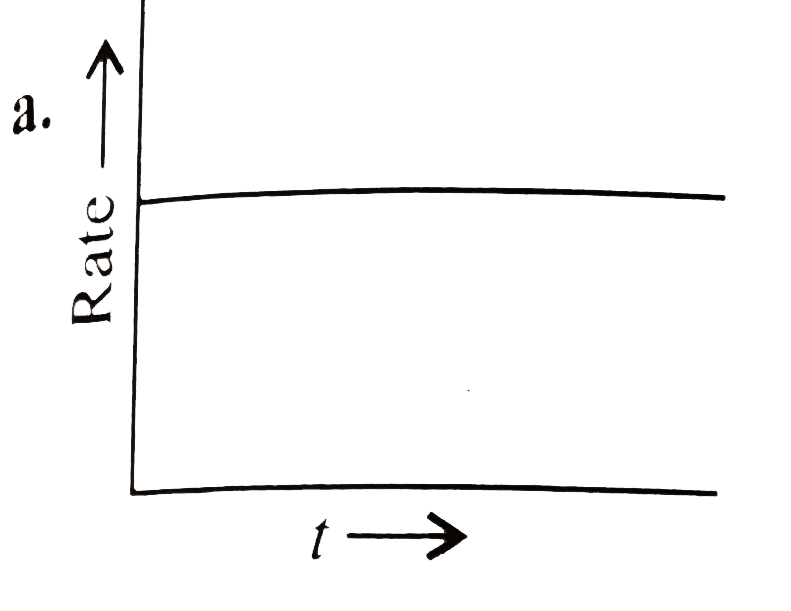
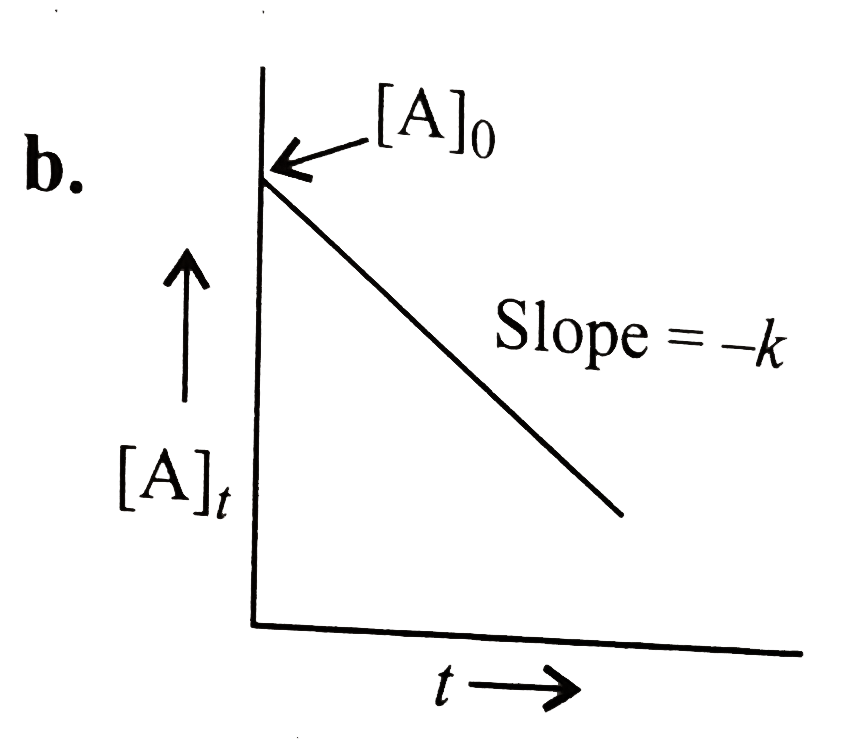
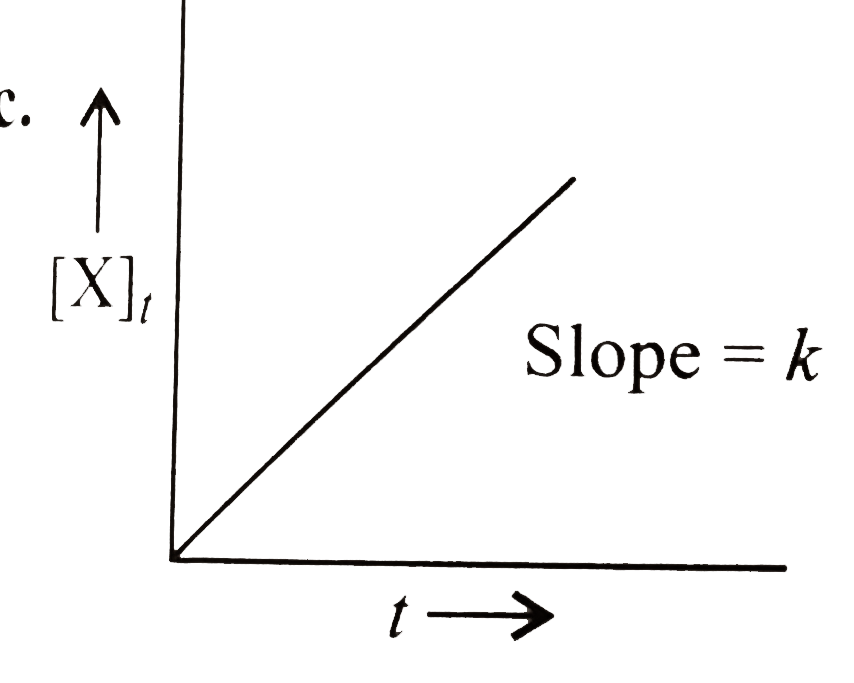
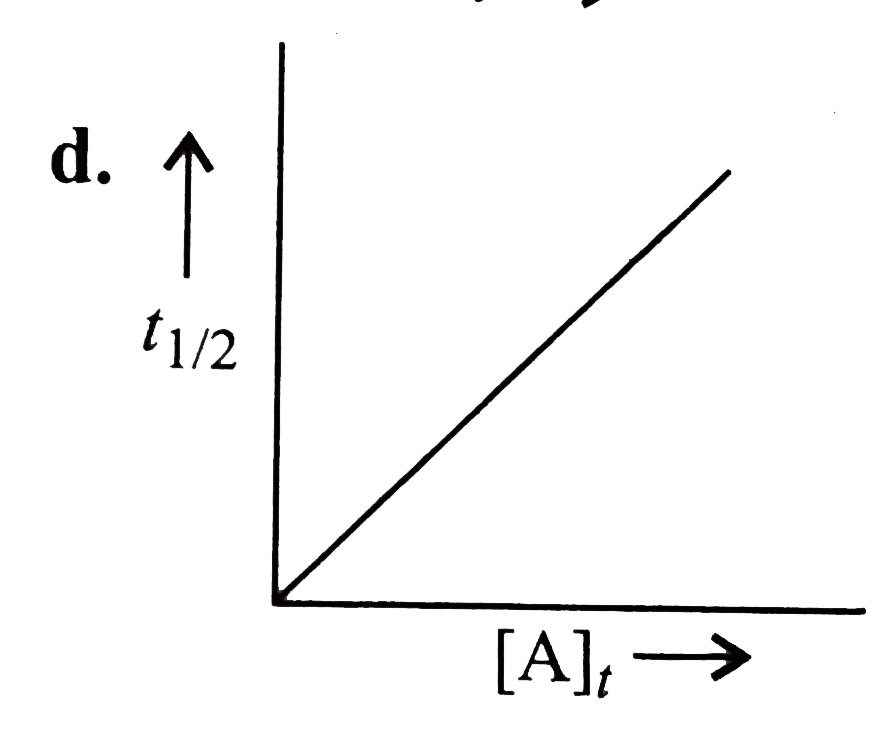
Which of the following graphs represents zero order if
`A rarr P` At `t = 0 rArr [A]_(0)` At `t = t rArr [A]_(t)`

A

B

C

D

Text Solution

AI Generated Solution

The correct Answer is:

To determine which graph represents a zero-order reaction for the reaction \( A \rightarrow P \), we need to analyze the characteristics of zero-order kinetics. ### Step-by-Step Solution: 1. **Understanding Zero-Order Reactions:** - In a zero-order reaction, the rate of reaction is constant and does not depend on the concentration of the reactant. The rate law can be expressed as: \[ \text{Rate} = k \] - Here, \( k \) is the rate constant. 2. **Mathematical Representation:** - For a zero-order reaction, the relationship between the concentration of reactant \( [A] \) and time \( t \) can be described by the equation: \[ [A]_0 - [A]_t = kt \] - Rearranging this gives: \[ [A]_t = [A]_0 - kt \] - This equation indicates that a plot of \( [A]_t \) versus time \( t \) will yield a straight line with a negative slope of \( -k \) and an intercept of \( [A]_0 \). 3. **Graphical Representation:** - The graph of \( [A]_t \) versus time \( t \) will be a straight line that starts at \( [A]_0 \) and decreases linearly over time. - The slope of the line will be negative, indicating that the concentration of \( A \) decreases as time increases. 4. **Identifying the Correct Graph:** - Among the given options, we need to look for a graph that shows a linear decrease in concentration over time, which corresponds to the equation derived above. 5. **Conclusion:** - The correct graph that represents a zero-order reaction will be a straight line with a negative slope, indicating a constant rate of reaction over time.

To determine which graph represents a zero-order reaction for the reaction \( A \rightarrow P \), we need to analyze the characteristics of zero-order kinetics. ### Step-by-Step Solution: 1. **Understanding Zero-Order Reactions:** - In a zero-order reaction, the rate of reaction is constant and does not depend on the concentration of the reactant. The rate law can be expressed as: \[ \text{Rate} = k ...
Promotional Banner

Topper's Solved these Questions

  • CHEMICAL KINETICS

    CENGAGE CHEMISTRY ENGLISH|Exercise Exercises Single Correct|177 Videos
  • CHEMICAL KINETICS

    CENGAGE CHEMISTRY ENGLISH|Exercise Exercises Assertion-Reasoning|22 Videos
  • CHEMICAL KINETICS

    CENGAGE CHEMISTRY ENGLISH|Exercise Exercises Linked Comprehension|59 Videos
  • CARBOXYLIC ACIDS AND THEIR DERIVATIVES

    CENGAGE CHEMISTRY ENGLISH|Exercise Exercises Archives (Analytical And Descriptive)|34 Videos
  • COORDINATION COMPOUNDS

    CENGAGE CHEMISTRY ENGLISH|Exercise Archives Subjective|18 Videos

Similar Questions

Explore conceptually related problems

Which of the following x-t graphs does not represent periodic motion?

Which of the following graph represents the variation of resistivity ( rho ) with temperature (T) for copper?

The graph shown the variation with times t of the velocity v of an object . Which one of the following graphs best represents the variation of acceleration a of the object with time t ?

The x-t graph shown in figure represents

The x-t graph shown in figure represents.

If 0 le t le 1 , which of the following graphs is the graph of y versus x where x and y are related by the parametric equations y=t^(2) and x = sqrt(t) ?

The velocity of a particle is zero at t=0

If P to T are second period p-block elements then which of the following graph show corrrect relation between valence electrons in P_(2) to T_(2)

Two simple harmonic motion are represented by equations y_(1) = 4 sin (10 t + phi) rArr y_(2) = 5 cos 10t What is the phase difference between their velocities ?

Switch S of the circuit shows in Fig. is closed at t = 0 . If e denotes the induced emf in L and i the current flowing through the circuit at time t , then which of the following graphs correctly represents the variation of e with i ?

CENGAGE CHEMISTRY ENGLISH-CHEMICAL KINETICS-Exercises Multiple Correct
  1. In acidic medium the rate of reaction between [BrO(3)^(-)] and [Br^(-)...

    Text Solution

    |

  2. Which of the following relations are correct if Delta H represents onl...

    Text Solution

    |

  3. Which of the following graphs represents zero order if A rarr P At ...

    Text Solution

    |

  4. Which one is correct according to the colliison theory of the rate of ...

    Text Solution

    |

  5. The rate expresison for the reaction: NH(4)CNO hArr NH(2)CONH(2) can...

    Text Solution

    |

  6. According to the colliison theory, most molecular colliisons do not le...

    Text Solution

    |

  7. Indentify the true statement(s)

    Text Solution

    |

  8. Which of the following statement (s) is/are correct?

    Text Solution

    |

  9. Which of the following plots are correctly made for the reaction nA hA...

    Text Solution

    |

  10. Rate constant k varies with temperature by equation log k (min^(-1)) =...

    Text Solution

    |

  11. Which of the following reaction (s) is // are of the first order ?

    Text Solution

    |

  12. The basis theory behind Arrhenius' equation is that

    Text Solution

    |

  13. In the Arrhenius equation, k = A exp^(-Ea//RT), A may be termed as the...

    Text Solution

    |

  14. Select the correct statement

    Text Solution

    |

  15. For a gaseous reaction: A(g) rarr B(g), the rate expresison may be giv...

    Text Solution

    |

  16. The rate of formation of C(6)H(6)+3H(2) underset(k(b))overset(k(f))hAr...

    Text Solution

    |

  17. A certain reaction A rarr B follows the given concentration (Molarity)...

    Text Solution

    |

  18. For a first order reaction,

    Text Solution

    |

  19. Which of the following statement (s) is/are correct

    Text Solution

    |

  20. For the reaction N(2)(g)+3H(2)(g) rarr 2NH(3)(g), under certain condit...

    Text Solution

    |
