Home
Class 12
CHEMISTRY
Which of the following plots are correct...

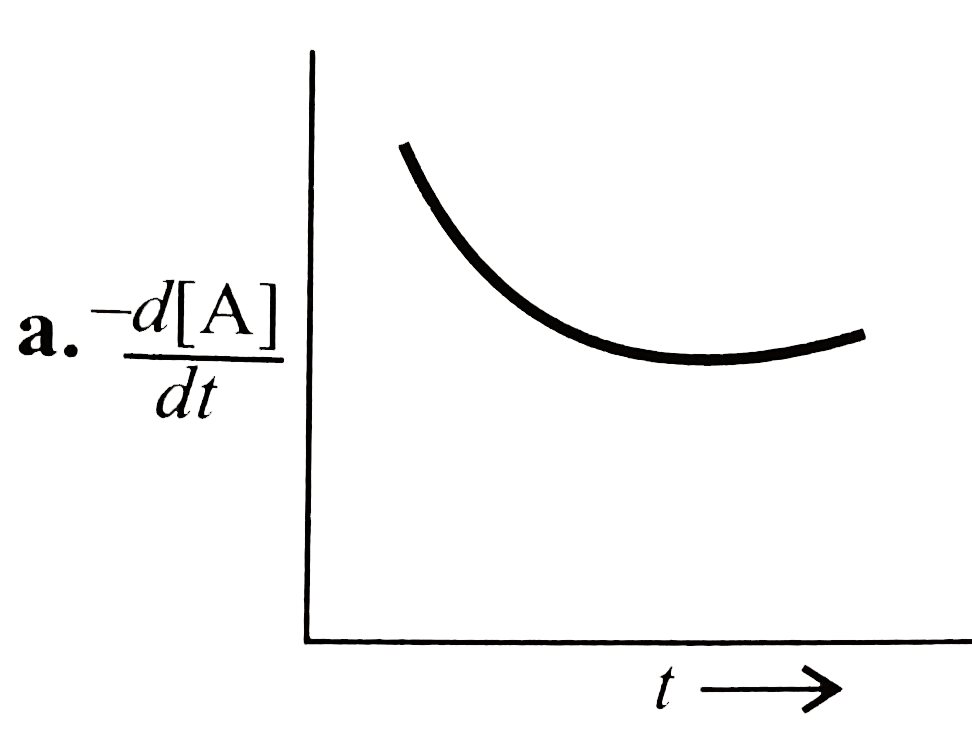
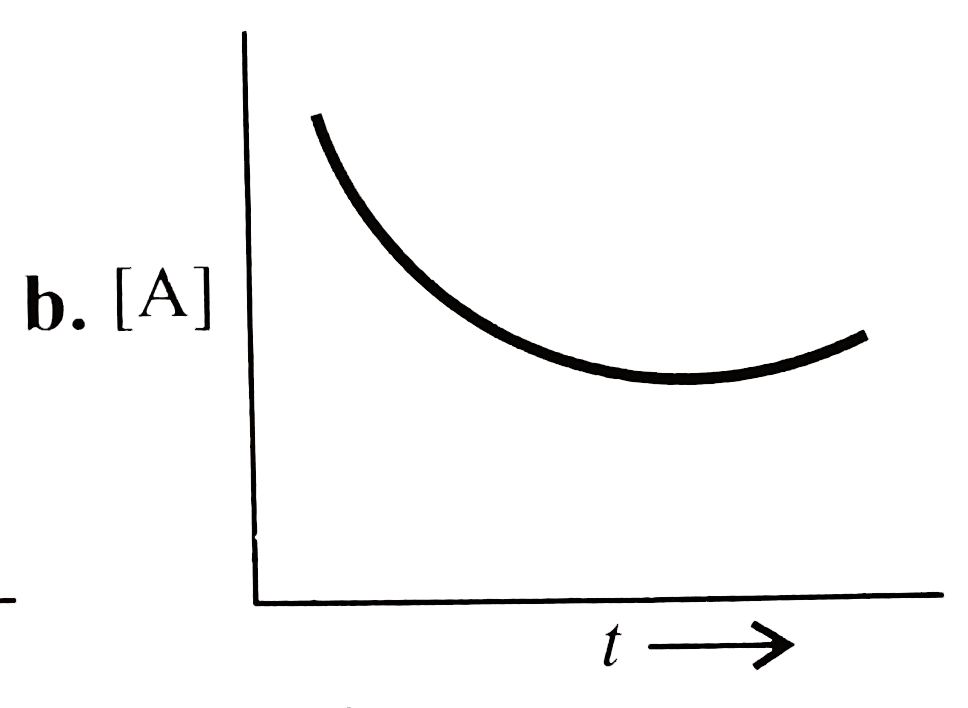
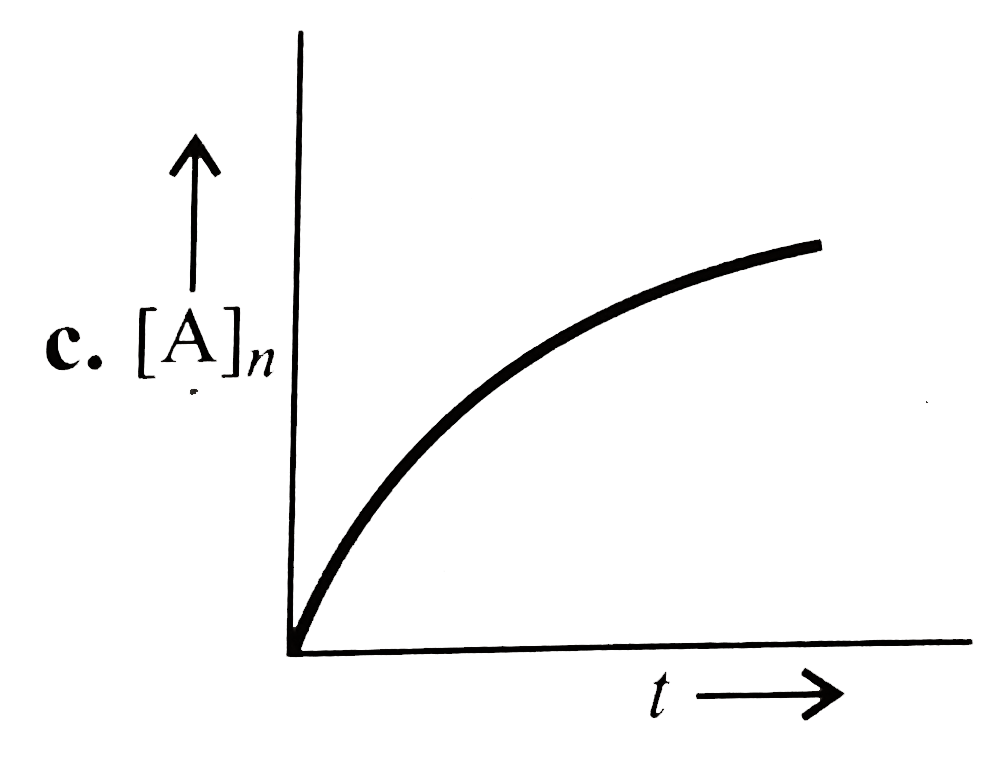
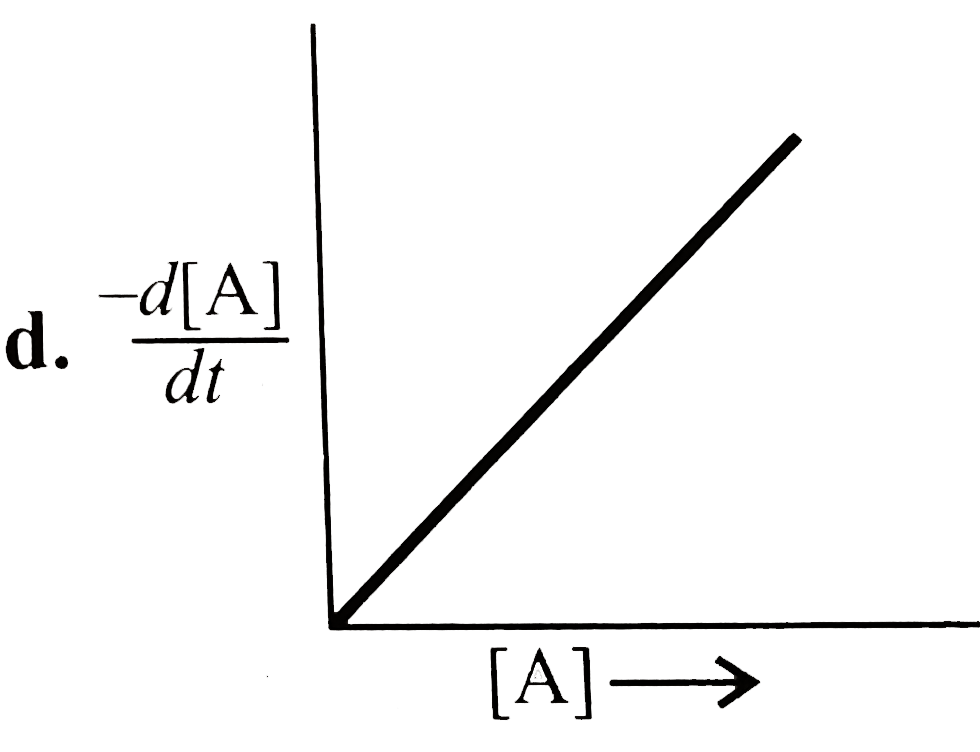
Which of the following plots are correctly made for the reaction `nA hArr (A)_(n)` if it obeys first order reaction?

A

B

C

D

Text Solution

AI Generated Solution

The correct Answer is:

To determine which plots are correctly made for the reaction \( nA \rightleftharpoons (A)_n \) that obeys first-order kinetics, we need to analyze the behavior of the concentration of reactants and products over time, as well as the rate of reaction. ### Step 1: Understand the Reaction and Rate Law The reaction given is \( nA \rightleftharpoons (A)_n \). For a first-order reaction, the rate law can be expressed as: \[ -\frac{d[A]}{dt} = k[A] \] where \( [A] \) is the concentration of reactant A and \( k \) is the rate constant. ### Step 2: Analyze the Rate of Reaction As the reaction proceeds, the concentration of A decreases over time. Since the rate of reaction is directly proportional to the concentration of A, as \( [A] \) decreases, the rate of reaction also decreases. - **Conclusion for Plot A**: The plot showing the rate of reaction decreasing with time is correct. ### Step 3: Concentration of Reactant Over Time Since A is being converted into products, the concentration of A will decrease over time. - **Conclusion for Plot B**: The plot showing the concentration of A decreasing with time is correct. ### Step 4: Concentration of Product Over Time As A is converted into products, the concentration of the product \( (A)_n \) will increase over time. Initially, the concentration of the product is zero, and as time approaches infinity, the concentration of A approaches zero, while the concentration of the product approaches its maximum. - **Conclusion for Plot C**: The plot showing the concentration of the product increasing over time is correct. ### Step 5: Rate of Reaction vs. Concentration of Reactant The rate of reaction is directly proportional to the concentration of A. Therefore, as the concentration of A decreases, the rate of reaction also decreases. - **Conclusion for Plot D**: The plot showing the rate of reaction being directly proportional to the concentration of A is correct. ### Final Conclusion All four plots (A, B, C, and D) are correctly made for the reaction \( nA \rightleftharpoons (A)_n \) if it obeys first-order kinetics. ---
Promotional Banner

Topper's Solved these Questions

  • CHEMICAL KINETICS

    CENGAGE CHEMISTRY ENGLISH|Exercise Exercises Single Correct|177 Videos
  • CHEMICAL KINETICS

    CENGAGE CHEMISTRY ENGLISH|Exercise Exercises Assertion-Reasoning|22 Videos
  • CHEMICAL KINETICS

    CENGAGE CHEMISTRY ENGLISH|Exercise Exercises Linked Comprehension|59 Videos
  • CARBOXYLIC ACIDS AND THEIR DERIVATIVES

    CENGAGE CHEMISTRY ENGLISH|Exercise Exercises Archives (Analytical And Descriptive)|34 Videos
  • COORDINATION COMPOUNDS

    CENGAGE CHEMISTRY ENGLISH|Exercise Archives Subjective|18 Videos

Similar Questions

Explore conceptually related problems

For a first order reaction,

For the first order reaction,

Which of the following is/are correct for the first order reaction?

Which of the following is correctly ordered :

Which of the following are correct about the reaction A + 2B hArr C + D

Which of the following is/are correct about the first order reaction ?

Which of the following reagents are not correctly matched with the reaction ?

CENGAGE CHEMISTRY ENGLISH-CHEMICAL KINETICS-Exercises Multiple Correct
  1. Indentify the true statement(s)

    Text Solution

    |

  2. Which of the following statement (s) is/are correct?

    Text Solution

    |

  3. Which of the following plots are correctly made for the reaction nA hA...

    Text Solution

    |

  4. Rate constant k varies with temperature by equation log k (min^(-1)) =...

    Text Solution

    |

  5. Which of the following reaction (s) is // are of the first order ?

    Text Solution

    |

  6. The basis theory behind Arrhenius' equation is that

    Text Solution

    |

  7. In the Arrhenius equation, k = A exp^(-Ea//RT), A may be termed as the...

    Text Solution

    |

  8. Select the correct statement

    Text Solution

    |

  9. For a gaseous reaction: A(g) rarr B(g), the rate expresison may be giv...

    Text Solution

    |

  10. The rate of formation of C(6)H(6)+3H(2) underset(k(b))overset(k(f))hAr...

    Text Solution

    |

  11. A certain reaction A rarr B follows the given concentration (Molarity)...

    Text Solution

    |

  12. For a first order reaction,

    Text Solution

    |

  13. Which of the following statement (s) is/are correct

    Text Solution

    |

  14. For the reaction N(2)(g)+3H(2)(g) rarr 2NH(3)(g), under certain condit...

    Text Solution

    |

  15. The distribution of molecular kinetic energy at two temperature is as ...

    Text Solution

    |

  16. Which of the following isomerization reactions is/are of the first ord...

    Text Solution

    |

  17. Which of the following is/are examples of unimolecular reactions?

    Text Solution

    |

  18. Zn+2H^(o+)rarrZn^(2+)+H(2) The half-life periof is independent of th...

    Text Solution

    |

  19. Which of the following is/are examples of pseudo unimolecular reaction...

    Text Solution

    |

  20. In which of the following ways does an activated complex differ form a...

    Text Solution

    |
