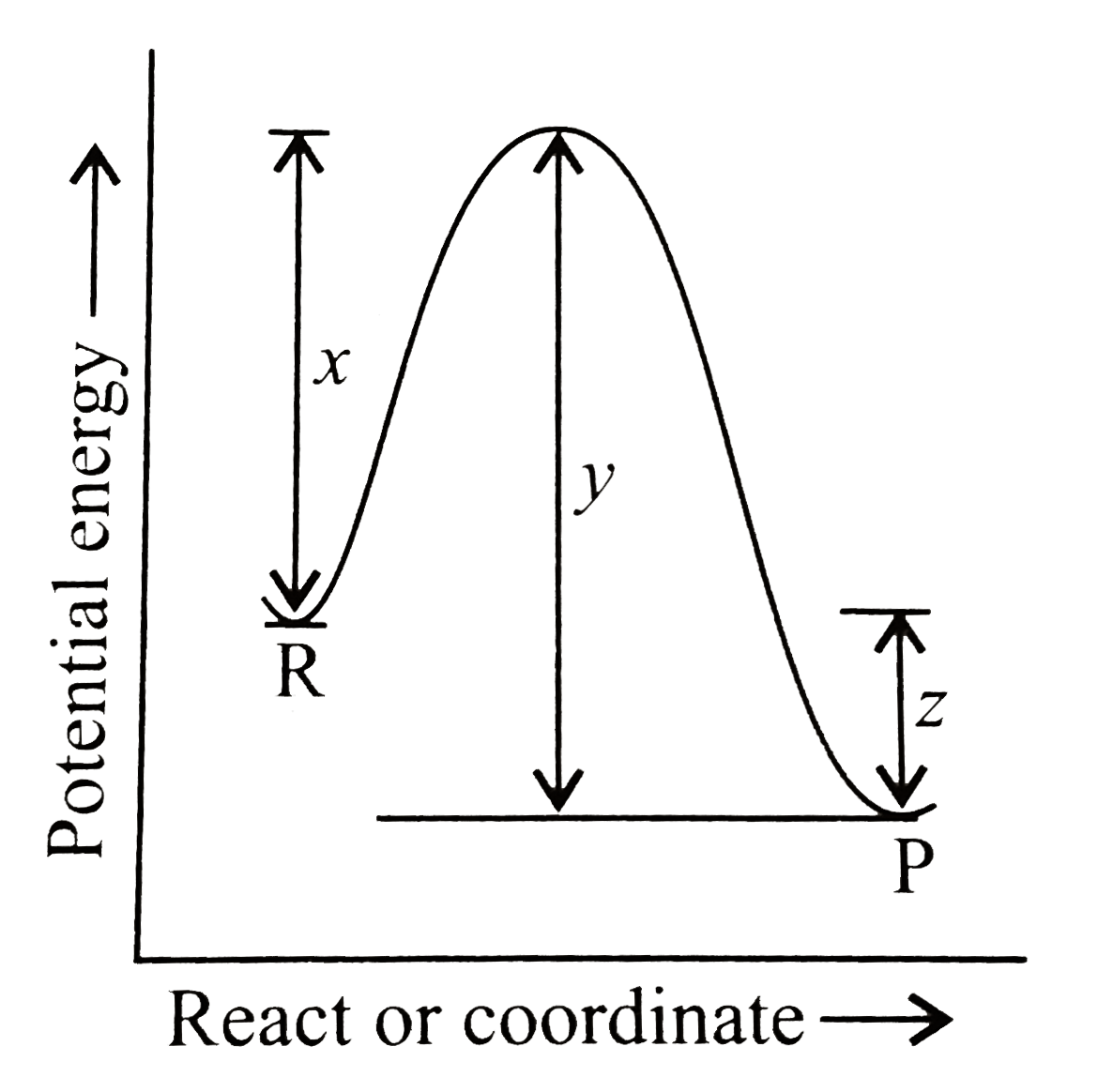
A
B
C
D
Text Solution
Verified by Experts
The correct Answer is:



Topper's Solved these Questions
CHEMICAL KINETICS
CENGAGE CHEMISTRY ENGLISH|Exercise Exercises Assertion-Reasoning|22 VideosCHEMICAL KINETICS
CENGAGE CHEMISTRY ENGLISH|Exercise Exercises Integer|15 VideosCHEMICAL KINETICS
CENGAGE CHEMISTRY ENGLISH|Exercise Exercises Multiple Correct|33 VideosCARBOXYLIC ACIDS AND THEIR DERIVATIVES
CENGAGE CHEMISTRY ENGLISH|Exercise Exercises Archives (Analytical And Descriptive)|34 VideosCOORDINATION COMPOUNDS
CENGAGE CHEMISTRY ENGLISH|Exercise Archives Subjective|18 Videos
Similar Questions
Explore conceptually related problems
CENGAGE CHEMISTRY ENGLISH-CHEMICAL KINETICS-Exercises Single Correct
- The rate equation for the second order reaction 2A+B rarr C is found t...
Text Solution
|
- A graph plotted between log k versus 1//T for calculating activation e...
Text Solution
|
- The potential energy diagram for a reaction R rarr P is given below. D...
Text Solution
|
- the activation energy for a simple chemical reaction A to B is...
Text Solution
|
- the reaction A to B follows first order Kinetics the time taken...
Text Solution
|
- Write the expression for quantum yield in photosynthesis.
Text Solution
|
- When the rate determined by the change in concentration of two differe...
Text Solution
|
- The slope of the line graph of log k versus 1//T for the reaction N(2)...
Text Solution
|
- The inversion of a sugar follows first order rate equation which can b...
Text Solution
|
- For a certain decompoistion, the rate is 0.30 M s^(-1) when the concen...
Text Solution
|
- For a second order reaction dx//dt =k(a-x)^(2). Its half life periof ...
Text Solution
|
- For a chemical reaction, activation energy of reactants depends on
Text Solution
|
- The dissociation of nitrogen pentaoxide is a first order reaction. In ...
Text Solution
|
- In a certain reaction, 10% of the reactant decomposes in one hour, 20%...
Text Solution
|
- The decompoistion of H(2)O(2) can be followed by titration with KMnO(4...
Text Solution
|
- The half life of decompoistion of N(2)O(5) is a first order reaction r...
Text Solution
|
- The rate constant of a reactant is 1.5 xx 10^(-3) at 25^(@)C and 2.1 x...
Text Solution
|
- In the reaction A + B rarr C+D, the concentration of A and B are equal...
Text Solution
|
- If a graph is plotted between log (a-x) and t, the slope of the straig...
Text Solution
|
- In the Wilhelmey equation of a first order reaction c(t) = c(0)e^(-kt)...
Text Solution
|