Home
Class 12
CHEMISTRY
Substances which alter the velocity of a...

Substances which alter the velocity of a reaction by mere presence, without undergoing any change in mass and compossition are termed catalyst and the phenomenon is known as catalysis
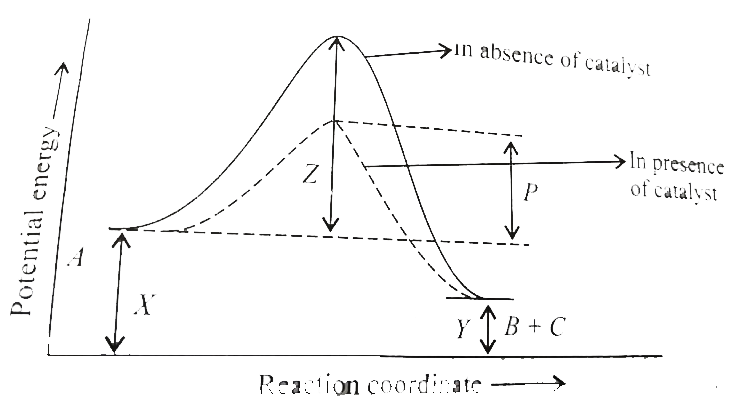
For the reaction `(ArarrB+C)` , the energy profile diagram is given in the figure below.

The decrease in the energy of activation in the presence of catalyst is

A

Z

B

`Z-P`

C

`Y-Z`

D

`Z-X`

Text Solution

Verified by Experts

The correct Answer is:

B
Promotional Banner

Topper's Solved these Questions

  • SURFACE CHEMISTRY

    CENGAGE CHEMISTRY ENGLISH|Exercise Exercises Multiple Correct|25 Videos
  • SURFACE CHEMISTRY

    CENGAGE CHEMISTRY ENGLISH|Exercise Exercises Single Correct|52 Videos
  • SURFACE CHEMISTRY

    CENGAGE CHEMISTRY ENGLISH|Exercise Exercises Subjective|10 Videos
  • SOLUTIONS

    CENGAGE CHEMISTRY ENGLISH|Exercise Ex 2.3 (Objective)|9 Videos
  • SYNTHETIC AND NATURAL POLYMERS

    CENGAGE CHEMISTRY ENGLISH|Exercise Exercises Assertion Reasoning|10 Videos

Similar Questions

Explore conceptually related problems

Substances which alter the velocity of a reaction by mere presence, without undergoing any change in mass and compossition are termed catalyst and the phenomenon is known as catalysis Which is incorrect for a catalyst?

Substances which alter the velocity of a reaction by mere presence, without undergoing any change in mass and compossition are termed catalyst and the phenomenon is known as catalysis According to the adsorption theroy of catalysis, the rate of reaction increases because

Substances which alter the velocity of a reaction by mere presence, without undergoing any change in mass and compossition are termed catalyst and the phenomenon is known as catalysis In homogenous catalytic reactions, there are three alternative paths A, B, and C (shown in figure). Which one of the following indicates the relative ease with which the reaction can take place?

Assertion : A catalyst increases the rate of reaction without itself undergoing any permanent chemical change. Reason : A catalyst changes the Gibbs energy (Delta G) of the reaction and equilibrium constant of the reaction.

Assertion: A catalyst increases the rate of a reaction. Reason: In presence of a catalyst, the activation energy of the reaction decreases.

The energy profile diagram for the reaction: CO(g)+NO_(2)(g) hArr CO_(2)(g)+NO(g) is given below: The activation energy of the forward reaction is

On introfucing a catalyst at 500K , the rate of a first order reaction increases by 1.718 times. The activation energy in the presence of a catalyst is 4.15 KJ mol^(-1) . The slope of the polt of k(s^(-1)) against 1//T in the absence of catalyst is

For a reaction A_(2) + B_(2) hArr 2AB the figure shows the path of the reaction in absence and presence of a catalyst. What will be energy of activation for forward (E_(f)) and backward (E_(b)) reaction in presence of a catalyst and Delta H for the reaction? The dotted curve is path of reaction in presence of a catalyst.

Rate of a reaction increases by 10^6 times when a reaction is carried out in presence of enzyme catalyst at same temperature. Determine change in activation energy.

The energy profile diagram for the reaction: CO(g)+NO_(2)(g) hArr CO_(2)(g)+NO(g) is given below: The activation energy of the backward reaction is

CENGAGE CHEMISTRY ENGLISH-SURFACE CHEMISTRY-Exercises Link Comprehension
  1. Adsorption is the tendency of accumulation of molecular species at the...

    Text Solution

    |

  2. Substances which alter the velocity of a reaction by mere presence, wi...

    Text Solution

    |

  3. Substances which alter the velocity of a reaction by mere presence, wi...

    Text Solution

    |

  4. Substances which alter the velocity of a reaction by mere presence, wi...

    Text Solution

    |

  5. Substances which alter the velocity of a reaction by mere presence, wi...

    Text Solution

    |

  6. Only the surface atoms in an adsorbent play an active role in adsorpti...

    Text Solution

    |

  7. A chemist studied the phenomenon of adsorption by putting blood charco...

    Text Solution

    |

  8. A chemist studied the phenomenon of adsorption by putting blood charco...

    Text Solution

    |

  9. Only the surface atoms in an adsorbent play an active role in adsorpti...

    Text Solution

    |

  10. Only the surface atoms in an adsorbent play an active role in adsorpti...

    Text Solution

    |

  11. Emulsions are also called the colloidal solutions in which the dispers...

    Text Solution

    |

  12. Emulsions are also called the colloidal solutions in which the dispers...

    Text Solution

    |

  13. Emulsions are also called the colloidal solutions in which the dispers...

    Text Solution

    |

  14. Emulsions are also called the colloidal solutions in which the dispers...

    Text Solution

    |

  15. Emulsions are also called the colloidal solutions in which the dispers...

    Text Solution

    |

  16. There are certain substances which behave as normal, strong electrolyt...

    Text Solution

    |

  17. There are certain substances which behave as normal, strong electrolyt...

    Text Solution

    |

  18. There are certain substances which behave as normal, strong electrolyt...

    Text Solution

    |

  19. There are certain substances which behave as normal, strong electrolyt...

    Text Solution

    |

  20. There are certain substances which behave as normal, strong electrolyt...

    Text Solution

    |
