Home
Class 11
CHEMISTRY
Assertion (A) : Rochelle's salt is used ...

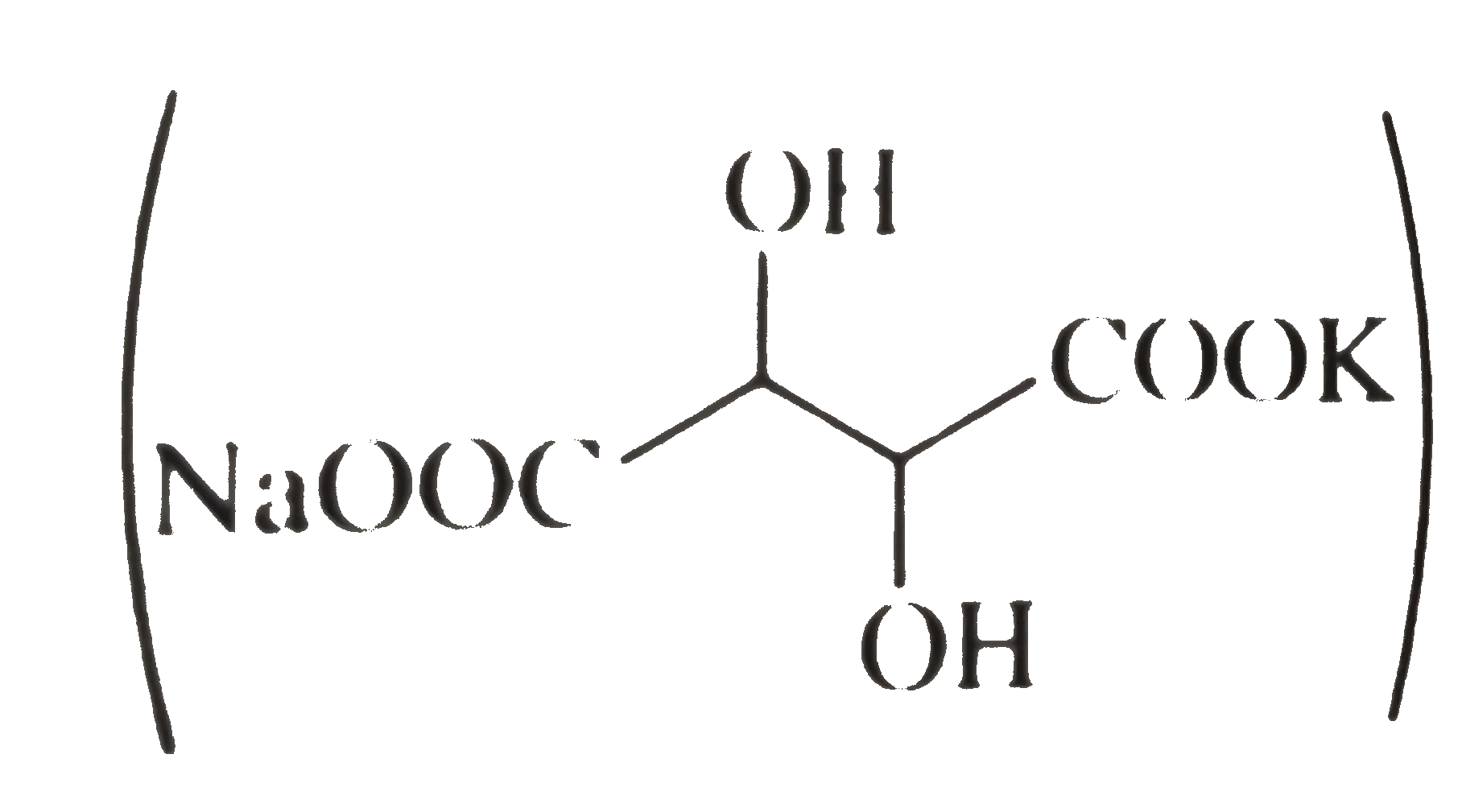
Assertion `(A)` : Rochelle's salt is used as a complexing agent in Tollens reagent.
Reason `(R )`. Sodium potassium salt of tartaric acid is known as Rochelle's salt. The `IUPAC` name of Rochelle's salt is sodium potassium-2,3-dihydroxy butance-1,4- diote.

A

If both `(A)` and `(R )` are correct and `(R )` is the correct explanation for `(A)`.

B

If both `(A)` and `(R )` are correct and `(R )` is not the correct explanation.

C

If `(A)` is correct and `(R )` is incorrect.

D

If both `(A)` and `(R )` are incorrect.

Text Solution

Verified by Experts

The correct Answer is:

D
Promotional Banner

Topper's Solved these Questions

  • CLASSIFICATION AND NOMENCLATURE OF ORGANIC COMPOUNDS

    CENGAGE CHEMISTRY ENGLISH|Exercise Fill in the Blanks Type|5 Videos
  • CLASSIFICATION AND NOMENCLATURE OF ORGANIC COMPOUNDS

    CENGAGE CHEMISTRY ENGLISH|Exercise Analytical and Descriptive Type|3 Videos
  • CLASSIFICATION AND NOMENCLATURE OF ORGANIC COMPOUNDS

    CENGAGE CHEMISTRY ENGLISH|Exercise Single correct Answer Type|44 Videos
  • CHEMICAL EQUILIBRIUM

    CENGAGE CHEMISTRY ENGLISH|Exercise Subjective type|1 Videos
  • GENERAL ORGANIC CHEMISTRY

    CENGAGE CHEMISTRY ENGLISH|Exercise Analytical and Descriptive|1 Videos

Similar Questions

Explore conceptually related problems

Soaps are sodium or potassium salt of long chain fatty acids like

Which of the following alkanes cannot be produced by Kolbe's electrolysis of sodium or potassium salts of carboxylic acids ?

Why is only molten salt used for the electrolysis of a very active metal like sodium or potassium ?

Assertion (A): Na_(2)CO_(3) and Li_(2)CO_(3) are thermally stable. Reason (R ): Both the carbonates are salts of large cations and large anions.

Assertion (A): Na_(2)S_(2)O_(3) is a salt of unstable acid. Reason (R) : H_(2)S_(2)O_(3) is a polyprotic acid.

Assertion (A): BaCO_(3) is more soluble in HNO_(3) than in water. Reason (R ): Carbonate is a weak base and reacts with H^(o+) ions to form strong acid causing barium salt to dissociate.

The ionization constant of chloroacetic acid is 1.35xx10^(-3) . What will be the pH of 0.1 M acid and its 0.1M sodium salt solution?

Assertion : Mixture of CH_(3)COOH and CH_(3)COONH_(4) is an example of acidic buffer. Reason : Acidic buffer contains equimolar mixture of weak acid and its salt with weak base.

A mixture of two salt was treated as follows : i. The mixture was heated with magnanese dioxide and concentrated sulphuric acid , when a yellowish -green gas was liberated. ii. The mixture on heating with sodium hydroxide solution gave a gas which turned red litmus blue iii. Its solution in water gave a blue precipitate with potassium ferricyanide and red colourtion with ammonium thiocynate iv. The mixture was boiled with potassium hydroxide and the librated gas was bubbled through an alkline solution of K_(2)HgI_(4) to give a brown precipitate identify the two salts gives ionic equation for the reaction involved in the tests (i) , (ii) and (iii).

In permanganate titrations, potassium pemanganats is used an an oxidizing agent in acidic medium. The medium is maintained acidic by the use of dilute sulphuric acid. Potassium permanganate acts as self indicator . The potential equation, when potassium permanganate acts as an oxidizing agent is 2KMnO_(4) + 3H_(2)SO_(4) to K_(2)SO_(4) + 2MnSO_(4) + 3H_(2)O + 5[O] or MnO_(4)^(-) + 8H^(+) + 5e^(-) to Mn^(2+) + 4H_(2)O Before the end point, the solution remains colourless but after teh equivalence point only one extra drop of KMnO_(4) solution imparts pink colour , i.e. appearance of pink colour indicates end point. These titrations are used for estimation of ferrous salts, oxalic acid, oxalates, hydrogen peroxide, As_(2)O_(3) etc. Mass of KHC_(2)O_(4) (potassium acid oxalate ) required to reduce 100 ml of 0.02 KMnO_(4) in acidic medium (MnO_(4)^(-)" changes to " Mn^(2+)) is x gm and to neutralize 100 ml of 0.05M Ca(OH)_(2) is y gm ,then
