Home
Class 11
CHEMISTRY
Arrange in decreasing order as directed....

Arrange in decreasing order as directed.
(a) Decreasing order of `EN: C, O, N,F`

Text Solution

Verified by Experts
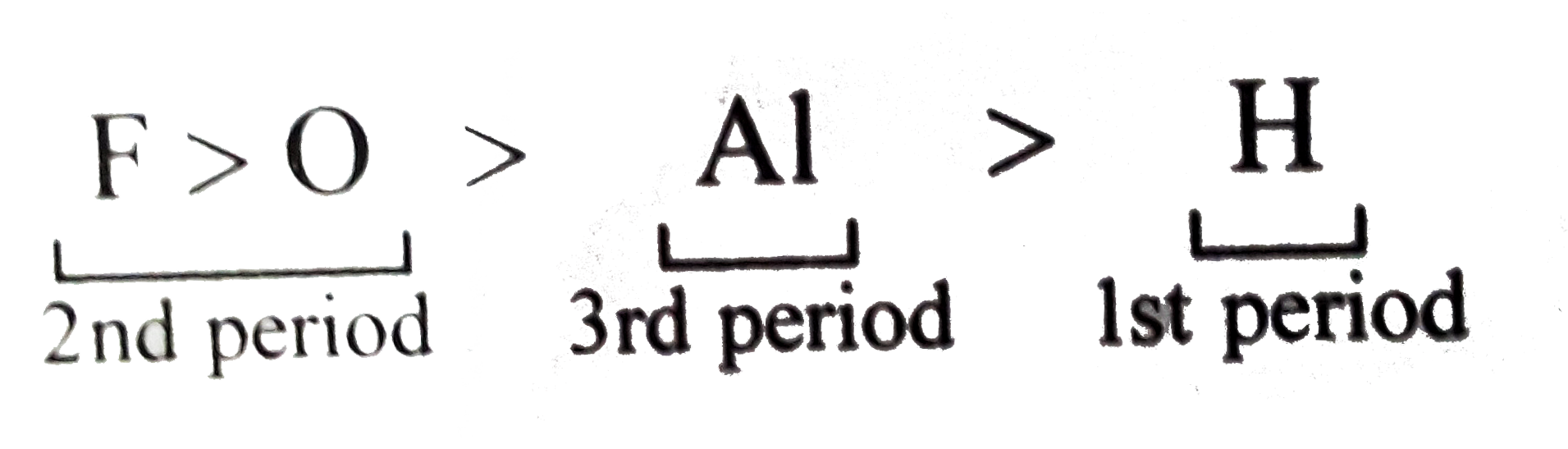

[`EN` increase along the period, `:. EN` of `F gt O`]
Aluminium `(Al)` belongs to `3rd` period. [ `EN` decreases down the group `(darr)`]

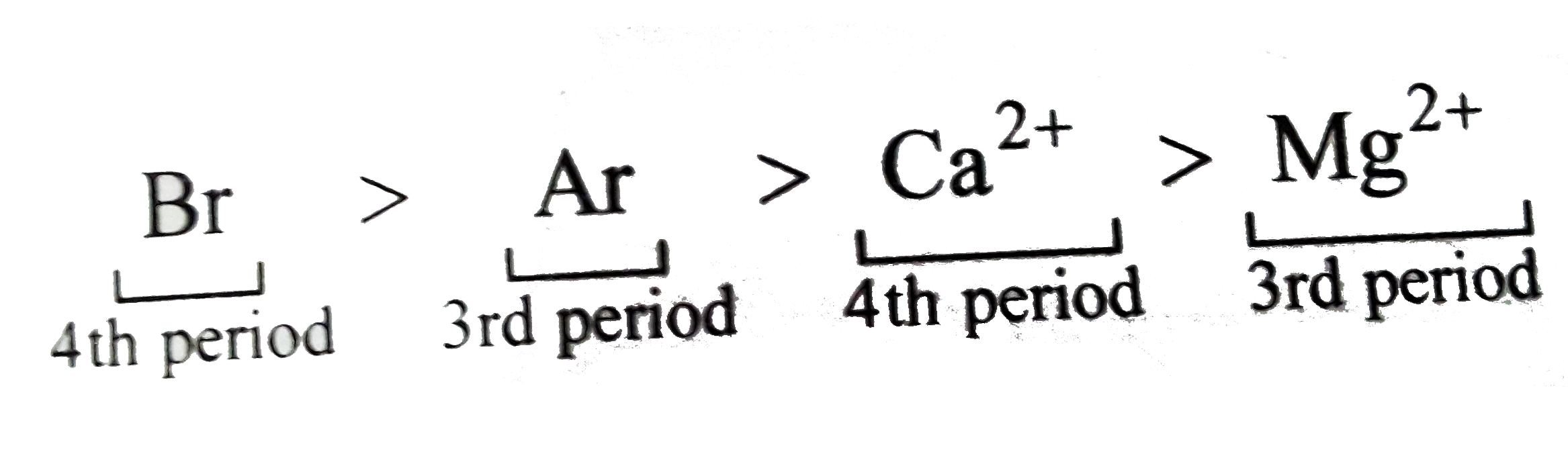
Althogh size of an atom decreases along the period `(darr)` but in a period, size of nolbe gas in highest. `Ar` belongs to `3 rd` period whereas `Br` belongs to `4 th` period.
`:.` Size of `Br gt` Size of `Ar`
Similarly, although both `Ca^(2+)` and `Mg^(2+)` ions have same charge, but `Ca` belongs to `4 th` period and `Mg` belongs to `3rd` period.
`:.` Size of `Ca^(2+) gt` size of `Mg^(2+)`
c. `EA:Cl gt F gt O gt C gt N gt Be`
Among halogens decreasing order of `EA` or `Delta_(Ag)H^(ɵ)=Cl gt F gt I`
Generally `EA` increase along the period `(rarr)`
Therefore, order of `EA` should be `O gt N gt C`
But there is exception in the `EA` of `N` and `C`, Since `N` has half-filled stable configuration, so it is difficult to add electron to `N` as compared to `C`.
`:. EA` of `C gt N`
Among `Be, C,N,O` and `F` (all of them belong to `2 nd` period) `EA` of `Be` is the least. Hence the order is as given above.
d. ` IE gt Cl gt Br gt I [{:("Generally" IE"decreases"),("down the group""("darr")"):}]`
`EA:Cl gtF gt Br gtI [{:("Exception in case"),("of" Cl gt F):}]`
e. EN:

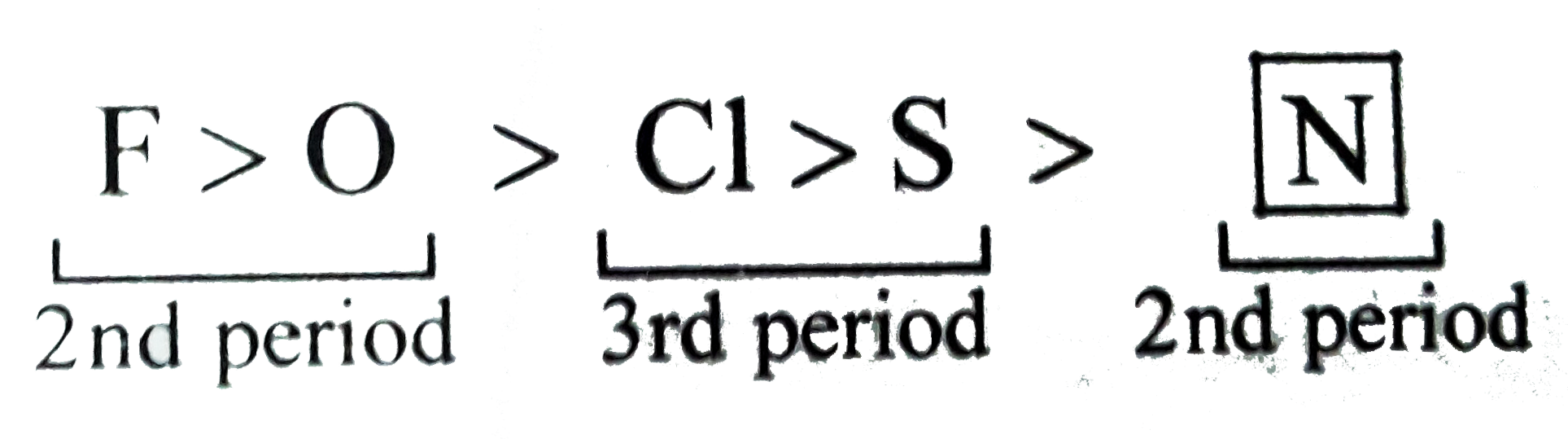
Generally `EN` increases along the same period `(rarr)`.
Therefore , `EN` of `2 nd` period `gt EN` of `3 rd` period. But `EN` of `N` ( 2nd period) is the least, and is an exception due to half-filled stable configuration.

`IE` increases along the same period `(rarr)` and `IE` of noble gas `(Ne)` is the highest.
`IE` of alkali metal `(Na)` is less as compared to `Na^(o+)` ion, since it is very difficult to remove an electron from a positve ion.
Generally, `IE` decreases down the group `(darr)`. so `IE` of `O gt Na`.
Hence the order is as given above.
g. Electropositive character: `Na gt Zn gt Cu`
Group `1` is more metallic ( or electropositive character) than group `2`. So, `Na` is most metallic than `Zn` and `Cu`. Similarly, `d`-block elements have more electropositive character than `p`-block elements.
Hence the electropositve character is as given below.
Note: In the metallic character series, the electropositve character (or reducing character is in the order)
`Na gt Mg gtZn gtFe gtNi gt Cu gt Ag`
Note that in metallic character series, PSBC MAZINTL CHAAP. `Zn` comes after `s`-block elements.
Promotional Banner

Topper's Solved these Questions

  • PERIODIC CLASSIFICATION OF ELEMENTS AND GENERAL INORGANIC CHEMISTRY

    CENGAGE CHEMISTRY ENGLISH|Exercise Ex 1.1|14 Videos
  • PERIODIC CLASSIFICATION OF ELEMENTS AND GENERAL INORGANIC CHEMISTRY

    CENGAGE CHEMISTRY ENGLISH|Exercise Ex 1.1 (Very Short)|22 Videos
  • PERIODIC CLASSIFICATION OF ELEMENTS AND GENERAL INORGANIC CHEMISTRY

    CENGAGE CHEMISTRY ENGLISH|Exercise Exercises (Archives )Subjective|4 Videos
  • P-BLOCK GROUP 14 - CARBON FAMILY

    CENGAGE CHEMISTRY ENGLISH|Exercise Exercises Archives (Subjective)|9 Videos
  • PURIFICATION OF ORGANIC COMPOUNDS AND QUALITATIVE AND QUANTITATIVE ANALYSIS

    CENGAGE CHEMISTRY ENGLISH|Exercise Assertion Reasoning Type|5 Videos

Similar Questions

Explore conceptually related problems

Arrange in decreasing order of reactivity with HCl :

Arrange marked atom in decreasing order of acidic strength

Arrange the following in decreasing order of acidity

Arrange the following in decreasing order of acidic nature of

Arrange F,Cl,O,N in the decreasing order of electronegativy

Arrange the following in decreasing order of their K_(a) value :

Arrange the follwing amines in the decreasing order of basicity :

CENGAGE CHEMISTRY ENGLISH-PERIODIC CLASSIFICATION OF ELEMENTS AND GENERAL INORGANIC CHEMISTRY-Solved Examples
  1. Identify the three elements A, B and C from the data given below a. ...

    Text Solution

    |

  2. Among the elements, Ar, Si, Na and Cl. Select an elements with a. Hi...

    Text Solution

    |

  3. Arrange in decreasing order as directed. (a) Decreasing order of EN:...

    Text Solution

    |

  4. Predict from each set, the atom/ion which has the greatest IE(1) with ...

    Text Solution

    |

  5. The Delta(eg)H^(ɵ) of Br is 3.4 eV. How much energy in kcal is release...

    Text Solution

    |

  6. Predict from each set, the element which has the more negative electro...

    Text Solution

    |

  7. The electronegativity of caesium is 0.7 and that of fluorine is 4.0 . ...

    Text Solution

    |

  8. Among the elements with Z = 9, 12 and 36, identify by atomic number of...

    Text Solution

    |

  9. Explain the question (based on ionisation energy): (a) Why IE(1) of ...

    Text Solution

    |

  10. Answer the following question (Based on EA, Delta(eg)H^(ɵ) and IE). I...

    Text Solution

    |

  11. a. Arrange the following species in decreasing order of their sizes//i...

    Text Solution

    |

  12. For the gaseous reaction K+F rarrK^(o+)+F^(ɵ) Delta H = 19 kcal mo...

    Text Solution

    |

  13. For the gaseous reaction K+F rarrK^(o+)+F^(ɵ) Delta H = 19 kcal mo...

    Text Solution

    |

  14. From N atoms of an element A, when half the atoms transfer one electro...

    Text Solution

    |

  15. The conservation of gaseous atoms K and F to K^(o+) and F^(ɵ) absorbs ...

    Text Solution

    |

  16. Which of the following Na, Mg, Si and P would have the greatest differ...

    Text Solution

    |

  17. Classify the following oxides as a. Strongly acidic b. Weakly acidic...

    Text Solution

    |

  18. Select the strongest and weakest acid in each of the following sets: ...

    Text Solution

    |

  19. A 0.10 M aqueous solution of which salt in the following pair would ha...

    Text Solution

    |

  20. Identify: a. The good oxidising agent b. The good reducing agent ...

    Text Solution

    |