Home
Class 11
CHEMISTRY
(a) In each of the following parts selec...

(a) In each of the following parts select the species having the greater resonance stabilisation
`H_(2)C =Oand underset(O^(Theta))underset(|)HC=O`
(ii) `HNO_(3)` and `NO_(3)^(Theta)`
(b) Draw all possible octet structural formulas for `N_(3)^(Theta)` Which ones are possible resonance forms ? .

Text Solution

Verified by Experts
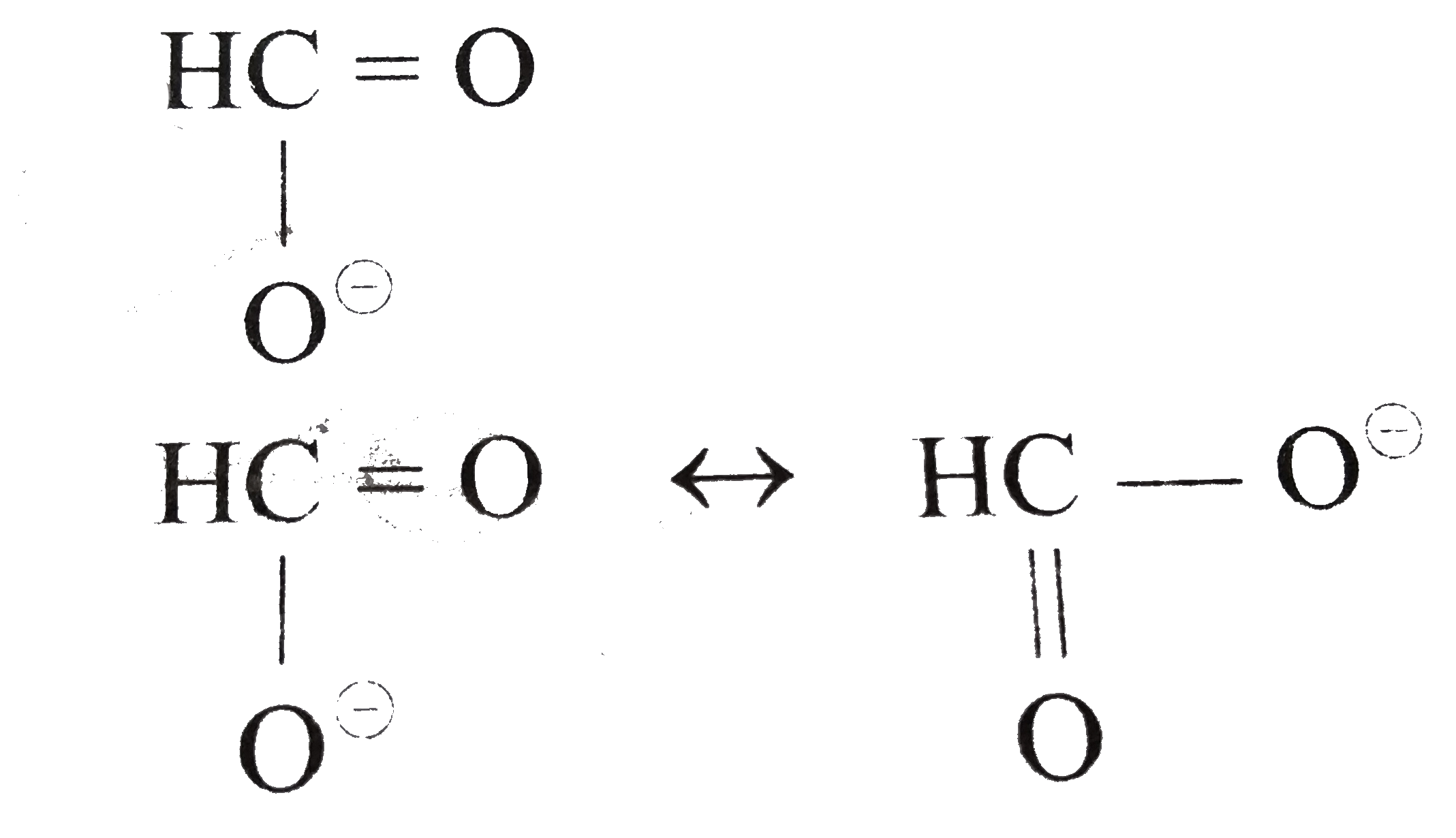
` underset(O^(Theta))underset(|)HC=O` has two equal resonance forms, as shown
`H_(2)C=O` does not have other resonance forms as low in energy
(ii) `NO_(3)^(Theta)` has three equal energey resonance forms `HNO_(3)` has only two, since the O-atom bonded to the H-atom is not equivalent to the others
(b) The possible linear structures are shown as In Two resonance structures (II) and (III) one of e terminal N-atom in an isolated `N_(3)^(Θ)` ion should be different from the other The structure (IV) although satisfies octel rule is ruled out as a reasonace form because the atoms are in different positions. Moreover, The structure (IV) has considerable strain
.
Promotional Banner

Topper's Solved these Questions

  • CHEMICAL BONDING AND MOLECULAR STRUCTURE

    CENGAGE CHEMISTRY ENGLISH|Exercise Ex 2 .2 Subjective (Intermolecular Forces And H-Bonding)|7 Videos
  • CHEMICAL BONDING AND MOLECULAR STRUCTURE

    CENGAGE CHEMISTRY ENGLISH|Exercise Ex 2 .2 Subjective (Molecular Orbital Theory)|4 Videos
  • CHEMICAL BONDING AND MOLECULAR STRUCTURE

    CENGAGE CHEMISTRY ENGLISH|Exercise Archives Subjective|15 Videos
  • ATOMIC STRUCTURE

    CENGAGE CHEMISTRY ENGLISH|Exercise Concept Applicationexercise(4.3)|19 Videos
  • CHEMICAL EQUILIBRIUM

    CENGAGE CHEMISTRY ENGLISH|Exercise Subjective type|1 Videos

Similar Questions

Explore conceptually related problems

Draw all the possible resonating structures for azide ion (N_(3)^(-)ion). Which our of these are actually feasible ?

overset(Theta)overset(..)CH_(2)-underset(O)underset(||)C-CH_(3) and CH_(2)=underset( :underset(..)O:_(Theta))underset(|)C-CH_(3) are :

The following conversion is/are possible by Ph-CH_(2)-CH=O to overset("(Phenyl alanine)")(Ph-CH_(3)-underset(NH_(3))underset(|)(C)H-COOH)

Correct order for N-O bond length in the given species is underset(I)(NO) underset(II) (NO^(+)) underset(III)(NO_(2)^(-)) underset(IV)(NO_(3)^(-))

Arrange the following in order of their leaving group tendency ? underset((I))(Br)^(-) , H_(3)C-underset((II))overset(O)overset(||)C-(O)^(-) , CH_(3)CH_(2)O^(-) , Ph-O^(-)

Write the possible functional isomers having the formula C_3 H_6 O_2

Draw the possible resonance for CH_(3)- underset(..)overset(..)(O)-overset(+)(C)H_(2) and predict which of the structures is more stable. Give reason for your answer.

Identify A-D in the following reactions . (1) A+B underset(Delta)overset("dil"NaOH) to C+H_(2)O (2) C overset("dil"NaOH) underset((ii) Zn//H_(2)O) to D+A (3)

Which of the two structures (A) and (B) given below is more stabilised by resonance. Explain underset((A))(CH_(3)COOH) " and " underset((B))(CH_(3)COoverset(Θ)(O))

Predict the product from claisen condensation of the following pair of esters. Ph-CH_(2)-underset(O)underset(||)(C)-OCH_(3)+Ph-underset(O)underset(||)(C)-OCH_(3)overset(EtO^(Theta))to

CENGAGE CHEMISTRY ENGLISH-CHEMICAL BONDING AND MOLECULAR STRUCTURE-Solved Examples
  1. Write electron dot and line structure for (a) SeO(3)^(2-) ,(b) Li(3)...

    Text Solution

    |

  2. By completing the following structures, adding unshared e^(-) pairs wh...

    Text Solution

    |

  3. (a) In each of the following parts select the species having the great...

    Text Solution

    |

  4. Arrange in decreasing polarity of bonds SbH(3),AsH(3),PH(3),NH(3)

    Text Solution

    |

  5. The dipole moment of HBr is 2.60 xx 10^(-30)Cm and the interatomic spa...

    Text Solution

    |

  6. The single and multiple bond radii of some elements given in the follo...

    Text Solution

    |

  7. Arrange C-C,C=C and C-=C in order of (i) Decreasing bond dissociatio...

    Text Solution

    |

  8. The Pt-Cl distance is 2.32 A in several crystalline compounds What i...

    Text Solution

    |

  9. The averge (C C) bond energy is 343 kJ mo1^(-1). What do you predict f...

    Text Solution

    |

  10. What is the hybridisation state of each C-atom in the following molecu...

    Text Solution

    |

  11. How many sigma and pi bonds are present in a benzene molecule ? .

    Text Solution

    |

  12. (a) What is the number of molecular orbitals obtained by mixing of two...

    Text Solution

    |

  13. Compare and contrast the concepts of hybrid orbitals and molecular orb...

    Text Solution

    |

  14. Which of the following molecules has the highest IE (i) Ne (ii) F

    Text Solution

    |

  15. Select the species with the largest IE in each (i )Na,K,Rb (ii) F,Ne

    Text Solution

    |

  16. Select from following gropus, the one which has the largest radius Li,...

    Text Solution

    |

  17. Distinguish using the property mentioned in brackets (e) NF(3),NH(3) ...

    Text Solution

    |

  18. Which of the following alkali metal chlorides is expected to have the ...

    Text Solution

    |

  19. Explain Why H(2)O is liquid while H(2)S is gas

    Text Solution

    |

  20. How do you account for the difference in melting points between (a) an...

    Text Solution

    |

