Home
Class 11
CHEMISTRY
(a)The CI-O bond distance in CIO(4)^(Θ) ...

(a)The `CI-O` bond distance in `CIO_(4)^(Θ)` is 144pm What do you conclude about the structure of this ion ?
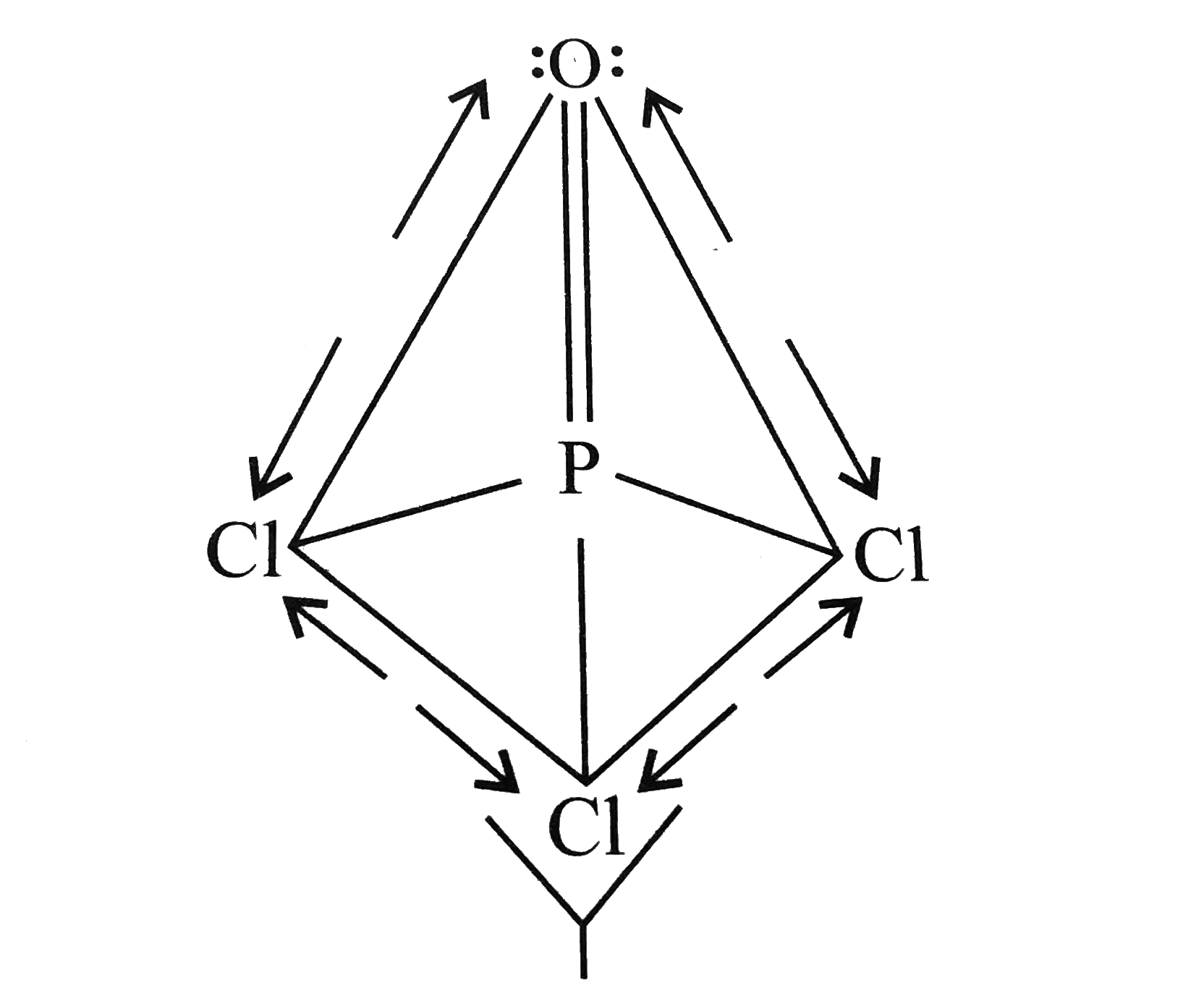
(b) The `POCI_(3)` molecule has the shape of an irregular tetrahedron with the `P` atom located centrally The `CI-P-CI` angle is found to be `1035^(@)` Give a qualitative explanation for the deviation of this structure from a regular tetrahedron .

Text Solution

Verified by Experts
There must be considerable double bond character in the bonds
(b) The Lewis structure for `POCI_(3)` would show some double bond character between `P` and `O` (`P` is allowed to exceed the octet because of the availabbility of 3d orbitals)
The increased `e^(-)` density in the `P=O` bond would make the intrinsic repulsion between the `P=O` bond and a `P-CI` bond greater than between two `(P-CI)` bonds Thus the `CI-P-CI` angle is lowered and the `CI-P=O` angle is raised as compared to regular tetrahedron
.
Promotional Banner

Topper's Solved these Questions

  • CHEMICAL BONDING AND MOLECULAR STRUCTURE

    CENGAGE CHEMISTRY ENGLISH|Exercise Ex 2 .2 Subjective (Intermolecular Forces And H-Bonding)|7 Videos
  • CHEMICAL BONDING AND MOLECULAR STRUCTURE

    CENGAGE CHEMISTRY ENGLISH|Exercise Ex 2 .2 Subjective (Molecular Orbital Theory)|4 Videos
  • CHEMICAL BONDING AND MOLECULAR STRUCTURE

    CENGAGE CHEMISTRY ENGLISH|Exercise Archives Subjective|15 Videos
  • ATOMIC STRUCTURE

    CENGAGE CHEMISTRY ENGLISH|Exercise Concept Applicationexercise(4.3)|19 Videos
  • CHEMICAL EQUILIBRIUM

    CENGAGE CHEMISTRY ENGLISH|Exercise Subjective type|1 Videos

Similar Questions

Explore conceptually related problems

coordination compounds often show various types of isomerism. The isomerism can be categorized in two main types (a) structural isomerism (b) stereo or space isomerism Structural isomerism arises due to the difference in structures of coordination-sempounds while stereo or space isomerism arises on account of the different positions and arrangements of ligands (atoms or groups) in space around the metal lonStructural isomerism can be classified in following types (i) tonization isomers- which give different ions in solution, e.g. [CoBr(NH_(3))_(5)]]SO_(4) and [Co(SO_(4))_(5)(NH_(3))_(5)]Br Hydrate isomers which differ in H_(2)O as ligand or as hydration, e.g. [Cr(H_(2)O)_(5)]CI_(2)(H_(2)O)]Cl_(2).H_(2)O[CrCl_(2)(H_(2)O)]CI.2H_(2)O (iii) Linkage isomers, which differ in atom linked to 'metal atom, e.g. [CO(NO_(2))(NH_(3))_(5)]^(2+) and CO(ONO)(NH_(3))_(6)]^(2+) Coordination isomers- which involve interchange of ligands, e.g. [Co(NH_(3))_(6)] [Cr(CN)_(6)] and [Cr(NH_(3))_(6)] [Co(CN)_(6)] (v) Coordination position isomerism-which arises in the bridged complexes due to the difference in the attachment of ligands with the metal atoms QThe compounds [Cr(H_(2)O_(6)]Cl_(3)[Cr(H_(2)O)_(5)CI]Cl_(2).H_(2)O and [Cr(H_(2)O)_(4)Cl_(2)]Cl2H_(2)O exhibit

coordination compounds often show various types of isomerism. The isomerism can be categorized in two main types (a) structural isomerism (b) stereo or space isomerism Structural isomerism arises due to the difference in structures of coordination-sempounds while stereo or space isomerism arises on account of the different positions and arrangements of ligands (atoms or groups) in space around the metal lonStructural isomerism can be classified in following types (i) tonization isomers- which give different ions in solution, e.g. [CoBr(NH_(3))_(5)]]SO_(4) and [Co(SO_(4))_(5)(NH_(3))_(5)]Br Hydrate isomers which differ in H_(2)O as ligand or as hydration, e.g. [Cr(H_(2)O)_(5)]CI_(2)(H_(2)O)]Cl_(2).H_(2)O[CrCl_(2)(H_(2)O)]CI.2H_(2)O (iii) Linkage isomers, which differ in atom linked to 'metal atom, e.g. [CO(NO_(2))(NH_(3))_(5)]^(2+) and CO(ONO)(NH_(3))_(6)]^(2+) Coordination isomers- which involve interchange of ligands, e.g. [Co(NH_(3))_(6)] [Cr(CN)_(6)] and [Cr(NH_(3))_(6)] [Co(CN)_(6)] (v) Coordination position isomerism-which arises in the bridged complexes due to the difference in the attachment of ligands with the metal atoms QThe pair [CO(NH_(3))_(5)NO_(3)]SO_(4) and [CO(NH_(3))SO_(4)]NO_(3) will exhibit

coordination compounds often show various types of isomerism. The isomerism can be categorized in two main types (a) structural isomerism (b) stereo or space isomerism Structural isomerism arises due to the difference in structures of coordination-sempounds while stereo or space isomerism arises on account of the different positions and arrangements of ligands (atoms or groups) in space around the metal lonStructural isomerism can be classified in following types (i) tonization isomers- which give different ions in solution, e.g. [CoBr(NH_(3))_(5)]]SO_(4) and [Co(SO_(4))_(5)(NH_(3))_(5)]Br Hydrate isomers which differ in H_(2)O as ligand or as hydration, e.g. [Cr(H_(2)O)_(5)]CI_(2)(H_(2)O)]Cl_(2).H_(2)O[CrCl_(2)(H_(2)O)]CI.2H_(2)O (iii) Linkage isomers, which differ in atom linked to 'metal atom, e.g. [CO(NO_(2))(NH_(3))_(5)]^(2+) and CO(ONO)(NH_(3))_(6)]^(2+) Coordination isomers- which involve interchange of ligands, e.g. [Co(NH_(3))_(6)] [Cr(CN)_(6)] and [Cr(NH_(3))_(6)] [Co(CN)_(6)] (v) Coordination position isomerism-which arises in the bridged complexes due to the difference in the attachment of ligands with the metal atoms QThe total number of possible isomers for the complex compound [Cu^(ll)(NH_(3))_(4)] [Pt^(ll)Cl_(4) ]are

coordination compounds often show various types of isomerism. The isomerism can be categorized in two main types (a) structural isomerism (b) stereo or space isomerism Structural isomerism arises due to the difference in structures of coordination-sempounds while stereo or space isomerism arises on account of the different positions and arrangements of ligands (atoms or groups) in space around the metal lonStructural isomerism can be classified in following types (i) tonization isomers- which give different ions in solution, e.g. [CoBr(NH_(3))_(5)]]SO_(4) and [Co(SO_(4))_(5)(NH_(3))_(5)]Br Hydrate isomers which differ in H_(2)O as ligand or as hydration, e.g. [Cr(H_(2)O)_(5)]CI_(2)(H_(2)O)]Cl_(2).H_(2)O[CrCl_(2)(H_(2)O)]CI.2H_(2)O (iii) Linkage isomers, which differ in atom linked to 'metal atom, e.g. [CO(NO_(2))(NH_(3))_(5)]^(2+) and CO(ONO)(NH_(3))_(6)]^(2+) Coordination isomers- which involve interchange of ligands, e.g. [Co(NH_(3))_(6)] [Cr(CN)_(6)] and [Cr(NH_(3))_(6)] [Co(CN)_(6)] (v) Coordination position isomerism-which arises in the bridged complexes due to the difference in the attachment of ligands with the metal atoms Qcoordinate isomerism 33. How many hydrate isomers are possible with the formulae CrCl_(3).6H_(2)O

coordination compounds often show various types of isomerism. The isomerism can be categorized in two main types (a) structural isomerism (b) stereo or space isomerism Structural isomerism arises due to the difference in structures of coordination-sempounds while stereo or space isomerism arises on account of the different positions and arrangements of ligands (atoms or groups) in space around the metal lonStructural isomerism can be classified in following types (i) tonization isomers- which give different ions in solution, e.g. [CoBr(NH_(3))_(5)]]SO_(4) and [Co(SO_(4))_(5)(NH_(3))_(5)]Br Hydrate isomers which differ in H_(2)O as ligand or as hydration, e.g. [Cr(H_(2)O)_(5)]CI_(2)(H_(2)O)]Cl_(2).H_(2)O[CrCl_(2)(H_(2)O)]CI.2H_(2)O (iii) Linkage isomers, which differ in atom linked to 'metal atom, e.g. [CO(NO_(2))(NH_(3))_(5)]^(2+) and CO(ONO)(NH_(3))_(6)]^(2+) Coordination isomers- which involve interchange of ligands, e.g. [Co(NH_(3))_(6)] [Cr(CN)_(6)] and [Cr(NH_(3))_(6)] [Co(CN)_(6)] (v) Coordination position isomerism-which arises in the bridged complexes due to the difference in the attachment of ligands with the metal atoms Q Which of the following coordination compounds, exhibits ionization isomerism

Give the correct order of initials T or F for following statements. Use T if statement is true and F if it is falese : (I) The order of repulsion between different pair of electron is I_(p)-I_(p)gtI_(p)-b_(p)gtb_(p)-b_(p) (II) In general, as the number o flone pair of electron on central atom increases, value of bond angle from normal bond angle also increases (III) The number of lone pair on O in H_(2)O is 2 while on N in NH_(3) is 1 (IV) The structures of xenon fluorides and xenon oxyfluorides could not be explained on the basis of VSEPR theory

Give the correct order of initials T or F for following statements. Use T if statement is true and F if it is falese : (I) The order of repulsion between different pair of electron is I_(p)-I_(p)gtI_(p)-b_(p)gtb_(p)-b_(p) (II) In general, as the number o flone pair of electron on central atom increases, value of bond angle from normal bond angle also increases (III) The number of lone pair on O in H_(2)O is 2 while on N in NH_(3) is 1 (IV) The structures of xenon fluorides and xenon oxyfluorides could not be explained on the basis of VSEPR theory

CENGAGE CHEMISTRY ENGLISH-CHEMICAL BONDING AND MOLECULAR STRUCTURE-Solved Examples
  1. Which of the following molecules has the highest IE (i) Ne (ii) F

    Text Solution

    |

  2. Select the species with the largest IE in each (i )Na,K,Rb (ii) F,Ne

    Text Solution

    |

  3. Select from following gropus, the one which has the largest radius Li,...

    Text Solution

    |

  4. Distinguish using the property mentioned in brackets (e) NF(3),NH(3) ...

    Text Solution

    |

  5. Which of the following alkali metal chlorides is expected to have the ...

    Text Solution

    |

  6. Explain Why H(2)O is liquid while H(2)S is gas

    Text Solution

    |

  7. How do you account for the difference in melting points between (a) an...

    Text Solution

    |

  8. A plant virus was found to consist of uniform cylindrical particles 10...

    Text Solution

    |

  9. Calculate the I-I distance in each of the isomeric compounds C(2)H(2)I...

    Text Solution

    |

  10. Calculate the I-I distance in each of the three isomeric diiodobenzene...

    Text Solution

    |

  11. Enthalpic of hydrogenation of ethene (C(2)H(4)) and benzene (C(6)H(6))...

    Text Solution

    |

  12. Select the species which is best described CI,Ar,K (has the smallest...

    Text Solution

    |

  13. (a)The CI-O bond distance in CIO(4)^(Θ) is 144pm What do you conclude ...

    Text Solution

    |

  14. Draw all geometrical isomers of PBr(2)Cl(3) molecule State which iso...

    Text Solution

    |

  15. Write structures and describe the geometry of the following molecules ...

    Text Solution

    |

  16. Reduce the hybridisation, geometry and shape of the following (i)Br(...

    Text Solution

    |

  17. State the bond order and indicate whether the species is paramagnetic ...

    Text Solution

    |

  18. If the internuclear axis in the diatomic molecule AB is designated as ...

    Text Solution

    |

  19. Make a table giving (i) number of orbitals with a given energy (ii) ma...

    Text Solution

    |

  20. When 2s orbital overlaps with 2p(x) or 2p(y) orbital (assuming Z -axis...

    Text Solution

    |

