Home
Class 11
CHEMISTRY
If the internuclear axis in the diatomic...

If the internuclear axis in the diatomic molecule `AB` is designated as the z-axis what are the varoius pairs of s,p or d atomic orbitals that can be combined to from (a) `pi_(x)` and (b) `pi_(y)` orbitals ? .

Text Solution

Verified by Experts
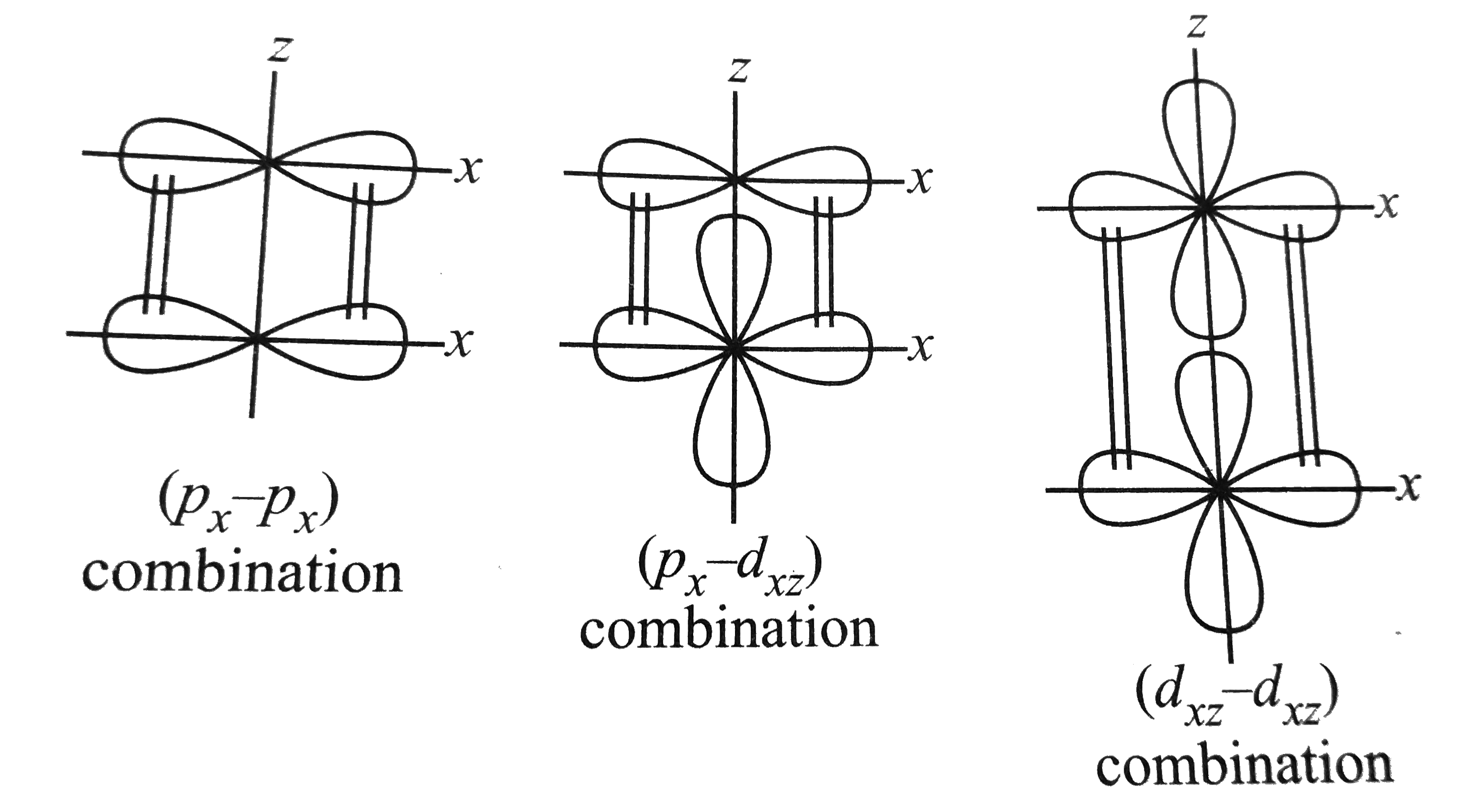
(a) `(p_(x),p_(x)),(p_(x),d_(xz)),(d_(xz),d_(xz))`
(b) `(p_(y),p_(y)),(p_(y),d_(yz)),(d_(yz,d_(yz)))`
The figures below indicate the combination in xz-projection
.
Promotional Banner

Topper's Solved these Questions

  • CHEMICAL BONDING AND MOLECULAR STRUCTURE

    CENGAGE CHEMISTRY ENGLISH|Exercise Ex 2 .2 Subjective (Intermolecular Forces And H-Bonding)|7 Videos
  • CHEMICAL BONDING AND MOLECULAR STRUCTURE

    CENGAGE CHEMISTRY ENGLISH|Exercise Ex 2 .2 Subjective (Molecular Orbital Theory)|4 Videos
  • CHEMICAL BONDING AND MOLECULAR STRUCTURE

    CENGAGE CHEMISTRY ENGLISH|Exercise Archives Subjective|15 Videos
  • ATOMIC STRUCTURE

    CENGAGE CHEMISTRY ENGLISH|Exercise Concept Applicationexercise(4.3)|19 Videos
  • CHEMICAL EQUILIBRIUM

    CENGAGE CHEMISTRY ENGLISH|Exercise Subjective type|1 Videos

Similar Questions

Explore conceptually related problems

How do p_(x),p_(y) and p_(z) atomic orbitals differ ?

If Z-axis is the internuclear axis, which of the following combinations are not permissible? 2p_x - 2p_y

If Z-axis is the internuclear axis, which of the following combinations are not permissible? 2s- 2P_x

If Z-axis is the internuclear axis, which of the following combinations are not permissible? 1s - 2p_z

If Z-axis is the internuclear axis, which of the following combinations are not permissible? 2p_x -2p_x

Molecular orbitals are formed by the overlap of atomic orbitals. Two atomic orbitals combine atom from two molecular orbitals called vonding molecular orbital (BOM) and anti bonding molecular orbital (ABMO). Energy of anti bonding orbital is raised above the parent atomic orbitals that have combined and the energy of the bonding orbital is lowered than the parent atomic orbitals. Energies of various molecular orbitals for elements hydrogen to nitrogne increase in the order : sigma_(1s)ltsigma_(1s)^(**)ltsigma_(2s)ltsigma_(2s)^(**)lt(pi_(2py)~~pi_(2py))lt sigma_(2py)lt(pi_(2py)^(**)~~pi_(2py)^(**))ltsigma_(2pz)^(**) and for ozygen and fluorine order of energy of molecular orbitals id given below : sigma_(1s)ltsigma_(1s)^(**)ltsigma_(2s)ltsigma_(2s)^(**)ltsigma_(2pz)lt(pi _(2px)^(**)~~pi_(2py)^(**))sigma_(2pz)^(**) Different atomic orbitals of one atom combine wiht the atomic orbitals of the second atom whihc have comparable energies and proper orientation. Further, if the overlapping is head on, the molecular orbital is called 'Sigma' (sigma) and if the overlap is atreal, the molecular orbital is called 'pi', (pi). The molecular orbitals are filled with electrons according to the same rules as followed for filling of atomic orbitals. However, the order for filling is not the same for all molecules or their ions, Bond order is one the most ipmrtaint parameters to compare the strength of bonds. Which of the following pair is expected to have the same bond order ?

Comprehension given below is followed by some multiple choice question, Each question has one correct options. Choose the correct option. Molecular orbitals are formed by the overlap of atomic orbitals. Two atomic orbitals combine to form two molecular orbitals called bonding molecular orbital (BMO) and anti-bonding molecular orbital (ABMO). Energy of anti-bonding orbital is raised above the parent atomic orbitals that have combined and hte energy of the bonding orbital is lowered than the parent atomic orbitals. energies of various molecular orbitals for elements hydrogen to nitrogen increase in the order sigma1s lt sigma^(star)1sltsigma^(star)2slt((pi2p_(x))=(pi2p_(y)))ltsigma2p_(z)lt(pi^(star)2p_(x) = pi^(star)2p_(y))ltsigma^(star)2p_(z) and For oxygen and fluorine order of enregy of molecules orbitals is given below. sigma1s lt sigma^(star)1s lt sigma2s lt sigma^(star)2s lt sigmap_(z) lt (pi2p_(x) ~~ pi2p_(y)) lt (pi^(star)2p_(x)~~ pi^(star)2py) lt sigma^(star)2p_(z) Different atomic orbitalsof one atom combine with those atoms orbitals of the second atom which have comparable energies and proper orientation. Further, if the overlapping is head on, the molecular orbital is called sigma, sigma andif the overlap is lateral, the molecular orbital is called pi, pi . The molecular orbitals are filled with electrons according to the same rules as followed for filling of atomic orbitals. However, the order for filling is not the same for all molecules or their ions. Bond order is one of the most important parameters to compare the strength of bonds. In which of the following molecules, sigma2p_(z) molecular orbital is filled after pi2p_(x) and pi2p_(y) molecular orbitals?

Expalin (a) H_(2)^(o+) and H_(2)^(Θ) ions have same bond order but H_(2)^(o+) ions are more stable than H_(2)^(Θ) (b) It is possible to have a diatomic molecule with its ground sate MO s full with electrons (c ) Why 2p_(x0 or 2p_(y) orbitals do not combine with 2s orbitals to form MO (Taking Z-axis as the internuclear axis) .

Comprehension given below is followed by some multiple choice question, Each question has one correct options. Choose the correct option. Molecular orbitals are formed by the overlap of atomic orbitals. Two atomic orbitals combine to form two molecular orbitals called bonding molecular orbital (BMO) and anti-bonding molecular orbital (ABMO). Energy of anti-bonding orbital is raised above the parent atomic orbitals that have combined and hte energy of the bonding orbital is lowered than the parent atomic orbitals. energies of various molecular orbitals for elements hydrogen to nitrogen increase in the order sigma1s lt sigma^(star)1s lt sigma^(star)2s lt ((pi2p_(x))=(pi2p_(y))) lt sigma2p_(z) lt (pi^(star)2p_(x) = pi^(star)2p_(y)) lt sigma^(star)2p_(z) and For oxygen and fluorine order of enregy of molecules orbitals is given below. sigma1s lt sigma^(star)1s lt sigma2s lt sigma^(star)2s lt sigmap_(z) lt (pi2p_(x) ~~ pi2p_(y)) lt (pi^(star)2p_(x)~~ pi^(star)2py) lt sigma^(star)2p_(z) Different atomic orbitalsof one atom combine with those atoms orbitals of the second atom which have comparable energies and proper orientation. Further, if the overlapping is head on, the molecular orbital is called sigma, sigma andif the overlap is lateral, the molecular orbital is called pi, pi . The molecular orbitals are filled with electrons according to the same rules as followed for filling of atomic orbitals. However, the order for filling is not the same for all molecules or their ions. Bond order is one of the most important parameters to compare the strength of bonds. 67) Which of the following pair is expected to have the same bonod order?

Comprehension given below is followed by some multiple choice question, Each question has one correct options. Choose the correct option. Molecular orbitals are formed by the overlap of atomic orbitals. Two atomic orbitals combine to form two molecular orbitals called bonding molecular orbital (BMO) and anti-bonding molecular orbital (ABMO). Energy of anti-bonding orbital is raised above the parent atomic orbitals that have combined and hte energy of the bonding orbital is lowered than the parent atomic orbitals. energies of various molecular orbitals for elements hydrogen to nitrogen increase in the order sigma1s lt sigma^(star)1s lt sigma^(star)2s lt ((pi2p_(x))=(pi2p_(y))) lt sigma2p_(z) lt (pi^(star)2p_(x) = pi^(star)2p_(y)) lt sigma^(star)2p_(z) and For oxygen and fluorine order of enregy of molecules orbitals is given below. sigma1s lt sigma^(star)1s lt sigma2s lt sigma^(star)2s lt sigmap_(z) lt (pi2p_(x) ~~ pi2p_(y)) lt (pi^(star)2p_(x)~~ pi^(star)2py) lt sigma^(star)2p_(z) Different atomic orbitalsof one atom combine with those atoms orbitals of the second atom which have comparable energies and proper orientation. Further, if the overlapping is head on, the molecular orbital is called sigma, sigma andif the overlap is lateral, the molecular orbital is called pi, pi . The molecular orbitals are filled with electrons according to the same rules as followed for filling of atomic orbitals. However, the order for filling is not the same for all molecules or their ions. Bond order is one of the most important parameters to compare the strength of bonds. 67) Which of the following pair is expected to have the same bond order?

CENGAGE CHEMISTRY ENGLISH-CHEMICAL BONDING AND MOLECULAR STRUCTURE-Solved Examples
  1. Which of the following molecules has the highest IE (i) Ne (ii) F

    Text Solution

    |

  2. Select the species with the largest IE in each (i )Na,K,Rb (ii) F,Ne

    Text Solution

    |

  3. Select from following gropus, the one which has the largest radius Li,...

    Text Solution

    |

  4. Distinguish using the property mentioned in brackets (e) NF(3),NH(3) ...

    Text Solution

    |

  5. Which of the following alkali metal chlorides is expected to have the ...

    Text Solution

    |

  6. Explain Why H(2)O is liquid while H(2)S is gas

    Text Solution

    |

  7. How do you account for the difference in melting points between (a) an...

    Text Solution

    |

  8. A plant virus was found to consist of uniform cylindrical particles 10...

    Text Solution

    |

  9. Calculate the I-I distance in each of the isomeric compounds C(2)H(2)I...

    Text Solution

    |

  10. Calculate the I-I distance in each of the three isomeric diiodobenzene...

    Text Solution

    |

  11. Enthalpic of hydrogenation of ethene (C(2)H(4)) and benzene (C(6)H(6))...

    Text Solution

    |

  12. Select the species which is best described CI,Ar,K (has the smallest...

    Text Solution

    |

  13. (a)The CI-O bond distance in CIO(4)^(Θ) is 144pm What do you conclude ...

    Text Solution

    |

  14. Draw all geometrical isomers of PBr(2)Cl(3) molecule State which iso...

    Text Solution

    |

  15. Write structures and describe the geometry of the following molecules ...

    Text Solution

    |

  16. Reduce the hybridisation, geometry and shape of the following (i)Br(...

    Text Solution

    |

  17. State the bond order and indicate whether the species is paramagnetic ...

    Text Solution

    |

  18. If the internuclear axis in the diatomic molecule AB is designated as ...

    Text Solution

    |

  19. Make a table giving (i) number of orbitals with a given energy (ii) ma...

    Text Solution

    |

  20. When 2s orbital overlaps with 2p(x) or 2p(y) orbital (assuming Z -axis...

    Text Solution

    |

