Home
Class 11
CHEMISTRY
On hydridisation of one s and one p-orbi...

On hydridisation of one s and one p-orbitals , we get

A

Two mutually perpendicualr orbitals

B

Two orbitals at `180^(@)` .

C

Four obitals directed tetrahedrally

D

Three orbitals in a plane

Text Solution

Verified by Experts

The correct Answer is:
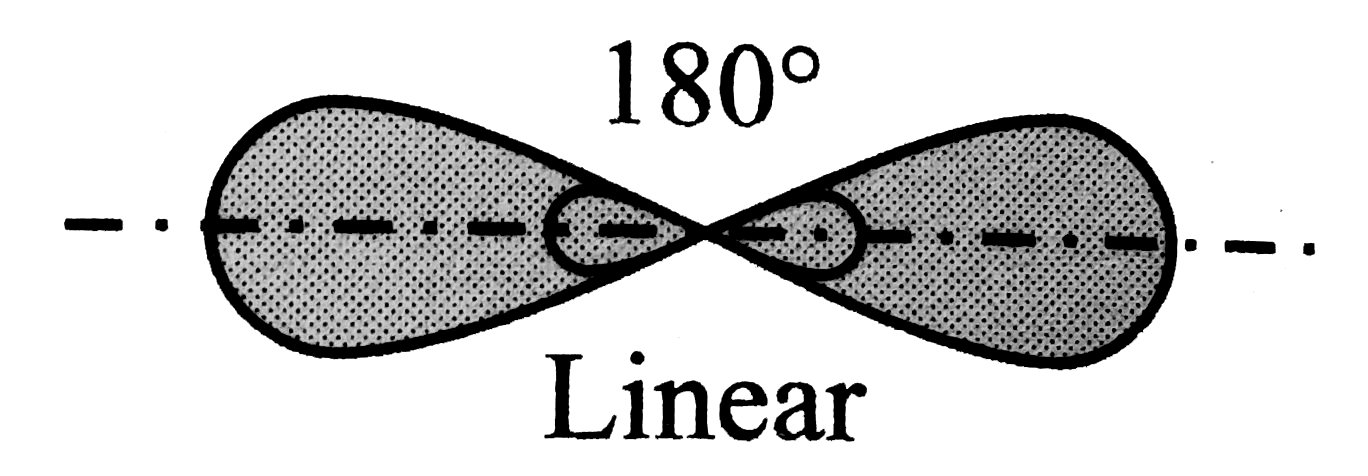
B

.
Promotional Banner

Topper's Solved these Questions

  • CHEMICAL BONDING AND MOLECULAR STRUCTURE

    CENGAGE CHEMISTRY ENGLISH|Exercise Archives Integer|2 Videos
  • CHEMICAL BONDING AND MOLECULAR STRUCTURE

    CENGAGE CHEMISTRY ENGLISH|Exercise Archives Fill In The Blanks|4 Videos
  • CHEMICAL BONDING AND MOLECULAR STRUCTURE

    CENGAGE CHEMISTRY ENGLISH|Exercise Archives Multiple Correct|10 Videos
  • ATOMIC STRUCTURE

    CENGAGE CHEMISTRY ENGLISH|Exercise Concept Applicationexercise(4.3)|19 Videos
  • CHEMICAL EQUILIBRIUM

    CENGAGE CHEMISTRY ENGLISH|Exercise Subjective type|1 Videos

Similar Questions

Explore conceptually related problems

On hybridisation of one s and three p-orbitals, we get

One hybridization of one s and one p orbital we get

On hybridization of one s and one p orbital we get

The angle between the overlapping of one s-orbital and one p-orbital is

The angle between the overlapping of one s-orbital and one p-orbital is

The molecule in which hybrid MO s involve only one d - orbital of the central atom is :

According to hybridisation theory, the % s-character in sp, sp^(2) and sp^(3) hybrid orbitals is 50, 33.3 and 25 respectively, but this is not true for all the species. When theta is the bond angle between equivalent hybrid orbitals then % s and p-character in hybrid orbitals (when only s and p-orbitals are involved in hybridisation) can be calculated by the following formula : costheta=(S)/(S-1)=(P-1)/(P) Q. Correct order of P-P bond length in the following compound is :

According to hybridisation theory, the % s-character in sp, sp^(2) and sp^(3) hybrid orbitals is 50, 33.3 and 25 respectively, but this is not true for all the species. When theta is the bond angle between equivalent hybrid orbitals then % s and p-character in hybrid orbitals (when only s and p-orbitals are involved in hybridisation) can be calculated by the following formula : costheta=(S)/(S-1)=(P-1)/(P) Q. Correct order of P-P bond length in the following compound is :

According to hybridisation theory, the % s-character in sp, sp^(2) and sp^(3) hybrid orbitals is 50, 33.3 and 25 respectively, but this is not true for all the species. When theta is the bond angle between equivalent hybrid orbitals then % s and p-character in hybrid orbitals (when only s and p-orbitals are involved in hybridisation) can be calculated by the following formula : costheta=(S)/(S-1)=(P-1)/(P) Q. Smallest Ohat(S)O bond angle is found in :

According to hybridisation theory, the % s-character in sp, sp^(2) and sp^(3) hybrid orbitals is 50, 33.3 and 25 respectively, but this is not true for all the species. When theta is the bond angle between equivalent hybrid orbitals then % s and p-character in hybrid orbitals (when only s and p-orbitals are involved in hybridisation) can be calculated by the following formula : costheta=(S)/(S-1)=(P-1)/(P) Q. Two elements X and Y combined together to form a covalent compound. If % p-character is found to be 80% in a orbital then the hybridised state of central atom X for the orbital is :

CENGAGE CHEMISTRY ENGLISH-CHEMICAL BONDING AND MOLECULAR STRUCTURE-Archives Single Correct
  1. Carbon tetrachloride has no net dipole moment because of

    Text Solution

    |

  2. Which one among the following does not have the hybrogen bond ?

    Text Solution

    |

  3. On hydridisation of one s and one p-orbitals , we get

    Text Solution

    |

  4. The molecule having one unpaired electrons is .

    Text Solution

    |

  5. The hybridisation of sulphur in sulphur dioxide is

    Text Solution

    |

  6. The bond between two indentical non-metal atoms has a pair of electron...

    Text Solution

    |

  7. Which of the following compounds has a zero dipole momnet ? .

    Text Solution

    |

  8. The species in which the central atom uses sp^(2) hybrid orbitals in i...

    Text Solution

    |

  9. The molecule that has linear structure is

    Text Solution

    |

  10. The Cl-C-Cl angle is 1,1,2,2-tetrachloroethene and tetrachloromethane ...

    Text Solution

    |

  11. The molecule which has pyramidal shape is

    Text Solution

    |

  12. Which of the following is paramagnetic ?

    Text Solution

    |

  13. The molecule which has zero dipole moment is

    Text Solution

    |

  14. The type of hybrid orbitals used by chlorine atom in ClO(2)^(-) is

    Text Solution

    |

  15. The maximum number of H-bonds a water molecule can form are

    Text Solution

    |

  16. Which one of the following molecules is planar?

    Text Solution

    |

  17. The number of types of bonds between two carbon atoms in calcium carbi...

    Text Solution

    |

  18. Among the following species, identify the isostuctural pairs NF(3). ...

    Text Solution

    |

  19. Polar covalent molecules exhibit dipole moment. Dipole moment is equal...

    Text Solution

    |

  20. CN^(Theta) and N(2) are isoelectronic But in contrast to CN^(Theta),N(...

    Text Solution

    |

