Home
Class 11
CHEMISTRY
Polar covalent molecules exhibit dipole ...

Polar covalent molecules exhibit dipole moment. Dipole moment is equal to the product of charge separation , q and the bond length d for the bond. Unit of dipole moment is debye. One debye is equal to `10^(-18)` esu cm.
Dipole moments is a vector quantity. It has both magnitude and direction. Hence, dipole moment of a molecule depends upon the relative orientation of the bond dipoles, but not on the polarity of bonds alone. A symmetrical structure shows zero dipole moment. Thus, dipole moment helps to predict the geometry of a molecules. Dipole moment values can be distinguish between cis- and trans- isomers, ortho, meta and pare-forms of a substance, etc.
Q. Arrange the following compounds in increasing order of dipole moments, toluene (I), o-dichlorobenzene (II), m-dichlorobenzene (III) and p-dichlorobenzene (IV) :

A

I ltIV lt II ltIII

B

I lt I lt II lt III

C

IV lt I lt III lt II

D

IV lt II lt I lt III

Text Solution

Verified by Experts

The correct Answer is:
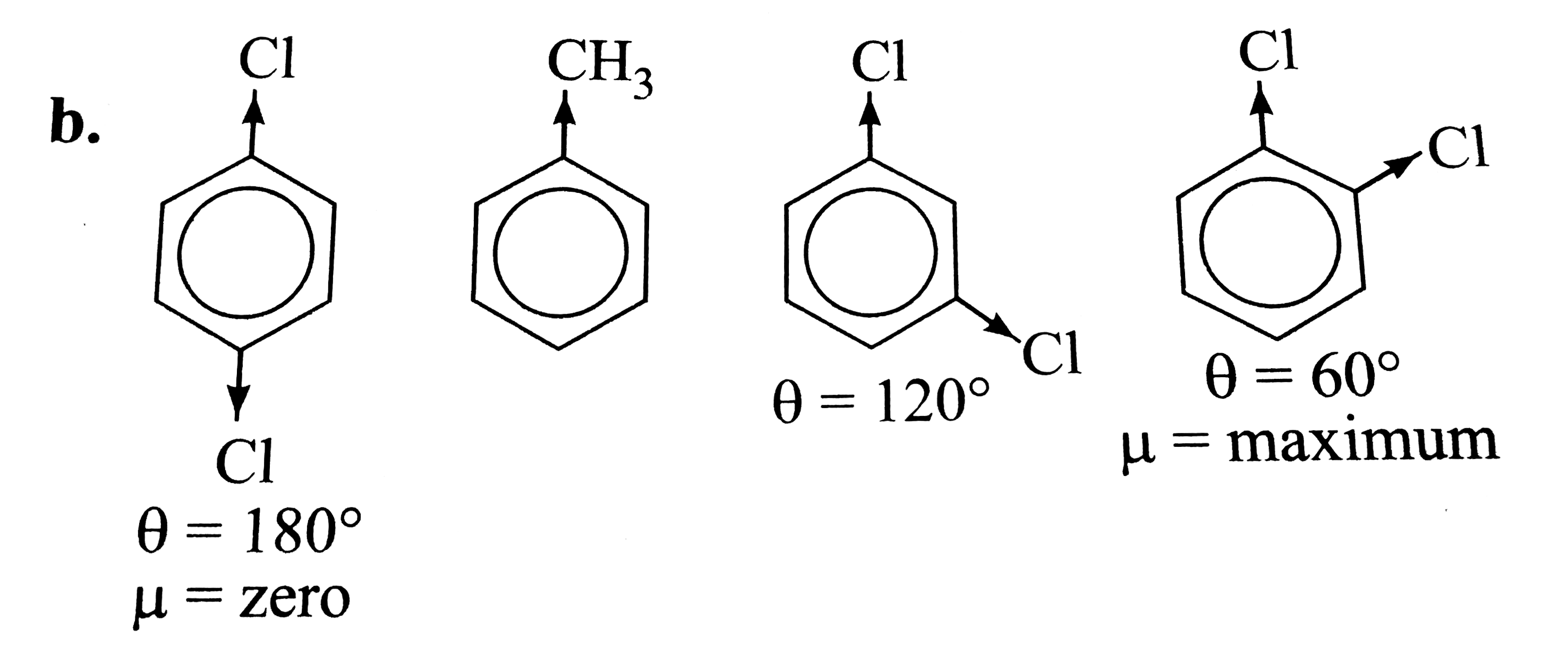
B

p-Dichlorobenzene lt Tolunce ltm-Dichlorobenzene o-Dichlorobenzene
.
Promotional Banner

Topper's Solved these Questions

  • CHEMICAL BONDING AND MOLECULAR STRUCTURE

    CENGAGE CHEMISTRY ENGLISH|Exercise Archives Integer|2 Videos
  • CHEMICAL BONDING AND MOLECULAR STRUCTURE

    CENGAGE CHEMISTRY ENGLISH|Exercise Archives Fill In The Blanks|4 Videos
  • CHEMICAL BONDING AND MOLECULAR STRUCTURE

    CENGAGE CHEMISTRY ENGLISH|Exercise Archives Multiple Correct|10 Videos
  • ATOMIC STRUCTURE

    CENGAGE CHEMISTRY ENGLISH|Exercise Concept Applicationexercise(4.3)|19 Videos
  • CHEMICAL EQUILIBRIUM

    CENGAGE CHEMISTRY ENGLISH|Exercise Subjective type|1 Videos

Similar Questions

Explore conceptually related problems

Polar covalent molecules exhibit dipole moment. Dipole moment is equal to the product of charge separation , q and the bond length d for the bond. Unit of dipole moment is debye. One debye is equal to 10^(-18) esu cm. Dipole moments is a vector quantity. It has both magnitude and direction. Hence, dipole moment of a molecule depends upon the relative orientation of the bond dipoles, but not on the polarity of bonds alone. A symmetrical structure shows zero dipole moment. Thus, dipole moment helps to predict the geometry of a molecules. Dipole moment values can be distinguish between cis- and trans- isomers, ortho, meta and pare-forms of a substance, etc. Q. Which is a polar molecule?

Polar covalent molecules exhibit dipole moment. Dipole moment is equal to the product of charge separation , q and the bond length d for the bond. Unit of dipole moment is debye. One debye is equal to 10^(-18) esu cm. Dipole moments is a vector quantity. It has both magnitude and direction. Hence, dipole moment of a molecule depends upon the relative orientation of the bond dipoles, but not on the polarity of bonds alone. A symmetrical structure shows zero dipole moment. Thus, dipole moment helps to predict the geometry of a molecules. Dipole moment values can be distinguish between cis- and trans- isomers, ortho, meta and pare-forms of a substance, etc. Q. Which is a polar molecule?

Polar covalent molecules exhibit dipole moment. Dipole moment is equal to the product of charge separation , q and the bond length d for the bond. Unit of dipole moment is debye. One debye is equal to 10^(-18) esu cm. Dipole moments is a vector quantity. It has both magnitude and direction. Hence, dipole moment of a molecule depends upon the relative orientation of the bond dipoles, but not on the polarity of bonds alone. A symmetrical structure shows zero dipole moment. Thus, dipole moment helps to predict the geometry of a molecules. Dipole moment values can be distinguish between cis- and trans- isomers, ortho, meta and pare-forms of a substance, etc. Q. mu of the AX_(4) type of molecule is zero. The geometry of it can be :

Polar covalent molecules exhibit dipole moment. Dipole moment is equal to the product of charge separation , q and the bond length d for the bond. Unit of dipole moment is debye. One debye is equal to 10^(-18) esu cm. Dipole moments is a vector quantity. It has both magnitude and direction. Hence, dipole moment of a molecule depends upon the relative orientation of the bond dipoles, but not on the polarity of bonds alone. A symmetrical structure shows zero dipole moment. Thus, dipole moment helps to predict the geometry of a molecules. Dipole moment values can be distinguish between cis- and trans- isomers, ortho, meta and pare-forms of a substance, etc. Q. Which of the following statement is correct regarding C_(2)H_(2)F_(2) molecule?

Polar covalent molecules exhibit dipole moment. Dipole moment is equal to the product of charge separation , q and the bond length d for the bond. Unit of dipole moment is debye. One debye is equal to 10^(-18) esu cm. Dipole moments is a vector quantity. It has both magnitude and direction. Hence, dipole moment of a molecule depends upon the relative orientation of the bond dipoles, but not on the polarity of bonds alone. A symmetrical structure shows zero dipole moment. Thus, dipole moment helps to predict the geometry of a molecules. Dipole moment values can be distinguish between cis- and trans- isomers, ortho, meta and pare-forms of a substance, etc. Q. A diatomic molecule has a dipole moment of 1.2D. If the bond length is 1.0times10^(-8) cm, what fraction of charge does exist each atom?

The correct order of dipole moment is :

The correct order of dipole moment is :

Unit of magnetic dipole moment is

Zero dipole moment is present in

Dipole moment is shown by

CENGAGE CHEMISTRY ENGLISH-CHEMICAL BONDING AND MOLECULAR STRUCTURE-Archives Single Correct
  1. The number of types of bonds between two carbon atoms in calcium carbi...

    Text Solution

    |

  2. Among the following species, identify the isostuctural pairs NF(3). ...

    Text Solution

    |

  3. Polar covalent molecules exhibit dipole moment. Dipole moment is equal...

    Text Solution

    |

  4. CN^(Theta) and N(2) are isoelectronic But in contrast to CN^(Theta),N(...

    Text Solution

    |

  5. Among KO(2), KAlO(2), CaO(2) and NO(2)^(+), unpaired electrons is pres...

    Text Solution

    |

  6. Which one of the following compounds has sp^(2) hybridisation ? .

    Text Solution

    |

  7. Among the following compounds the one that is polar and has the centra...

    Text Solution

    |

  8. Which contains both polar and non-polar bonds ? .

    Text Solution

    |

  9. The correct order of decreasing bond lengths of CO,CO(2) and CO(3)^(2-...

    Text Solution

    |

  10. The geometry of H2S and its dipole moment are

    Text Solution

    |

  11. Molecular shapes of SF(4), CF(4), XeF(4) are

    Text Solution

    |

  12. The types of hybrid orbitals of nitrogen in NO(2)^(+), NO(3)^(-) and N...

    Text Solution

    |

  13. The correct order of hybridisation of the central atom in the followin...

    Text Solution

    |

  14. Which of the following statement is correct among the species CN^(Θ),C...

    Text Solution

    |

  15. Specify the coordination geometry around and the hybridisation of N an...

    Text Solution

    |

  16. The least stable ion among the following is

    Text Solution

    |

  17. Which of the following species has unpaired electrons?

    Text Solution

    |

  18. Which of the following are iso-electronic as well as iso-structural ? ...

    Text Solution

    |

  19. Which of the following oxoacids of sulpher has -O-O- linkage ?

    Text Solution

    |

  20. According to MO theory,

    Text Solution

    |

