Home
Class 11
CHEMISTRY
Give reason for the following : a. The...

Give reason for the following :
a. The first ioisation eathalpy of carbon carbon is greater than that foboron, whereas the reverse is true fore the second ionisation enthalpy .
b. Solid carbon dioxie is known as dry ice .
c. Why does not silicon form an analogue fo graphite ?

Text Solution

Verified by Experts
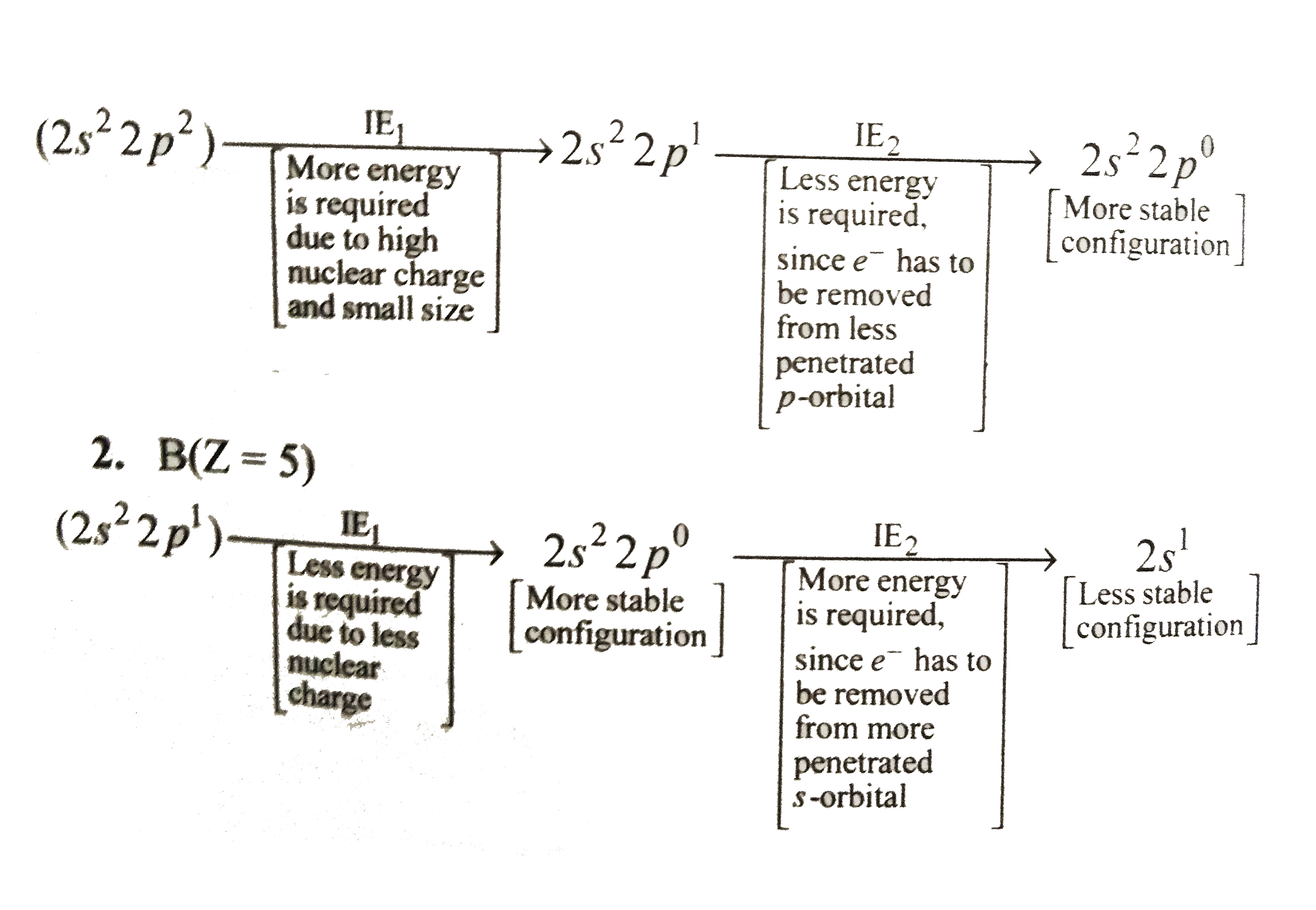
a. Electronic configuration of carbon is ` 1s^2 , 2s^2 , 2s^2` , whereas that of boron is ` 1s^2 2s^2 2p^1` . The first ionisation enthalpy of carnon is grater than that of boron due to its smaller size and higher effective nuclear charge . The valence shell electons are nore tightly bound to the nucleus , hence , for its removal grater amount of enrgy is requreed .
The second ionisation enthalpy of carbon is less than that of boron , as the removal fo second electron in carbon has to be doen from `2p` orbital whereas in boron it has to gbe done from `2s` orbial . First , `2s` orbital , therfore , the electrons are more tightly bound . Also `2s^2` configuration in `C` being fully filled is more stable than `2p^(1)` in `B` Because of these two reasone , `IE_2` or `C lt IE_2` of B.
Altenrate explanation :

Therefore , `IE _21` of `C gt IE_1` of `B` and `IE_2` of `Clt IE_2` of `B`
b. Solid carbon dioxdie on veape on evaporation change directly to the gaseous state without changing to the liwuid state . It produces cooling diring evaporation and doen not wet the surface , therefore , solid `CO_2` is known as dry ice .
c. Due to small size and high electronegativity of `C` , it is capable of forming `p pi - p pi` bond , which occures in graphite , whereas in `Si` the size of the orbital involmed i.e.,e `3p` in `p pi -p pi` bond formation is large and ghecne multiple bond formation is not freasible `Si` . Hence silicon does not form an anlogous of grapbite .
Promotional Banner

Topper's Solved these Questions

  • P-BLOCK GROUP 14 - CARBON FAMILY

    CENGAGE CHEMISTRY ENGLISH|Exercise Solved Examples|9 Videos
  • P-BLOCK GROUP 14 - CARBON FAMILY

    CENGAGE CHEMISTRY ENGLISH|Exercise Ex (Subjective)|21 Videos
  • P-BLOCK GROUP 13 - BORON FAMILY

    CENGAGE CHEMISTRY ENGLISH|Exercise Exercise Archives (Subjecive)|9 Videos
  • PERIODIC CLASSIFICATION OF ELEMENTS AND GENERAL INORGANIC CHEMISTRY

    CENGAGE CHEMISTRY ENGLISH|Exercise Exercises (Archives )Subjective|4 Videos

Similar Questions

Explore conceptually related problems

Why the first ionisation energy of carbon atom is greater than that of boron atom whereas, the reverse is true for the second ionisation energy.

The first ionisation enthalpy of nitrogen (Z=7) is greater than that of oxygen (Z =8) but the reverse is true for the second ionisation enthalpy. Explain why.

Give reason for the following in one or two sentences : ''Solid carbon dioxide is known as dry ice.''

Give reason for the following. a) Covalent bonds are directional bonds while ionic bonds are non-directional. b) Wate molecules has bent whereas carbon dioxide molecule is linear. c) Ethyne molecule is linear.

Give reasons for the following (a) C Cl_(4) is immiscible in water, whereas SiCl_(4) is easily hydrolysed. (b) Carbon has a strong tendency for catenation compared to silicon.

(a) When a chromite ore (A) is fused with an aqueous solution of sodium carbonate in free excess of air, a yellow solution of compound (B) is obtained. This solution is filtered and acidified with sulphuric acid to form compound (C). Compound (C) on treatment with solution of KCl gives orange crystals of compound (D). Write the chemical formulae of compounds A to D. (b) Describe the cause of the following variations with respect to lanthanoids and actinoids: (i) Greater range of oxidation states of actinoids as compared to lanthanoids. (ii) Greater actinoid contraction as compared to lanthanoid contraction. (iii) Lower ionisation enthalpy of early actinoids as compared to the early lanthanoids.

Write the balanced chemical equations for the following reactions and identify the type of reaction in each case. (a) Iron (III) oxide reacts with aluminium and gives molten iron and aluminium oxide. (b) Magnesium ribbon is burnt in an atmosphere of nitrogen gas to form solid magnesium nitride. (c) Chlorine gas is passed in an aqueous potassium iodide solution to form potassium chloride solution and solid iodine. (d) Ethanol is burnt in air to form carbon dioxide, water and releases heat.

Why does elemental silicon not form a graphite-like structure, whereas carbon does?

Explain the following (a) CO_(2) is a gas whereas SiO_(2) is a solid (b) Silicon forms SiF_(6)^(2-) ion whereas corresponding fluoro compound of carbon is not known.

How many of the following statements are correct regarding allotropes of carbon: (a) Graphite is not a good conductor of electicity in perpendicular direction of layers at ordinary temperatures. (b) Coke is the impure form of carbon. ( c) Anthracite is the purest form of carbon. (d) Buckminister fullerence contains 12 five membered rings and 20 six-membered rings. (e) Diamond is a good conductor of heat. (f) Graphite is diamagnetic in nature. (g) Graphite is thermodynamically more stable than diamond

