Home
Class 11
CHEMISTRY
Discuss the pattern of variation in the ...

Discuss the pattern of variation in the oxidation states of (i) B to Tl and (ii) C to Pb.

Text Solution

Verified by Experts

a. Electronic configuration of group `13` elements is `ns^(2)np^(2)`. `B` and `Al` have noble gas core beneath the valence shell electron, whereas `Ga, In` and `TI` have fully filled lesser shielding `d-` and or `f`-orbital present in-between the noble gas core and valence electron. Since `d` and `f` orbitals have lesser shielding effect, Ga, in and Ti exhibit inert part effect, whereas `B` and `Al` do not. Hence, `B` and `Al` exhibit only one stable oxidation state, i.e. `+3`, whereas `Ga,In` and `TI` due to inert pair effect shows as oxidation state of `+1` also, besides group oxidation state of `+3`.
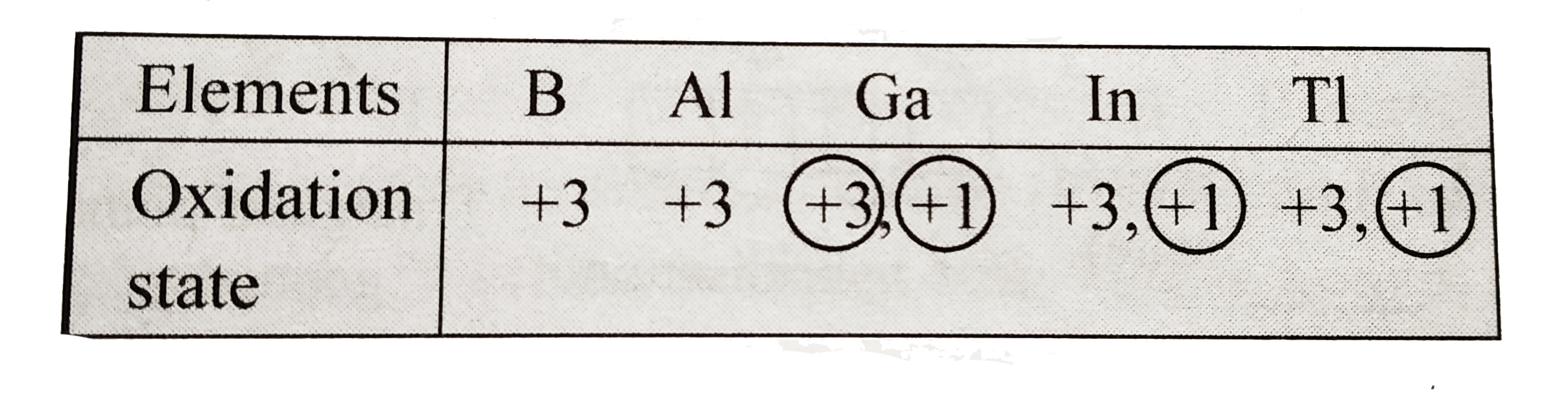
Down the group `(darr)`, stability of lower oxidation state `(+1)` increases, i.e. `GaltTnltTI`, whereas that of higher oxidation state `(+3)` decreases, i.e.`Gagt"In"gtTI`
b. Electronic configuration of group `14` elements in `ns^(2)np^(2)`.`C` and `Si` have noble gas core beneath the valence shell electrons, whereas `Ge,Sn` and `Pb` have fully filled lesser shielding `d`- and or `f`-orbital in between the noble gas core and valence shell electrons.
Shielding effect varies in the order:`nsgtnpgtndgtnf`. Hence,`C` and `Si` do not exhibit inert pair effect, whereas `Ge,Sn` and `Pb` exhibit inert pair effect. Consequently, `C` and `Si` shows as oxidation state, `+4` (group oxidation state), whereas `Ge,Sn` and `Pb`,besides showing group oxidation state of `+4`, also shows an oxidation state of `+2`.Stability of higher oxidation state `(+4)` decreases down the group `(darr)`,`GegtSngtPb`,whereas that of lower oxidation state `(+2)` increases:`GeltSnltPb`.

Promotional Banner

Topper's Solved these Questions

  • APPENDIX - INORGANIC VOLUME 1

    CENGAGE CHEMISTRY ENGLISH|Exercise Exercise very short|70 Videos
  • APPENDIX - INORGANIC VOLUME 1

    CENGAGE CHEMISTRY ENGLISH|Exercise Exercise Short|146 Videos
  • ALKYNES

    CENGAGE CHEMISTRY ENGLISH|Exercise Exercises (Archives - Analytical and Desriptive Type)|4 Videos
  • ATOMIC STRUCTURE

    CENGAGE CHEMISTRY ENGLISH|Exercise Concept Applicationexercise(4.3)|19 Videos

Similar Questions

Explore conceptually related problems

Discuss the pattern of variation in the oxidation states of (a) B to TI and (b) C to Pb .

Oxidation state of nitrogen in H-N equiv C is

Predict the highest and lowest oxidation state of (a) Ti and (b) Tl

Match the statements given in Column I with the oxidation states given in Column II.

Name the following: (a) A transition metal which does not exhibit variation in oxidation state in its compounds. (b) A compound where the transition metal is the +7 oxidation state. (c) A member of the lanthanoid series which is well known to exhibit +4 oxidation state. (d) Ore used in the preparation of Potassium dichromate.

Discuss the properties of group 13 elements with reference to oxidation states

Match column I and column II for the oxidation states of the central atoms.

What is the covalency of B in [B(OH)_(4)] and its oxidation state ?

Match the compounds given in column I with oxidation states of carbon given in column II and mark the appropriate choice.

Why Al^(3+) is the only stable oxidation state of Al in its compounds while Tl has +1 and +3 oxidation states?

