Home
Class 11
CHEMISTRY
Suggest reasons why the B–F bond lengths...

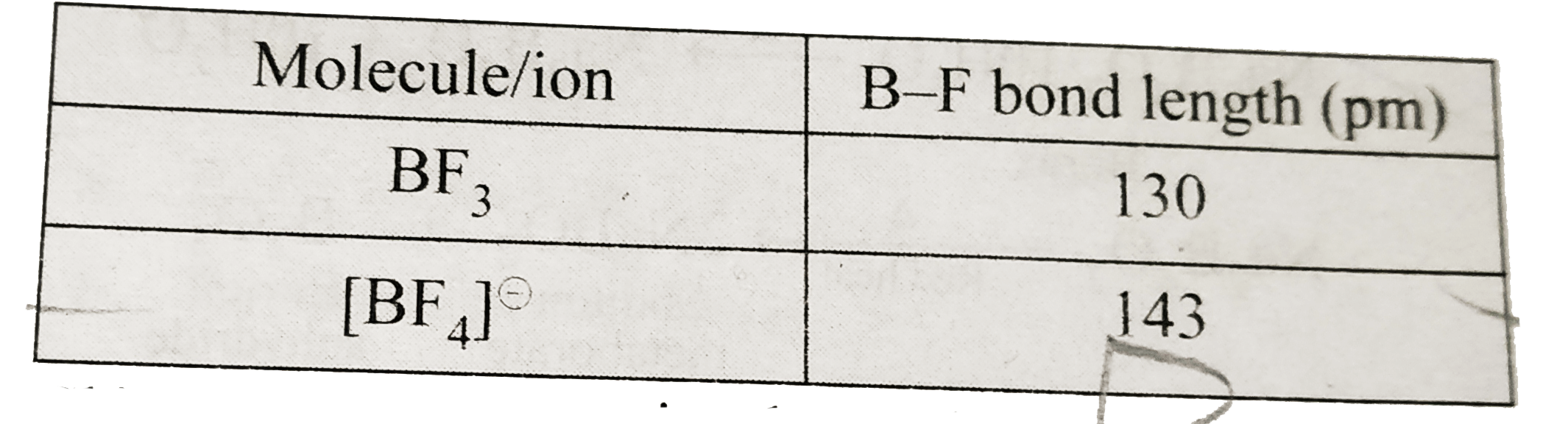
Suggest reasons why the B–F bond lengths in `BF_(3)` (130 pm) and `BF_(4 )^(– )`(143 pm) differ.

Text Solution

Verified by Experts
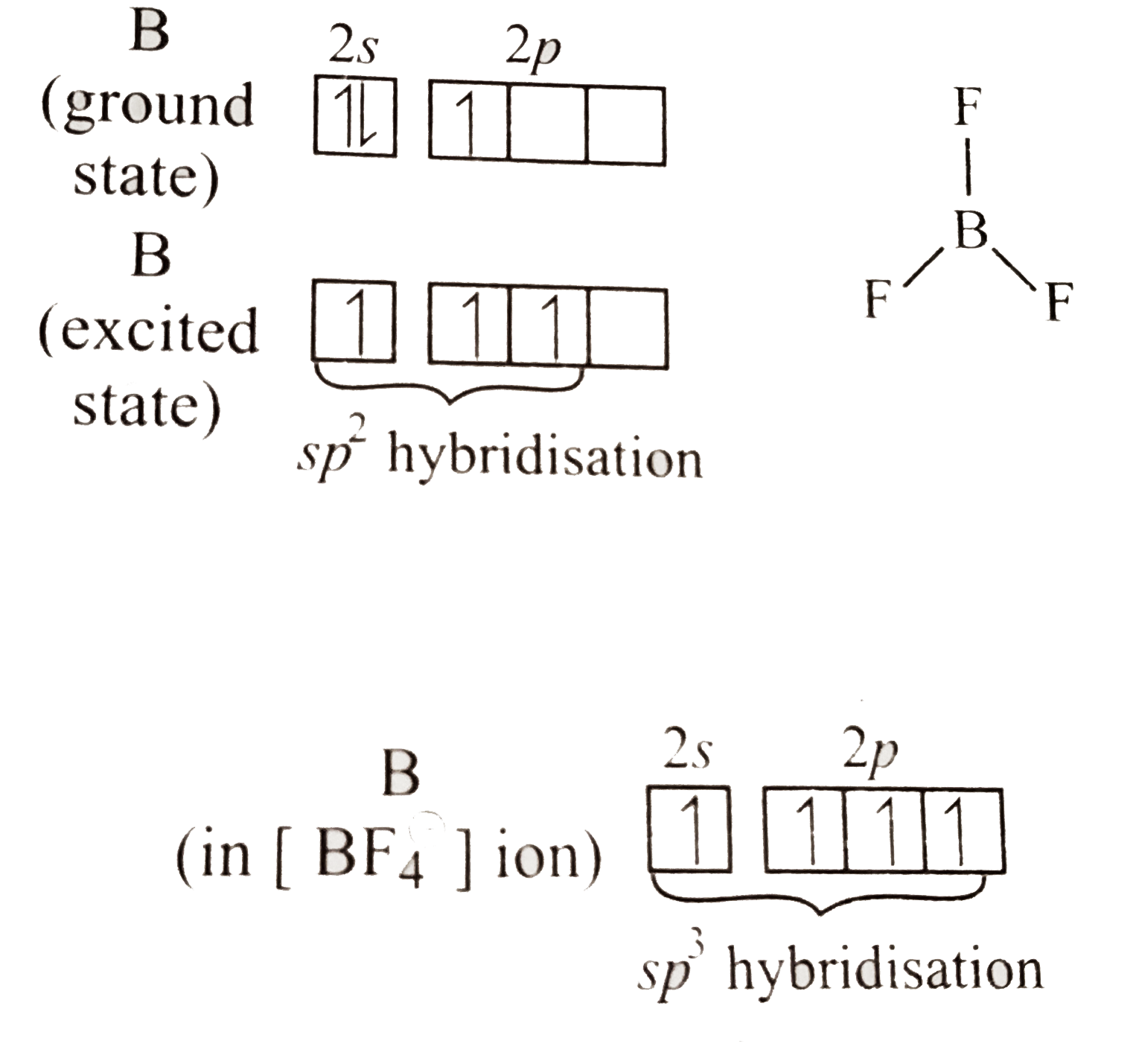
In `BF_(3)`,B is `sp^(2)` hybridised and has only six electrons in the valence shell and behaves as an electron-deficient compound. To reduce its electron deficiency, `B` accept a pair of electron from filled `2p` orbital present on it. This is known as `ppi-ppi` back bonding which happens due to compatibility in the size and energy of `2p`orbital on `F` and `2p` orbital on `B` atom in `BF_(3)`.
Due to back-bonding in `BF_(3)` `B-F` bond acquires some double bond character resulting in shortening of the bond.
However, in `[BF_(4)](ө)`,B is `sp^(3)` hybridised and hence has eight electrons in its valence shell. Since there is an empty `p`-orbital available in `B` in `[BF_(4)](ө)` ion, back-bonding is not possible and `B-F` is purely single bond. Since double bonds are shorter than single bond, the `B-F` bond length in `BF_(3)` is shorter than in `[BF_(4)](ө)`.

Promotional Banner

Topper's Solved these Questions

  • APPENDIX - INORGANIC VOLUME 1

    CENGAGE CHEMISTRY ENGLISH|Exercise Exercise very short|70 Videos
  • APPENDIX - INORGANIC VOLUME 1

    CENGAGE CHEMISTRY ENGLISH|Exercise Exercise Short|146 Videos
  • ALKYNES

    CENGAGE CHEMISTRY ENGLISH|Exercise Exercises (Archives - Analytical and Desriptive Type)|4 Videos
  • ATOMIC STRUCTURE

    CENGAGE CHEMISTRY ENGLISH|Exercise Concept Applicationexercise(4.3)|19 Videos

Similar Questions

Explore conceptually related problems

(a) Explain why BF_(3) exists whereas BH_(3) does not. (b) Compare the B-F bond length in BF_(3) and BF_(4)^(-)

(a) Explain why BF_(3) exists whereas BH_(3) does not. (b) Compare the B-F bond length in BF_(3) and BF_(4)^(-)

Why is BF_(3) a Lewis acid?

Why is O-O bond length in ozone (128 pm) more than in O_2 (122 pm)?

Back bonding in BF_(3) does not afect

In the following questions, a statement of assertion (A) is followed by a statement of reason (R ) A: bond angle of BF_(3) and NF_(3) are different. R : Both the molecules are having different shape

Explain why C—C bond length in ethane is 154 pm while that in ethylene is 134 pm.

A chemist wants to prepare diborane by the reaction BF_(3) rarr 6 Li BF_(4)+B_(2)H_(6) If the starts with 2.0 moles each of LiH & BF_(3) . How many moles B_(2)H_(6) can be prepared.

Give reasons for the following (a) PF_(5) is know but NF_(3) is not (b) H_(2)O is a good solvent (c ) BF_(3) is non- polar but planar (e) Carbon -oxygen (C-O) bond lengths are equal in Na_(2)CO_(3) (f) MgF_(2) is more soluble in water than MgCI_(2) .

The correct order of decreasing bond angles in H_(2)S, NH_(3), BF_(3) and SiH_(4) is