Home
Class 11
CHEMISTRY
Elements of group 14 exhibit oxidation s...

Elements of group 14 exhibit oxidation state of

A

Exhibit oxidation state of `+4` only

B

Exhibit oxidation state of `+2` and `+4`

C

Form `M^(2+)` and `M^(4+)` ions

D

Form `M^(3+)` and `M^(4+)` ions

Text Solution

Verified by Experts

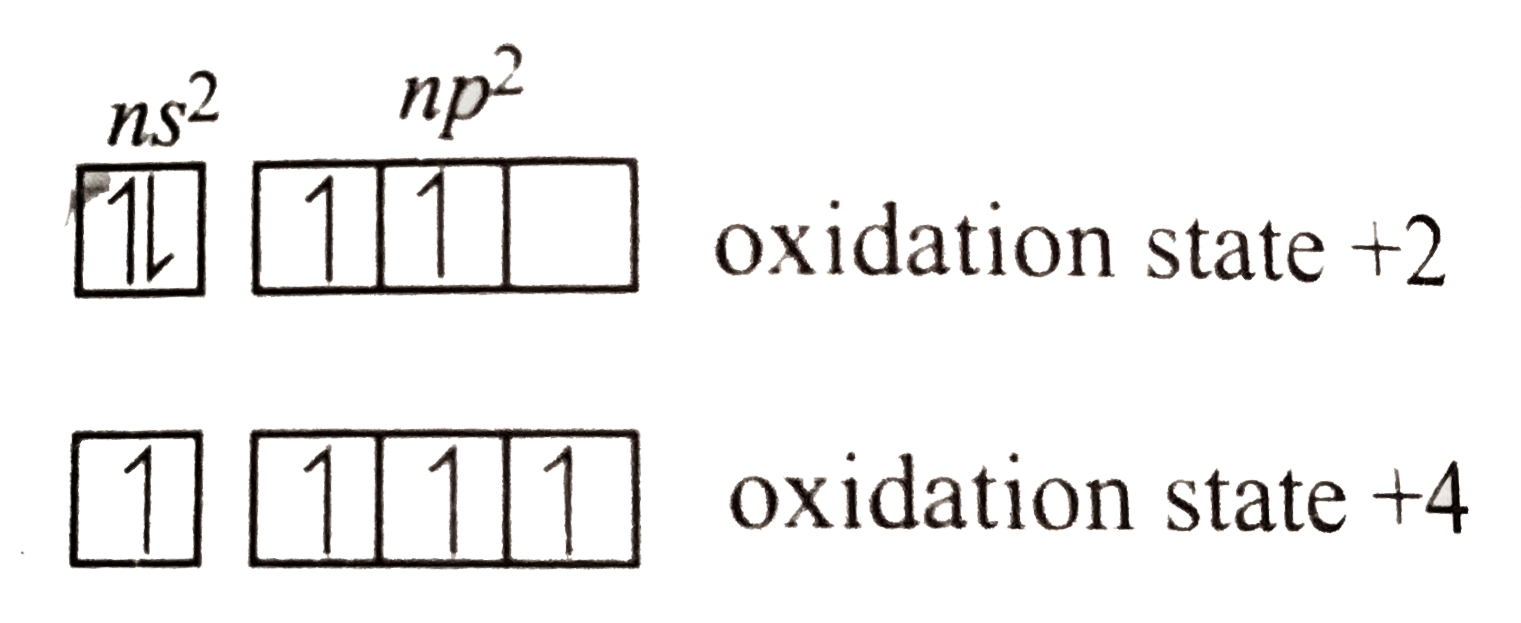
Due to inert pair effect, elements of group `14` exhibit oxideation state of `+2` and `+4`.
Promotional Banner

Topper's Solved these Questions

  • APPENDIX - INORGANIC VOLUME 1

    CENGAGE CHEMISTRY ENGLISH|Exercise Exercise very short|70 Videos
  • APPENDIX - INORGANIC VOLUME 1

    CENGAGE CHEMISTRY ENGLISH|Exercise Exercise Short|146 Videos
  • ALKYNES

    CENGAGE CHEMISTRY ENGLISH|Exercise Exercises (Archives - Analytical and Desriptive Type)|4 Videos
  • ATOMIC STRUCTURE

    CENGAGE CHEMISTRY ENGLISH|Exercise Concept Applicationexercise(4.3)|19 Videos

Similar Questions

Explore conceptually related problems

Elements of group 14 (a) exhibit oxidation state of +4 only (b) exhibit oxidation state of +2 and +4 (c) form M^(2–)" and "M^(4+) ions (d) form M^(2+)" and "M^(4+) ions

Which element of group 13 exhibits +1 oxidation state

The heavier members of 13 and 14 groups besides the group oxidation state also show another oxidation state. Down the group (darr) , the stability of higher oxidation state increases. This concept which is commonly called inert pair effect has been used to explain many physical and chemical properties of the element of these groups. Heavier members of group 13 exhibit oxidation state.

Sulphur and rest of the elements of group 16 are less electronegative than oxygen, Therefore, their atoms cannot take electrons easily. They can acquire ns^2 np^6 configuration by sharing two electrons with the atoms of other elements and thus, exhibit +2 oxidation state in their compounds. In addition to this, their atoms have vacant d-orbitals in their valence shell to which electrons can be promoted from the p and s-orbitals of the same shell. As a result, they can show +4 and + 6 oxidation states. Oxygen exhibits +2 oxidation state in

Which one of the following elements does exhibit +1 oxidation state as well ? AI, B, Ca, TI, Be.

The element that exhibits negative oxidation state in IIIA group is

Which transition elements exhibit +8 oxidation state

Name a lanthanoid element which exhibits +4 oxidation state besides +3 oxidation state.

Which transition element does not exhibit variable oxidation state?

Oxygen almost invariably exhibits oxidation state of -2 but the other members of family exhibit negative as well as positive oxidation states of +2, + 4 and +6 . Explain.