Home
Class 12
CHEMISTRY
Bleaching powder and bleach solution are...

Bleaching powder and bleach solution are produced on a large scale and used in several house hold production. The effectiveness of bleach solution is often measured by iodometry.
Bleaching powder contains s salt of an oxoacid as one of its components. The anhyride of that oxoacid is

A

`Cl_(2)O`

B

`Cl_(2)O_(7)`

C

`ClO_(2)`

D

`ClO_(2)O_(8)`

Text Solution

Verified by Experts

The correct Answer is:
A

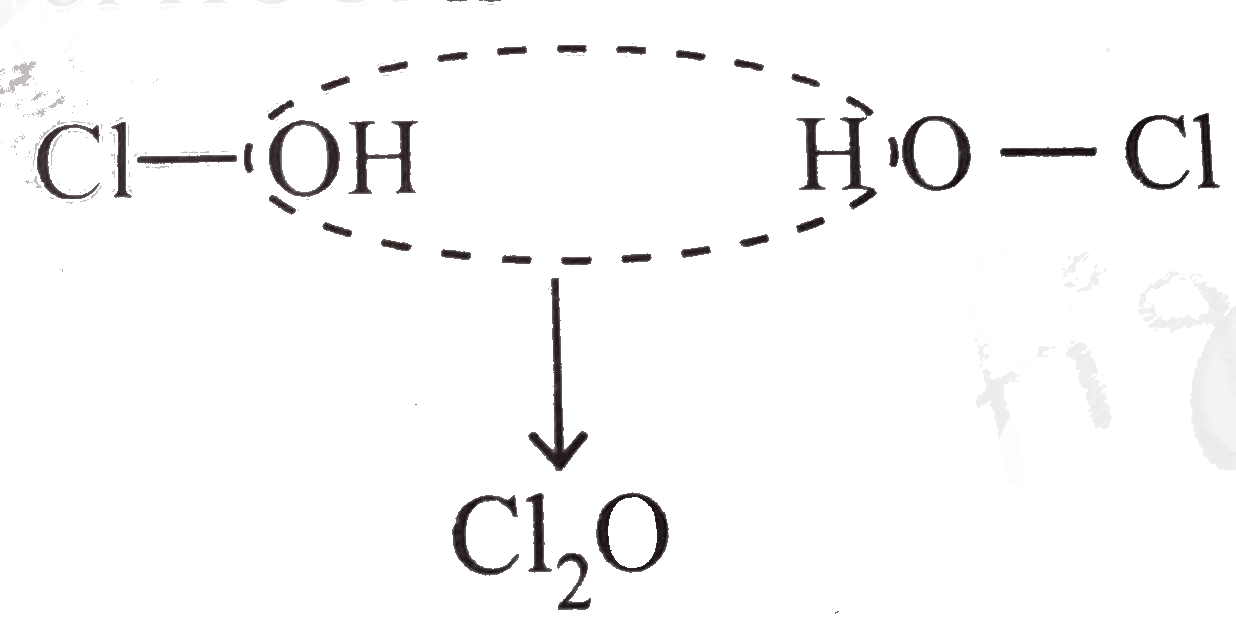
`CaOCI_(2)=Ca(OCI)CI`
`OCI^(Theta)` = Hypochlorite ion, which is anion of HOCI. Anhydride of HOCI is
Promotional Banner

Topper's Solved these Questions

  • P-BLOCK GROUP 17 ELEMENTS - THE HALOGEN FAMILY

    CENGAGE CHEMISTRY ENGLISH|Exercise Exercises Archives (Multiple Correct)|3 Videos
  • P-BLOCK GROUP 17 ELEMENTS - THE HALOGEN FAMILY

    CENGAGE CHEMISTRY ENGLISH|Exercise Exercises Archives (Single Correct)|12 Videos
  • P-BLOCK GROUP 17 ELEMENTS - THE HALOGEN FAMILY

    CENGAGE CHEMISTRY ENGLISH|Exercise Exercises (True/False)|14 Videos
  • P-BLOCK GROUP 16 ELEMENTS - THE OXYGEN FAMILY

    CENGAGE CHEMISTRY ENGLISH|Exercise Archives Subjective|10 Videos
  • P-BLOCK GROUP 18 ELEMENTS - THE INERT GASES

    CENGAGE CHEMISTRY ENGLISH|Exercise Ex 5.1 (Objective)|14 Videos

Similar Questions

Explore conceptually related problems

Bleaching powder contains a salt of an oxoacid as one of its components . The anhydride of that acid is

Bleaching powder and bleach solution are produced on a large scale and used in several house-hold products. The effectiveness of bleach solution is often measured by iodometry. 25 mL of household bleach solution was mixed with 30 mL of 0.50 M KI and 10 mL of 4N acetic acid. In the titration of the liberated iodine, 48 mL of 0.25 N Na_(2)S_(2)O_(3) was used to reach the end point. The molarity of the household bleach solution is :

10 g of bleaching powder on reaction with KI required 50 mL of 2N hypo solution. Thus, % of bleaching powder is

Work out the following using chemical equations: Chlorination of calcium hydroxide produces bleaching powder'.

In an experiment to estimate the size of a molecule of oleic acid 1 mL of oleic acid is dissolved in 19 mL of alcohol. Then 1 mL of this solution is diluted to 20 mL by adding alcohol. Now, 1 drop of this diluted solution is placed on water in a shallow trough. The solution spreads over the surface of water forming one molecule thick layer. Now, lycopodium powder is sprinkled evenly over the film and its diameter is measured. Knowing the volume of the drop and area of the film we can calculate the thickness of the film which will give us the size of oleic acid molecule. Read the passage carefully and answer the following questions (a) Why do we dissolve oleic acid in alcohol ? (b) What is the role of lycopodium powder? (c) What would be the volume of oleic acid in each mL of solution prepared? (d) How will you calculate the volume of n drops of this solution of oleic acid ? (e) What will be the volume of oleic acid in one drop of this solution ?

