Home
Class 12
CHEMISTRY
In terms of CFT explain why a d^(9) octa...

In terms of `CFT` explain why a `d^(9)` octahedral complex with six identical ligands is not expected tom have all size `m-L` distane identical .

Text Solution

Verified by Experts
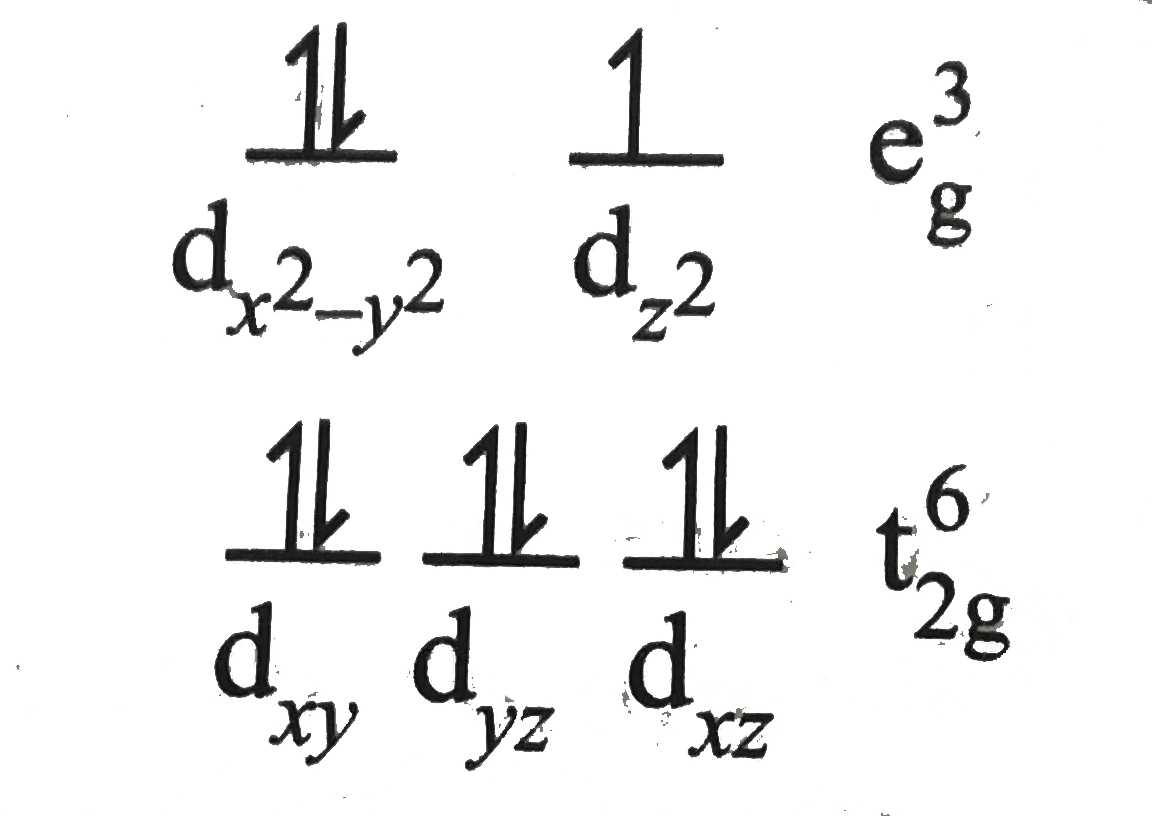
For `d^(9)` octahedral complex the configuration will be `t_(2g) ^(6) e_(g)^(3)`

One of the `e_(g)` orbitals is completely filled and other is half filled and hence interation with the ligands is expected to be different .
Promotional Banner

Topper's Solved these Questions

  • COORDINATION COMPOUNDS

    CENGAGE CHEMISTRY ENGLISH|Exercise Ex 7.1 Subjective (Terminology)|5 Videos
  • COORDINATION COMPOUNDS

    CENGAGE CHEMISTRY ENGLISH|Exercise Ex 7.1 Subjective (Effective Atomic Number (Ean))|3 Videos
  • COORDINATION COMPOUNDS

    CENGAGE CHEMISTRY ENGLISH|Exercise Archives Subjective|18 Videos
  • CHEMICAL KINETICS

    CENGAGE CHEMISTRY ENGLISH|Exercise Archives Subjective|23 Videos
  • D AND F BLOCK ELEMENTS

    CENGAGE CHEMISTRY ENGLISH|Exercise Archives Subjective|29 Videos

Similar Questions

Explore conceptually related problems

Velence bond theroy describes the bonding in complexs in terms of coordinate -covalent bond resulting from overlap filled ligand orbitals with vacant metal hybrid orbitals This theory explains magnetic behaviour and geometrical shape of coordination compounds Magnetic moment of a complex compound can be determined experimentally and theoretically by using spin only formula Magnetic moment sqrtn (n+2)BM (where n = No. unpaired electrons) . The value of of spin only magnetic moment for octahedral complex of the following configuration is 2.84BM The correct statement is (a) d^(4) (in weak field ligand) (b) d^(2) (in weak field and in strong field ligand) (c) d^(3) (in weak field and in strong field ligand) (d) d^(5) (in strong field ligand) .

When degenerate d-orbitals of an isolated atom/ion come under influence of magnetic field of ligands, the degeneray is lost. The two set t_(2g)(d_(xy),d_(yz),d_(xz)) and e_(g) (d_(x^(2))-d_(x^(2)-y^(2)) are either stabilized or destabilized depending upon the nature of magnetic field. it can be expressed diagrammatically as: Value of CFSE depends upon nature of ligand and a spectrochemical series has been made experimentally, for tetrahedral complexes, Delta is about 4/9 times to Delta_(0) (CFSE for octahedral complex). this energy lies in visible region and i.e., why electronic transition are responsible for colour. such transition are not possible with d^(0) and d^(10) configuration. Q. Ti^(3+)(aq) . is purple while Ti^(4+)(aq) . is colourless because:

When degenerate d-orbitals of an isolated atom/ion come under influence of magnetic field of ligands, the degeneray is lost. The two set t_(2g)(d_(xy),d_(yz),d_(xz)) and e_(g) (d_(x^(2))-d_(x^(2)-y^(2)) are either stabilized or destabilized depending upon the nature of magnetic field. it can be expressed diagrammatically as: Value of CFSE depends upon nature of ligand and a spectrochemical series has been made experimentally, for tetrahedral complexes, Delta is about 4/9 times to Delta_(0) (CFSE for octahedral complex). this energy lies in visible region and i.e., why electronic transition are responsible for colour. such transition are not possible with d^(0) and d^(10) configuration. Q. Ti^(3+)(aq) . is purple while Ti^(4+)(aq) . is colourless because:

When degenerate d-orbitals of an isolated atom/ion come under influence of magnetic field of ligands, the degeneray is lost. The two set t_(2g)(d_(xy),d_(yz),d_(xz)) and e_(g) (d_(x^(2))-d_(x^(2)-y^(2)) are either stabilized or destabilized depending upon the nature of magnetic field. it can be expressed diagrammatically as: Value of CFSE depends upon nature of ligand and a spectrochemical series has been made experimentally, for tetrahedral complexes, Delta is about 4/9 times to Delta_(0) (CFSE for octahedral complex). this energy lies in visible region and i.e., why electronic transition are responsible for colour. such transition are not possible with d^(0) and d^(10) configuration. Q. Cr^(3+) form four complexes with four different ligands which are [Cr(Cl)_(6)]^(3-), [Cr(H_(2)O)_(6)]^(3+) , [Cr(NH_(3))_(6)]^(3+) and [Cr(CN)_(6)]^(3-) , the order of CFSE (Delta_(0)) in these complexes in the order:

When degenerate d-orbitals of an isolated atom/ion come under influence of magnetic field of ligands, the degeneray is lost. The two set t_(2g)(d_(xy),d_(yz),d_(xz)) and e_(g) (d_(x^(2))-d_(x^(2)-y^(2)) are either stabilized or destabilized depending upon the nature of magnetic field. it can be expressed diagrammatically as: Value of CFSE depends upon nature of ligand and a spectrochemical series has been made experimentally, for tetrahedral complexes, Delta is about 4/9 times to Delta_(0) (CFSE for octahedral complex). this energy lies in visible region and i.e., why electronic transition are responsible for colour. such transition are not possible with d^(0) and d^(10) configuration. Q. The vlaue of CFSE (Delta_(0)) for completes given below follow the order, (I) [Co(NH_(3))_(6)]^(3+) (II) [Rh(NH_(3))_(6)]^(3+) (III) [IR(NH_(3))_(6)]^(3+)

When degenerate d-orbitals of an isolated atom/ion come under influence of magnetic field of ligands, the degeneray is lost. The two set t_(2g)(d_(xy),d_(yz),d_(xz)) and e_(g) (d_(x^(2))-d_(x^(2)-y^(2)) are either stabilized or destabilized depending upon the nature of magnetic field. it can be expressed diagrammatically as: Value of CFSE depends upon nature of ligand and a spectrochemical series has been made experimentally, for tetrahedral complexes, Delta is about 4/9 times to Delta_(0) (CFSE for octahedral complex). this energy lies in visible region and i.e., why electronic transition are responsible for colour. such transition are not possible with d^(0) and d^(10) configuration. Q. The extent of crystal field splitting in octahedral complexes of the given metal with particular weak field ligand are:

When degenerate d-orbitals of an isolated atom/ion come under influence of magnetic field of ligands, the degeneray is lost. The two set t_(2g)(d_(xy),d_(yz),d_(xz)) and e_(g) (d_(x^(2))-d_(x^(2)-y^(2)) are either stabilized or destabilized depending upon the nature of magnetic field. it can be expressed diagrammatically as: Value of CFSE depends upon nature of ligand and a spectrochemical series has been made experimentally, for tetrahedral complexes, Delta is about 4/9 times to Delta_(0) (CFSE for octahedral complex). this energy lies in visible region and i.e., why electronic transition are responsible for colour. such transition are not possible with d^(0) and d^(10) configuration. Q. Which of the following is correct arrangement of ligand in terms of the Dq values of their complexes with any particularr 'hard' metal ion:

When degenerate d-orbitals of an isolated atom/ion come under influence of magnetic field of ligands, the degeneray is lost. The two set t_(2g)(d_(xy),d_(yz),d_(xz)) and e_(g) (d_(x^(2))-d_(x^(2)-y^(2)) are either stabilized or destabilized depending upon the nature of magnetic field. it can be expressed diagrammatically as: Value of CFSE depends upon nature of ligand and a spectrochemical series has been made experimentally, for tetrahedral complexes, Delta is about 4/9 times to Delta_(0) (CFSE for octahedral complex). this energy lies in visible region and i.e., why electronic transition are responsible for colour. such transition are not possible with d^(0) and d^(10) configuration. Q. Which of the following is correct arrangement of ligand in terms of the Dq values of their complexes with any particularr 'hard' metal ion:

According to C.F.T, attraction between the central metal ion and ligands in a complex is purely electrostatic. The transition metal which forms the central atom cation in the complex is regarded as a positive ion. It is surrounded by negative ligands or neutral molecules which have a lone apir of electrons, if the ligand is a neutral molecule such as NH_(3) , the negative and of the dipole in the molecule is directed towards the metal cation. the electrons on the central metal ion are under repulsive forces from those on the ligands. thus the electrons occupy the d-orbitals remain away from the direction of approach ligands. ltBrgt Q. The crystal field-spliting order for Cr^(3+) cation is octahedral field for ligands CH_(3)COO^(-),NH_(3),H_(2)O,CN^(-) is:

According to C.F.T, attraction between the central metal ion and ligands in a complex is purely electrostatic. The transition metal which forms the central atom cation in the complex is regarded as a positive ion. It is surrounded by negative ligands or neutral molecules which have a lone apir of electrons, if the ligand is a neutral molecule such as NH_(3) , the negative and of the dipole in the molecule is directed towards the metal cation. the electrons on the central metal ion are under repulsive forces from those on the ligands. thus the electrons occupy the d-orbitals remain away from the direction of approach ligands. Q. The crystal field-spliting order for Cr^(3+) cation is octahedral field for ligands CH_(3)COO^(-),NH_(3),H_(2)O,CN^(-) is:

CENGAGE CHEMISTRY ENGLISH-COORDINATION COMPOUNDS-Solved Examples
  1. The enthalpy of hydration of the Fe^(2+) ion is 11.4kcal//mol higher t...

    Text Solution

    |

  2. If a complexing metal of the first transition series has a di configur...

    Text Solution

    |

  3. In terms of CFT explain why a d^(9) octahedral complex with six identi...

    Text Solution

    |

  4. Derive the geometry of the complex compound corresponding to the brown...

    Text Solution

    |

  5. Which of the electronic configuration according to crystal field theor...

    Text Solution

    |

  6. Which of the electronic configuration according to crystal field theor...

    Text Solution

    |

  7. According to crystal field therory the electronic configuration of the...

    Text Solution

    |

  8. According to crystal field therory the electronic configuration of the...

    Text Solution

    |

  9. According to crystal field theory the electronic configuration of the ...

    Text Solution

    |

  10. Corystal field splitting energy (CFSE) for the complex [Cr(H(2)O)(6)]^...

    Text Solution

    |

  11. Crystal field splitting energy (CFSE) for the complex [Cr(NH(3))(6)]^(...

    Text Solution

    |

  12. Crystal field splitting energy (CFSE) for the complex [Cr(H(2)O)(6)]^(...

    Text Solution

    |

  13. Crystal field splitting energy (CFSE) for the complex [Cr(NH(3))(6)]^(...

    Text Solution

    |

  14. Crystal field splitting energy (CFSE) for the complex [Cr(NH(3))(6)]^(...

    Text Solution

    |

  15. In which structure crystal field splitting energey (CFSE) for octahedr...

    Text Solution

    |

  16. In which structure crystal field splitting energey (CFSE) for octahedr...

    Text Solution

    |

  17. Crystal field splitting energey (CFSE) for the complex [Fe(CN)(4)]^(Θ)...

    Text Solution

    |

  18. Crystal field splitting energey (CFSE) for the complex [Fe(O)(4)]^(2-)...

    Text Solution

    |

  19. CFSE for d^(6) octahedral complex having Delta =250 and P =125kJmo1^(-...

    Text Solution

    |

  20. The enthalpy of hydration of Cr^(+2) is -460 kcal mo1^(-1) In the abse...

    Text Solution

    |

