Home
Class 12
CHEMISTRY
NiCl(2) in the presence of dimethyl glyo...

`NiCl_(2)` in the presence of dimethyl glyoxime (DMG) gives a complex with precipitates in the presence of `NH_(4)OH`, giving a bright red colour.
(i) Draw its structure and show H- bonding
(ii) Give oxidation state of Ni and its hybridisation .
(iii) Predict whether it is paramagnetic or diamagnetic .

Text Solution

Verified by Experts
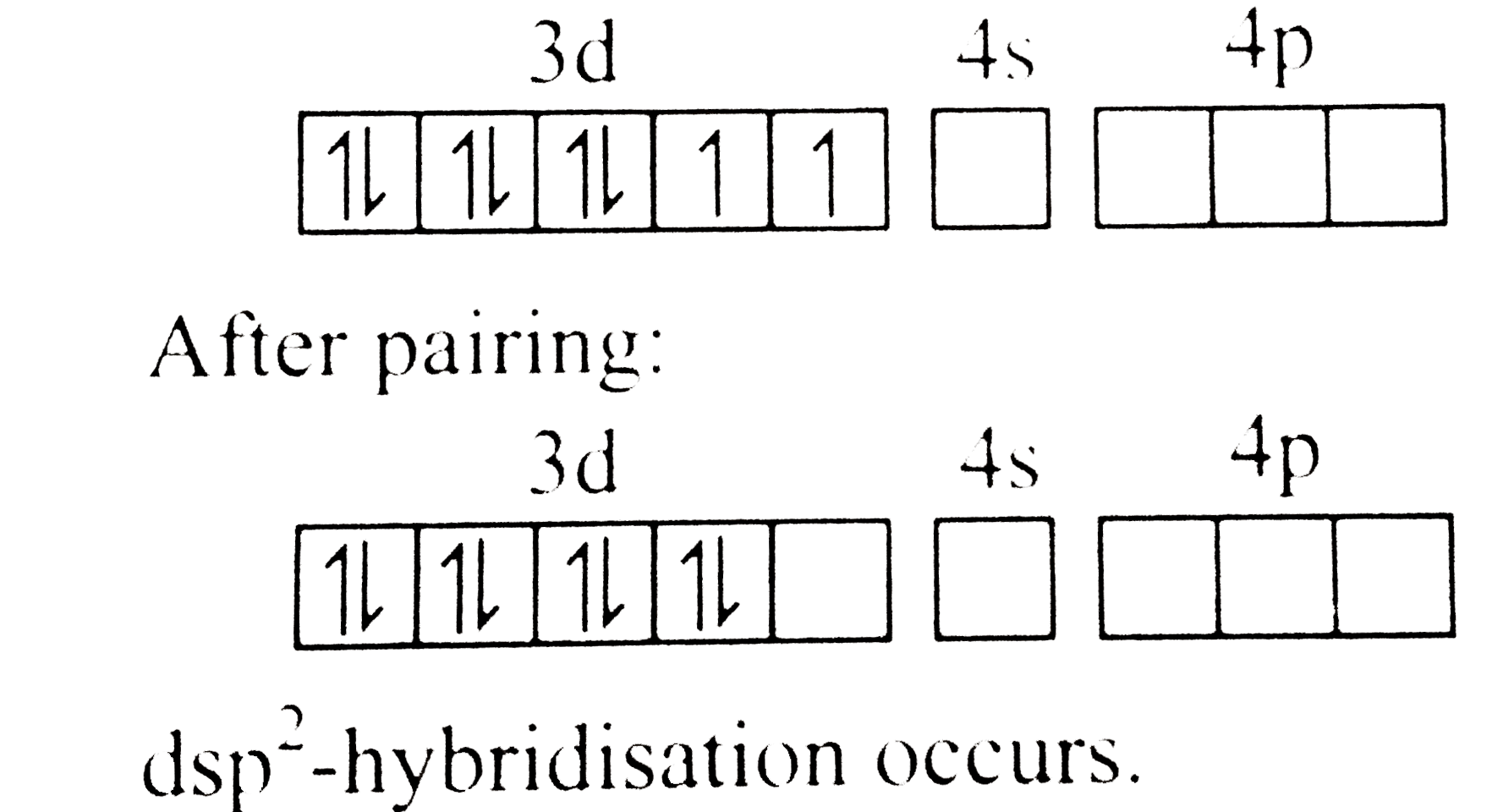
`NiCI_(2)` in the presence of dimethyl glyoxime `(DMG)` give a complex which precipitates in the presence of `NH_(4)OH` giving a bright-red colour The structure of the complex is The oxidation state of Ni in this compound is +2 The ligand is strong so it causes pairing Therefore it the shape `dsp^(2)` hybridisation The oxidation number =28
`Ni =[Ar] 3d^(8) 4s^(2)`
`Ni^(2+) =[Ar] 3d^(8)`
After pairing `dsp^(2)` hybridisation occurs There are no unpaired electrons, so the complex diamagnetic
Promotional Banner

Topper's Solved these Questions

  • COORDINATION COMPOUNDS

    CENGAGE CHEMISTRY ENGLISH|Exercise Archives True/False|1 Videos
  • CHEMICAL KINETICS

    CENGAGE CHEMISTRY ENGLISH|Exercise Archives Subjective|23 Videos
  • D AND F BLOCK ELEMENTS

    CENGAGE CHEMISTRY ENGLISH|Exercise Archives Subjective|29 Videos

Similar Questions

Explore conceptually related problems

NiCI_(2) in the presence of dimethy1 glyoxime (DMG) gives a complex which precipitates in the presence of NH_(4)OH giving a bright red colour . (a) Draw its structure and show H bonding (b) Give the oxidation state of Ni and its hybridisation (c ) Predict whether it is paramagnetic or dimagnetic .

When diemethyl glyoxime is added to the aqueous solution of nickel (II) chloride in presence of dilute ammonia solution, a bright red coloured precipitate is obtained . (a) Draw the structure of bright red substance . (b) Write the oxidation state of nickel in the substance and hybridisation. (c ) State whether the substance is paramagnetic or diamagnetic.

Nickel chloride, when treated with dimethyl gyloxime in presence of ammonium hydroxide, a bright red precipitate is obtained. Answer the following: (a) Draw the structure of the complex showing H-bonds (b) Give oxidation state of nickel and its hybridization (c) Predict the magnetic behaviour of the complex

Dimethyl glyoxime gives a red precipitate with Ni^(2+) , which is used for its detection. To get this precipitate readily the best pH range is

A metal salt solution when treated with dimethyl glyoxime and NH_(4)OH give a rose red complex.The metal is

A metal complex having composition Cr(NH_(3))_(4)CI_(2)Br has been isolated in two forms A and B. The form A reacts with AgNO_(3) to give a white precipitate readily soluble in dilute aqueous ammonia whereas B gives a pale yellow precipitate soluble in concentrated ammonia. (i) Write the formulae of isomers A and B. (ii) State the hybridisation of chromium in each of them. (iii) Calculate the magnetic moment (spin only) of the isomer A.

(a) Draw Lewis structures for : (i) Ethanol (C_2 H_5 O H) (ii) BrNO (iii) HOCN (b) Give an isomeric structure for NH_2 OH and explain which structure is more stable.

(i) An organic compound A with molecular formula C_(7)H_(8) on oxidation by chromyl chloride in the presence of C Cl_(4) gives a compound B which gives positive Tollen's test. The compound B on treatment with NaOH followed by acid hydrolysis gives two product C and D. C on oxidation gives B which on further oxidation gives D. the compound D on distillation with sodalime gives a hydrocarbon E. Below 60^(@)C , concentrated nitric acid reacts with E in the presence of concentrated sulphuric acid forming a compound F. identify the compounds A,B,C,D,E and F. (ii) Give chemical test to distinguish : Formaldehyde and acetaldehyde.

A white crystalline compound (X) swells open heating and gives violet-coloured flame. Its aqueous solution gives the following reactions : (a) A white precipitate is formed, with BaCl_(2) in presence of HCl . (b) When treated with excess of NH_(4) OH , it gives white gelatinous precipitate. the white precipitate dissolves in NaOH and reappears on boiling with concentrated solution of NH_(4) Cl . ( c) It gives yellow precipitate with cobaltinitrite solution. Identify (X) and explain the reaction at steps a, b and c .

Give reason for the following : (i) Mn shows the highest oxidation state of +7 with oxygen but with fluorine, it shows the highest oxidation state of +4 (ii) Transition metals show variable oxidation states. (iii) Actinoids show irregularities in their electronic configurations.

CENGAGE CHEMISTRY ENGLISH-COORDINATION COMPOUNDS-Archives Subjective
  1. Write the balanced chemical equations for the following "Potassium fer...

    Text Solution

    |

  2. Give reasons in two or three sentences only for the following "The s...

    Text Solution

    |

  3. The acidic aqueous solution of ferrous ion forms a brown complex in th...

    Text Solution

    |

  4. Identify the complexes which are expected to be coloured. a. [Ti(NO(...

    Text Solution

    |

  5. Write the IUPAC name for the following compounds (a) [Co(NH(3))(5)O...

    Text Solution

    |

  6. Write the IUPAC name for [Cr(NH(3))(5)CO(3)]CI .

    Text Solution

    |

  7. Write a balanced equation for the reaction of argentite with KCN and n...

    Text Solution

    |

  8. Write the formulae of the following complexes (a) Pentamminechloroco...

    Text Solution

    |

  9. A,B and C are three complexes of chromium(III) with the empirical form...

    Text Solution

    |

  10. An aqueous solution containing one mole of HgI2 and two moles of NaI i...

    Text Solution

    |

  11. Draw the structures of [Co(NH(3))(6)]^(3+),[Ni(CN)(4)]^(2-) and [Ni(CO...

    Text Solution

    |

  12. A metal complex having composition Cr(NH(3))(4)CI(2)Br has been isolat...

    Text Solution

    |

  13. The magnitude of magnetic moment (spin only ) of [NiCl(4)]^(2-) will b...

    Text Solution

    |

  14. Write the IUPAC nomenclature of the given complex along with its hybr...

    Text Solution

    |

  15. NiCl(2) in the presence of dimethyl glyoxime (DMG) gives a complex wit...

    Text Solution

    |

  16. Aluminium trifluoride is insoluble in anhydrous HF but dissolves on ad...

    Text Solution

    |

  17. Write the balanced chemical equations for developing a black and white...

    Text Solution

    |

  18. Fe^(3+)overset(SNC^(Θ)("Excess"))rarrunderset("Bloodre"d)(A)overset(F^...

    Text Solution

    |

