Home
Class 12
CHEMISTRY
HgCI(2)+ "excess of" KI rarr (A) underse...

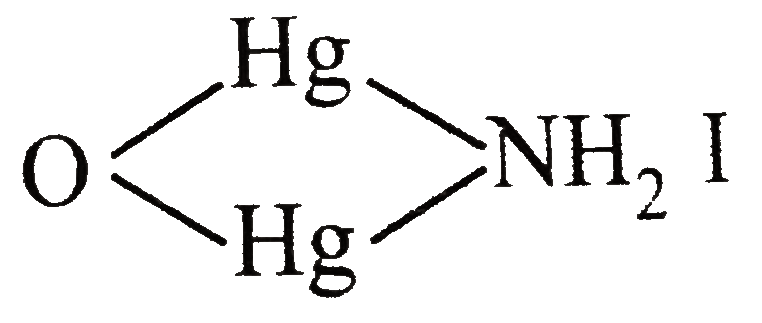
`HgCI_(2)+ "excess of" KI rarr (A) underset(NH_(3)) to (B)` ,(A) and (B) respectively are

A

B

`(Y),(X)`

C

both (X)

D

both (Y)

Text Solution

AI Generated Solution

The correct Answer is:

To solve the question, we need to determine the compounds A and B formed from the reaction of mercury(II) chloride (HgCl₂) with excess potassium iodide (KI) and then with ammonia (NH₃) and sodium hydroxide (NaOH). ### Step-by-Step Solution: 1. **Reaction of HgCl₂ with KI**: - When mercury(II) chloride (HgCl₂) reacts with excess potassium iodide (KI), it undergoes a double displacement reaction. - The reaction can be represented as: \[ \text{HgCl}_2 + 2 \text{KI} \rightarrow \text{HgI}_2 + 2 \text{KCl} \] - Here, mercuric iodide (HgI₂) is formed, which is a scarlet precipitate. Thus, we identify **A** as: \[ A = \text{HgI}_2 \quad (\text{scarlet precipitate of mercuric iodide}) \] 2. **Further Reaction of HgI₂ with NH₃ and NaOH**: - The next step involves treating the mercuric iodide (HgI₂) with ammonia (NH₃) and sodium hydroxide (NaOH). - The reaction can be represented as: \[ \text{HgI}_2 + 2 \text{KI} + 2 \text{NH}_3 + 2 \text{NaOH} \rightarrow \text{K}_2\text{HgI}_4 + 2 \text{NaCl} + 2 \text{NH}_4\text{I} \] - The product formed in this reaction is potassium tetraiodomercurate(II) (K₂HgI₄), which is also known as Nessler's reagent. Thus, we identify **B** as: \[ B = \text{K}_2\text{HgI}_4 \quad (\text{Nessler's reagent}) \] ### Final Answer: - **A** = HgI₂ (scarlet precipitate of mercuric iodide) - **B** = K₂HgI₄ (Nessler's reagent)
Promotional Banner

Topper's Solved these Questions

  • QUALITATIVE INORGANIC SALT ANALYSIS

    CENGAGE CHEMISTRY ENGLISH|Exercise Viva Voce Questions And Part-A (Analysis Of Anions)|30 Videos
  • QUALITATIVE INORGANIC SALT ANALYSIS

    CENGAGE CHEMISTRY ENGLISH|Exercise Viva Voce Questions And Part-B (Dry Tests)|9 Videos
  • QUALITATIVE INORGANIC SALT ANALYSIS

    CENGAGE CHEMISTRY ENGLISH|Exercise Ex 8.1|14 Videos
  • P-BLOCK GROUP 18 ELEMENTS - THE INERT GASES

    CENGAGE CHEMISTRY ENGLISH|Exercise Ex 5.1 (Objective)|14 Videos
  • REDUCTION AND OXIDATION REACTION OF ORGANIC COMPOUNDS

    CENGAGE CHEMISTRY ENGLISH|Exercise SUBJECTIVE TYPE|4 Videos

Similar Questions

Explore conceptually related problems

Ketone (A) overset(NH_(2)OH.HCl)rarr (B) overset(H^(o+))rarr The ketone (A) and compound (B), respectively, are: Ketone (A) I. Compound (B)

(A)+NaCl to (B) (white ppt.) (B)+Kito(C) (green ppt). (C)+underset(("excess"))(KI) to (D)+(E) (colourless solution) (E)+NH_(3)+KOH to (F) Q. Compounds (A) and (B) are respectively:

KO_(2) + CO_(2) + H_(2)O underset(CO_(2))overset("more")(rarr) A + B , then A and B are respectively

Aldehyde (A) overset(NH_(2)OH.HCl)rarr (B) overset(H^(o+))rarr Me NH_(2)+HCOOH Aldehyde (A) and compound (B), respectively are: Aldehyde (A) I. MeCHO II. HCHO Compound (B) III.

In the chemical reaction , CH_(3)CH_(2)NH_(2) +CHCl_(3) +3KOH to (A) +(B) +3H_(2)O The compounds (A) and (B) are respectively:

Cl_2 + NH_3 (excess) to A+B

CH_(3)-CH_(2)-underset(O)underset(||)C-NH_(2)overset(A)rarrCH_(3)-CH_(2)-NH_(2) overset(B)rarrCH_(3)-CH_(2)-OH In the above sequence A & B respectively are-

CH_(3)CH_(2)NH_(2) overset((CH_(3)CO)_(2)O)underset(Delta) to A+B , (A) and (B) are

CH_(3)CH_(2)NH_(2) overset((CH_(3)CO)_(2))underset(Delta) to A+B , (A) and (B) are

CENGAGE CHEMISTRY ENGLISH-QUALITATIVE INORGANIC SALT ANALYSIS-Ex 8.2
  1. Aluminium sulphate (X) is slightly insoluble in water it is convert...

    Text Solution

    |

  2. CoCI(2) gives blue colour with NH(4)SCN due to formation of

    Text Solution

    |

  3. HgCI(2)+ "excess of" KI rarr (A) underset(NH(3)) to (B) ,(A) and (B) ...

    Text Solution

    |

  4. NH(4)SCN can be used to test ion or more out of Fe^(3+) ,Co^(2+),Cu...

    Text Solution

    |

  5. K(4)[Fe(CN)(6)] can be used to detect one or more out of Fe^(2+)...

    Text Solution

    |

  6. Aqueous solution of borax reacts with two moles of acid. This is becau...

    Text Solution

    |

  7. Ag(2)S is soluble in NaCN due to formation of

    Text Solution

    |

  8. A compound give violet flame rest and gives a white ppt with AgNO(3...

    Text Solution

    |

  9. Bromine vapours turms ……..paper blue

    Text Solution

    |

  10. Solution of a salt in sulphanilic acid a naphithy lamine give red pp...

    Text Solution

    |

  11. Solution of a salt in dil H(2)SO(4) produces deep blue colour with st...

    Text Solution

    |

  12. The gas which turns mercurous nitrate paper black is

    Text Solution

    |

  13. A mixture when heated with dil H(2)SO(4) does not evolve brown vapour...

    Text Solution

    |

  14. To solution of a salt in acid medium AgNO(3) is added a white ppts r...

    Text Solution

    |

  15. Nitrite and nitrite both respond to ring test Nitrate are removed b...

    Text Solution

    |

  16. Which of the following metal oxide is white in colour but become ...

    Text Solution

    |

  17. Chromyl chloride test is preformed for the detection of CI^(Theta)...

    Text Solution

    |

  18. The chromyl chloride test responds poorly with the chlorides of Pb,Ag...

    Text Solution

    |

  19. When a salt is heated with dil H(2)SO(4) and KMnO(4) solution the pi...

    Text Solution

    |

  20. Ring test for mirates conformed by acidifying prepared FeSO(4) soi...

    Text Solution

    |
