Home
Class 12
CHEMISTRY
The HNH angle value is higher than HPH, ...

The HNH angle value is higher than HPH, HAsH and HSbH angles. Why?
[Hint: Can be explained on the basis of `sp_(3)` hybridisation in `NH_(3)` and only s–p bonding between hydrogen and other elements of the group].

Text Solution

Verified by Experts
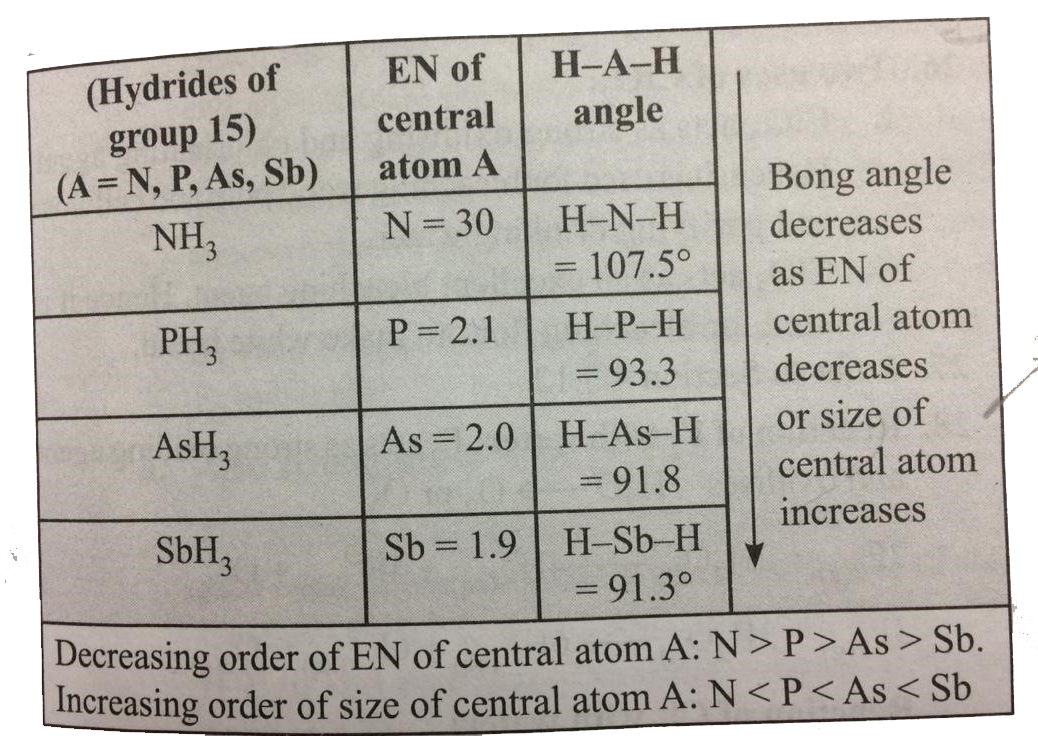
Calculation of bond angle:
(a). The concept of EN has been found to be very useful to explain the variation of bond angle.
For example, for `AB_x` type molecule (A) is the central atom, B are the atoms attached with atom A and x is the number og B atoms), the `B-A-B` bond angle is changed with the change of EN of central atom or with change of size of central atom.
Rule (i): If the EN of central atom decreases or/and size increases bond angle decreases.
Bond angle `(B-A-B)propEN` central atoms and
`prop(1)/("Size of central atom")`
In all hydrides of group 15 elements the central atom is `sp^3-`hydridised Three of the four `sp^3` orbitals form three `A-H`,`sigma`- ponds while the fourth contains the lone pair of electrons.
Since the `(lp-lp)` repulsions are larger than the `(bp-bp)` repulsions therefore in `NH_3` the bond angle decreases from `109.28^@` to `107.5^@` Down the group `(darr)`, the electronegativity of tbhe central atom goes on decreasing as a result bond pairs of electrons lie away and away from the central atom. In other words, force of repulsion between the adjacent bond pairs goes on decreasing and consequently the bond angles keep on decreasing from `NH_3` to `SbH_3` as shown in table. Bond angle order is
`NH_3(107.5^@)gtPH_3(93.3^@)gtAsH_3(91.8@)`
Change of bond angle of hydrides of groups 15 with change of EN and size of central atom.
Promotional Banner

Topper's Solved these Questions

  • APPENDIX INORGANIC VOLUME 2

    CENGAGE CHEMISTRY ENGLISH|Exercise Short Answer Type|179 Videos
  • APPENDIX INORGANIC VOLUME 2

    CENGAGE CHEMISTRY ENGLISH|Exercise Short Answer Type|179 Videos
  • ALIPHATIC AND AROMATIC ALDEHYDES AND KETONES

    CENGAGE CHEMISTRY ENGLISH|Exercise Archives Subjective|26 Videos
  • AROMATIC COMPOUNDS AND ALKYL AND ARYL HALIDES

    CENGAGE CHEMISTRY ENGLISH|Exercise Archives Subjective Type|4 Videos

Similar Questions

Explore conceptually related problems

Bond angle in PH_(4)^(+) is higher than that in PH_(3) .Why ?

C-O-C bond angle in ether is more than H-O-H bond angle in water although oxygen is sp^(3) hybridised in both the cases. Explain

The transition element ( with few exceptions ) show a large number of oxidation states . The various oxidation states are related to the electronic configuration of their atoms. The variable oxidation states of a transition metal is due to the involvement of (n-1)d and outer ns electrons . For the first five elements of 3d transition series , the minimum oxidation state is equal to the number of electrons in 4s shell and the maximum oxidation state is equal to the sum of 4s and 3d electrons. The relative stability of various oxidation states of a given element can be explained on the basis of stability of d^(0),d^(5) and d^(10) configuration . In which of the following pairs , the first species is more stable than second one

Bond angle in NH_(3) is more than in PH_(3). Explain.

Explain why bond angle of NH_(3) is greater than NF_(3) while bond angle of PH _(3) is less than that of PF _(3),

Most of the polyatomic molecules except a few such as CO_(2) and CS_(2) are linear or angular with a bond angle generally somewhat greater than 90^(@) A bond angle is defined as the angle between the direction of two covalent bonds Since the atoms in molecules are in constant motion with respect to each other they are not expected to have a fixed value of bond angle Repulsion between non-bonded atoms alone does not provide an adequate explanation Hybridisation of bonding orbitals an adequate explanation Hybridisation of bonding orbitals also plays a very important role in detrmining the value of bond angle It has been observed that in hybridisation as the s-character of hybrid orbital increases the bond angle increases In P_(4) molecule phosphorous atoms are tetrahedrally arranged The angle P-P-P in the molecule is .

All the boron trihalides except BI_(3) may be prepared by direction between the elements. Boron trihalides consist of trigonal-planar BX_(3) molecules. Unlike the halides of the other elements in the group they are monomeric in the gas, liquid and solid states, BF_(3) and BCl_(3) are gases, BBr_(3) is a volatile liquid and BI_(3) is a solid. Boron trihalides are Lewis acids because they form simple Lewis complexes with suitable bases, as in the reaction: BF_(3)(g)+NH_(3)(g)toF_(3)B-NH_(3)(s) However, boron chlorides, bromides and iodides are susceptible (sensitive) to protolysis by mild proton sources such as water, alcohols and even amines, for example BCl_(3) undergoes rapid hydrolysis: BCl_(3)(g)+3H_(2)O(l)toB(OH)_(3)(aq)+3HCl (aq) It is supposed that the first step in the above reaction is the formation of the complex Cl_(3)B larr OH_(2) which then eliminates HCl and reacts with water. Which of the following is the correct prediction about observed B-X bond length, in BX_(3) molecules?

All the boron trihalides except BI_(3) may be prepared by direction between the elements. Boron trihalides consist of trigonal-planar BX_(3) molecules. Unlike the halides of the other elements in the group they are monomeric in the gas, liquid and solid states, BF_(3) and BCl_(3) are gases, BBr_(3) is a volatile liquid and BI_(3) is a solid. Boron trihalides are Lewis acids because they form simple Lewis complexes with suitable bases, as in the reaction: BF_(3)(g)+NH_(3)(g)toF_(3)B-NH_(3)(s) However, boron chlorides, bromides and iodides are susceptible (sensitive) to protolysis by mild proton sources such as water, alcohols and even amines, for example BCl_(3) undergoes rapid hydrolysis: BCl_(3)(g)+3H_(2)O(l)toB(OH)_(3)(aq)+3HCl (aq) It is supposed that the first step in the above reaction is the formation of the complex Cl_(3)B larr OH_(2) which then eliminates HCl and reacts with water. Which of the follwoing is the best order of Lewis acid strength of BF_(3),BCl_(3) and BBr_(3) ?

All the boron trihalides except BI_(3) may be prepared by direction between the elements. Boron trihalides consist of trigonal-planar BX_(3) molecules. Unlike the halides of the other elements in the group they are monomeric in the gas, liquid and solid states, BF_(3) and BCl_(3) are gases, BBr_(3) is a volatile liquid and BI_(3) is a solid. Boron trihalides are Lewis acids because they form simple Lewis complexes with suitable bases, as in the reaction: BF_(3)(g)+NH_(3)(g)toF_(3)B-NH_(3)(s) However, boron chlorides, bromides and iodides are susceptible (sensitive) to protolysis by mild proton sources such as water, alcohols and even amines, for example BCl_(3) undergoes rapid hydrolysis: BCl_(3)(g)+3H_(2)O(l)toB(OH)_(3)(aq)+3HCl (aq) It is supposed that the first step in the above reaction is the formation of the complex Cl_(3)B larr OH_(2) which then eliminates HCl and reacts with water. Which of the following reactions is incorrect ?

Assertion: The bond angle in alcohols is slighty less than the tetrahedral angle. Reason : In alcohols, the oxygen of the -OH group is attached to carbon by a sigma bond formed by the overlap a sp^3 hybridised orbital of carbon with sp^3 hybridised orbital of oxygen .

CENGAGE CHEMISTRY ENGLISH-APPENDIX INORGANIC VOLUME 2-Exercises
  1. Pb + conc. HNO(3) gives

    Text Solution

    |

  2. Give the resonating structures of NO(2) and N(2)O(5).

    Text Solution

    |

  3. The HNH angle value is higher than HPH, HAsH and HSbH angles. Why? ...

    Text Solution

    |

  4. Why does R(3)P = O exist but R(3)N = O does not (R = alkyl group)?

    Text Solution

    |

  5. Explain why NH(3) is basic while BiH3 is only feebly basic.

    Text Solution

    |

  6. Nitrogen exists as diatomic molecule and phosphorus as P(4). Why?

    Text Solution

    |

  7. Write main differences between the properties of white phosphorus and ...

    Text Solution

    |

  8. Why does nitrogen show catenation properties less than phosphorus ?

    Text Solution

    |

  9. Give the disproportionation reaction of H(3)PO(3).

    Text Solution

    |

  10. Can PCl(5) act as an oxidising as well as a reducing agent? Justify.

    Text Solution

    |

  11. Justify the placement of O, S, Se, Te and Po in the same group of the ...

    Text Solution

    |

  12. Why is dioxygen a gas but sulphur a solid?

    Text Solution

    |

  13. Knowing the electron gain enthalpy values for O to O^(-) and O to O^(...

    Text Solution

    |

  14. Which aerosols deplete ozone?

    Text Solution

    |

  15. Describe the manufacture of H(2)SO(4) by contact process?

    Text Solution

    |

  16. How is SO(2) an air pollutant?

    Text Solution

    |

  17. Why are halogens strong oxidising agents?

    Text Solution

    |

  18. Explain why fluorine forms only one oxoacid, HOF.

    Text Solution

    |

  19. Although chlorine and oxygen have nearly same electronegativity yet on...

    Text Solution

    |

  20. Write two uses of ClO(2).

    Text Solution

    |

