Home
Class 12
CHEMISTRY
Why does R(3)P = O exist but R(3)N = O d...

Why does `R_(3)P = O` exist but `R_(3)N = O` does not (R = alkyl group)?

Text Solution

Verified by Experts
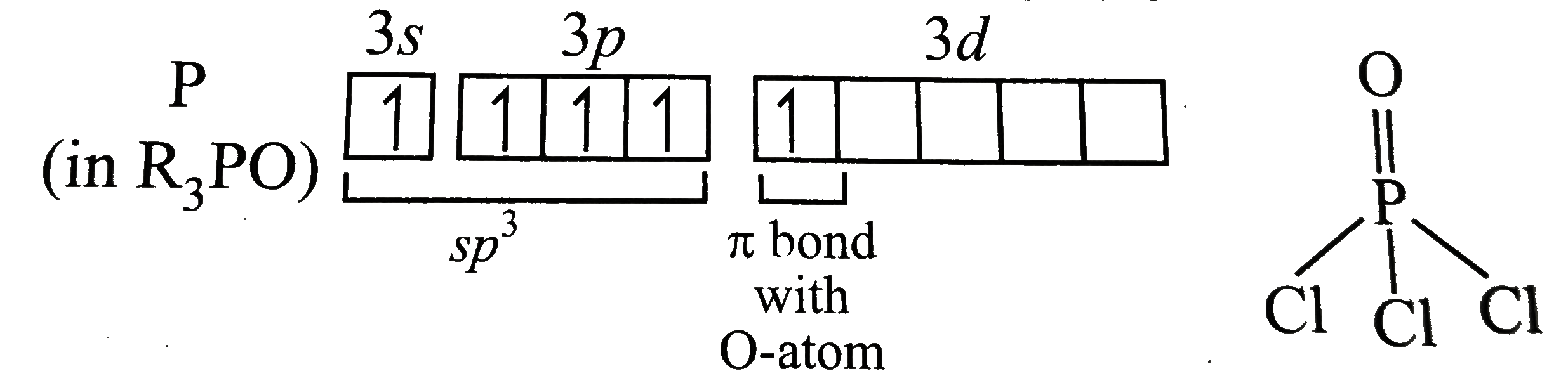
`R_3P=O` exists as P due to presence of d-orbitals form
`dpi-ppi` bond with O-atom and hence expands its covalency to five. On the other hand `R_3N=0` does not exist, as N due to absence of d-orbitals in its valence shell cannot expand its covalency beyond four.
Promotional Banner

Topper's Solved these Questions

  • APPENDIX INORGANIC VOLUME 2

    CENGAGE CHEMISTRY ENGLISH|Exercise Short Answer Type|179 Videos
  • APPENDIX INORGANIC VOLUME 2

    CENGAGE CHEMISTRY ENGLISH|Exercise Short Answer Type|179 Videos
  • ALIPHATIC AND AROMATIC ALDEHYDES AND KETONES

    CENGAGE CHEMISTRY ENGLISH|Exercise Archives Subjective|26 Videos
  • AROMATIC COMPOUNDS AND ALKYL AND ARYL HALIDES

    CENGAGE CHEMISTRY ENGLISH|Exercise Archives Subjective Type|4 Videos

Similar Questions

Explore conceptually related problems

(a) Complete the followingh chemical reaction equations : (i) Cu+HNO_(3 (dilute))to (ii) P_4+NaOH+H_2Oto (b) (i) why does R_3P=O exist but R_3N=O does not ? (R=alkyl group) (ii) why is dioxygen a gas but sulphur a solid ? (iii) why are halogens coloured ?

Why does R_3P=0 exist but R_3N=0 does not (R= alkyl group)?

Give reasons for the following : (i) Where R is an alkyl group, R_(3)P=O" exists but "R_(3)N=O does not. (ii) PbCl_(4)" is more covalent than "PbCl_(2). (iii) At room temperature, N_(2) is much less reactive.

CIF_3 exists but FCl_3 does not exist. Why?

Ketones (R-overset(O)overset("||")C-R') can be obtained in one step by (where R and R' are alkyl groups)

Why does O_3 act as a powerful oxidising agent?

A : Tailing of Hg caused by ozone is due to formation of HgO . R : In the presence of O_(3) , Hg does not loses its meniscus .

Statement-I: Unlike the gtC=O group of aldehydes and ketones, the C=O of R-overset(O)overset(||)C-OH does not undergo nucleophilic addition reactions. Because Statement-II: Carboxylic acids exist as dimers due to intermolecular hydrogen bonding in aprotic medium.

Given n sraight lines and a fixed point O.A straight line is drawn through O meeting these lines in the points R_(1),R_(2),R_(3),……R_(n) and a point R is taken on it such that n/(OR)= sum_(r=1)^(n) 1/(OR_(r)) , Prove that the locus of R is a straight line .

(a) Why elemental phosphorous does not exist as P_2 like N_2 ? (b) NCl_3 gets easily hydrolysed, while NF_3 does not. Why ?

CENGAGE CHEMISTRY ENGLISH-APPENDIX INORGANIC VOLUME 2-Exercises
  1. Give the resonating structures of NO(2) and N(2)O(5).

    Text Solution

    |

  2. The HNH angle value is higher than HPH, HAsH and HSbH angles. Why? ...

    Text Solution

    |

  3. Why does R(3)P = O exist but R(3)N = O does not (R = alkyl group)?

    Text Solution

    |

  4. Explain why NH(3) is basic while BiH3 is only feebly basic.

    Text Solution

    |

  5. Nitrogen exists as diatomic molecule and phosphorus as P(4). Why?

    Text Solution

    |

  6. Write main differences between the properties of white phosphorus and ...

    Text Solution

    |

  7. Why does nitrogen show catenation properties less than phosphorus ?

    Text Solution

    |

  8. Give the disproportionation reaction of H(3)PO(3).

    Text Solution

    |

  9. Can PCl(5) act as an oxidising as well as a reducing agent? Justify.

    Text Solution

    |

  10. Justify the placement of O, S, Se, Te and Po in the same group of the ...

    Text Solution

    |

  11. Why is dioxygen a gas but sulphur a solid?

    Text Solution

    |

  12. Knowing the electron gain enthalpy values for O to O^(-) and O to O^(...

    Text Solution

    |

  13. Which aerosols deplete ozone?

    Text Solution

    |

  14. Describe the manufacture of H(2)SO(4) by contact process?

    Text Solution

    |

  15. How is SO(2) an air pollutant?

    Text Solution

    |

  16. Why are halogens strong oxidising agents?

    Text Solution

    |

  17. Explain why fluorine forms only one oxoacid, HOF.

    Text Solution

    |

  18. Although chlorine and oxygen have nearly same electronegativity yet on...

    Text Solution

    |

  19. Write two uses of ClO(2).

    Text Solution

    |

  20. Why are halogens coloured?

    Text Solution

    |

