Home
Class 12
CHEMISTRY
What can be inferred from the magnetic m...

What can be inferred from the magnetic moment values of the following complex species ?`{:("Example","Magnetic",(BM)),(K_(4)[Mn(CN)_(6)),2.2),([Fe(H_(2)O)_(6)]^(2+),5.3),(K_(2)[MnCl_(4)],5.9):}`

Text Solution

Verified by Experts
The value of magnetic moment `(mu)` in `(BM)` are as follows:
When `n=1,mu=sqrt(3)=1.75`
`n=2,mu=sqrt(8)=2.76`
`n=3,mu=sqrt(15)=3.86`
`n=4,mu=sqrt(24)=4.80`
`n=5,mu=sqrt(35)=5.96`
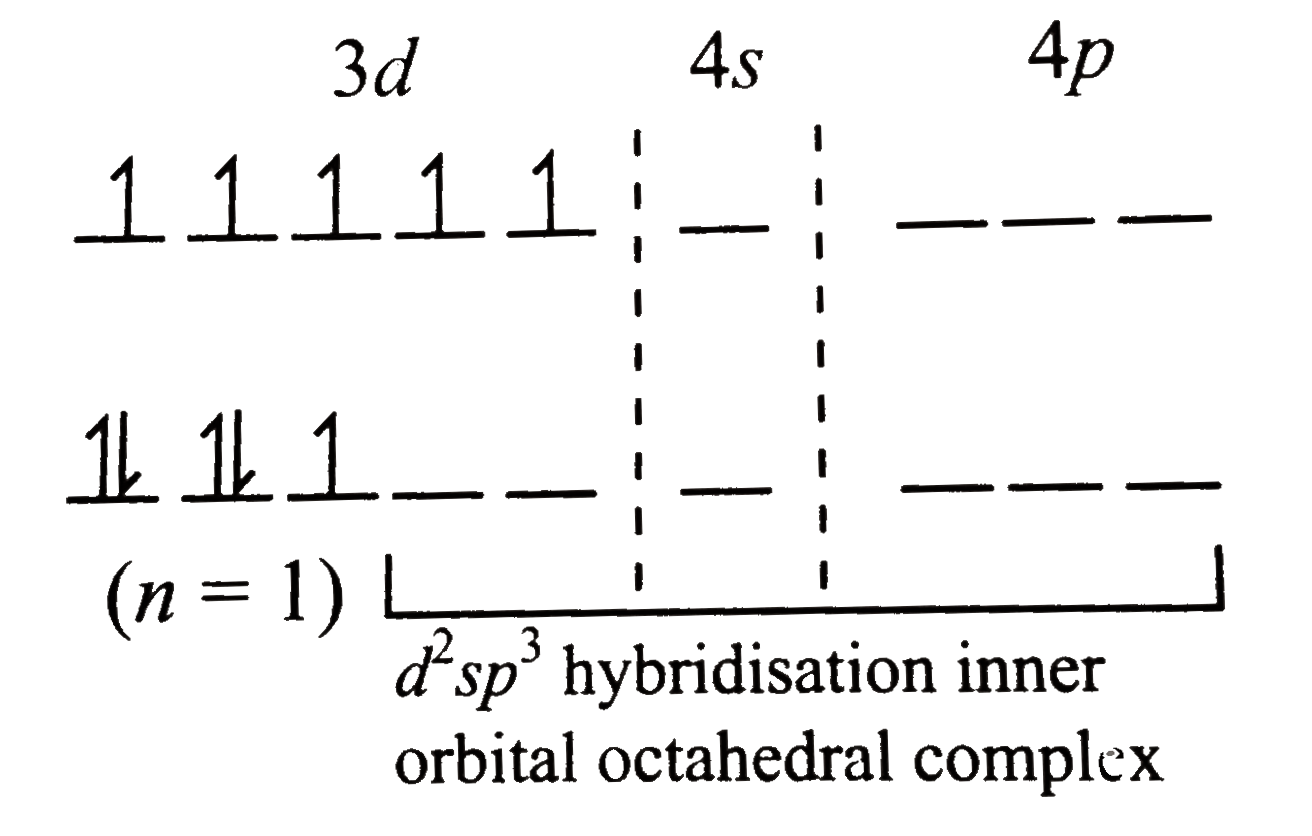
(a). `K_4(Mn(CN)_6]^(4-),Mn^(2+)=3d^(5),mu=2.2BM`
`mu` value suggest that it has only one unpaired electron, which is due to the pairing of electrons by strong field `CN^(ɵ)` ligand.

(b). `[Fe(H_2O)_6]^(2+),Fe^(2+)=3d^(6),mu=5.3BM`
`mu` value suggest that it has 4 unpaired electrons. Since `H_2O` is a weak field ligand, thus no pairing of d-electrons occurs.

(c). `K_2[MnCl_4]Mn^(2+)=3d^(5),mu=5.92BM`
`mu` value suggests that it has 5 unpaired electrons. Since `Cl^(ɵ)` ion is a wak field ligand thus no pairing of d-electrons occurs.
Promotional Banner

Topper's Solved these Questions

  • APPENDIX INORGANIC VOLUME 2

    CENGAGE CHEMISTRY ENGLISH|Exercise Short Answer Type|179 Videos
  • APPENDIX INORGANIC VOLUME 2

    CENGAGE CHEMISTRY ENGLISH|Exercise Short Answer Type|179 Videos
  • ALIPHATIC AND AROMATIC ALDEHYDES AND KETONES

    CENGAGE CHEMISTRY ENGLISH|Exercise Archives Subjective|26 Videos
  • AROMATIC COMPOUNDS AND ALKYL AND ARYL HALIDES

    CENGAGE CHEMISTRY ENGLISH|Exercise Archives Subjective Type|4 Videos

Similar Questions

Explore conceptually related problems

K_(4)[Fe(CN)_(6)]+2ZnSO_(4) to Zn_(2)[Fe(CN)_(6)]darr+2K_(2)SO_(4)

Correct order of magnetic moment (spin only) for the following complexes (a) [Pd(PPh_(3))_(2)Cl_(2)] (b) [Ni(CO)_(4)] (c) [Ni(CN)_(4)]^(2-) (d) [Ni(H_(2)O)_(6)]^(2+)

The magnetic moment of a complex ion is 2.83BM The complex ion is [Cr(H_(2))O)_(6)]^(3+) (b) [Cu(CN)_(6)]^(2-) (c ) [V(H_(2)O))_(6)]^(3+) (d) [MnCI_(4)]^(2-) .

The magnetic moment of a complex ion is 2.83BM The complex ion is (a) [Cr(H_(2)O)_(6)]^(3+) (b) [Cu(CN)_(6)]^(2-) (c ) [V(H_(2)O)_(6)]^(3+) (d) [MnCI_(4)]^(2-) .

K_(4)[Fe(CN)_(6)]+2CuSO_(4)toCu_(2)[Fe(CN)_(6)]darr+2K_(2) SO_(4)

Which of the following complex ion has a magnetic moment same as [Cr(H_(2)O)_(6)]^(3+) ?

Using crystal field theory, draw energy level diagram, write electronic configuration of the central metal atom/ion and determine the magnetic moment value in the following (a) [CoF_(6)]^(3-), [Co(H_(2)O)_(6)]^(2+), [Co(CN)_(6)]^(3-) (b) FeF_(6)^(3-), [Fe(H_(2)O)_(6)]^(2+), [Fe(CN)_(6)]^(4-)

K_(4)[Fe(CN)_(6)]+2CuSO_(4)toCu_(2)[Fe(CN)_(6)]darr

Predict the hybridisation and geometry of the following complexes. (a) [Fe(CN)_(6)]^(3-) " " (b)[MnBr_(4)]^(2-)" " (c ) [Fe(H_(2)O)_(6)]^(2+)" " (d) [Co(SCN)_(4)]^(2-)

Write the state of hybridization, the shape and the magnetic behaviour of the following complex entities: (i) [Cr(NH_(3))_(4) Cl_(2)]Cl (ii) [Co Fe_(6)]^(3-) (iii) K_(2)[Ni(CH)_(4)]

CENGAGE CHEMISTRY ENGLISH-APPENDIX INORGANIC VOLUME 2-Exercises
  1. Write down the number of 3d electrons in each of the following ions: ...

    Text Solution

    |

  2. Comment on the statement that elements of the first transition series ...

    Text Solution

    |

  3. What can be inferred from the magnetic moment values of the following ...

    Text Solution

    |

  4. Which of the following postulates of kinetic theory of gases is not co...

    Text Solution

    |

  5. FeSO(4) solution mixed with (NH(4))(2)SO(4) solution in 1:1 molar rati...

    Text Solution

    |

  6. Explain with two examples each of the following: coordination entity, ...

    Text Solution

    |

  7. What is meant by unidentate, didentate and ambidentate ligands? Give t...

    Text Solution

    |

  8. Specify the oxidation numbers of the metals in the following coordinat...

    Text Solution

    |

  9. Using IUPAC norms write the formulas for the following (i) Tetrahydr...

    Text Solution

    |

  10. Using IUPAC norms write the systematic names of the following: (i). ...

    Text Solution

    |

  11. List various types of isomerism possible for coordinatior compounds, g...

    Text Solution

    |

  12. How many geometrical isomers are possible in the following coordinatio...

    Text Solution

    |

  13. Draw the structures of optical isomers of: [Cr(C(2)O(4))(3)]^(3-) ...

    Text Solution

    |

  14. Draw the structures of optical isomers of: [Cr(C(2)O(4))(3)]^(3-) ...

    Text Solution

    |

  15. Write all the geometrical isomers of [Pt(NH(3))(Br)(Cl)(py)] and how m...

    Text Solution

    |

  16. Aqueous copper sulphate solution (blue in colour) gives: (i) a green p...

    Text Solution

    |

  17. What is the coordination entity formed when excess of aqueous KCN is a...

    Text Solution

    |

  18. Discuss the nature of bonding in the following coordination entities o...

    Text Solution

    |

  19. The magnitude of CFSE (Crystal Field Splitting Energy , Delta(0)) can ...

    Text Solution

    |

  20. Write 1st 5 order and define What is spectrochemical series?

    Text Solution

    |