Home
Class 11
CHEMISTRY
Explain why alkyl groups act as electron...

Explain why alkyl groups act as electron donors when attached to a n system

Text Solution

Verified by Experts
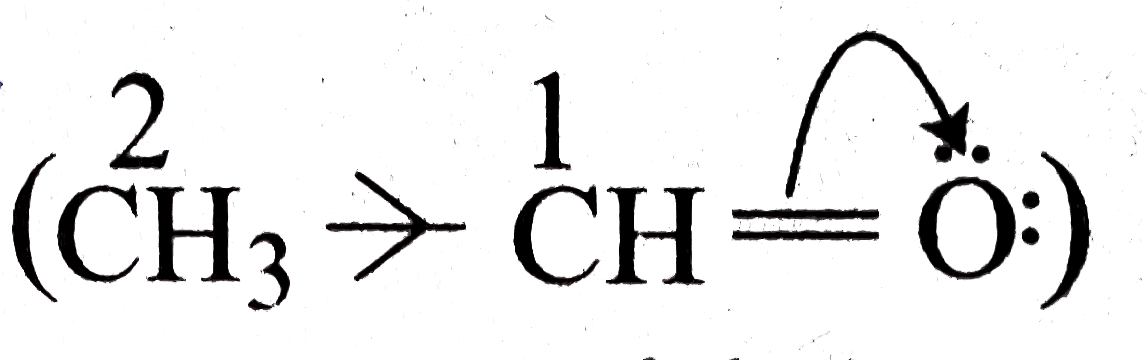
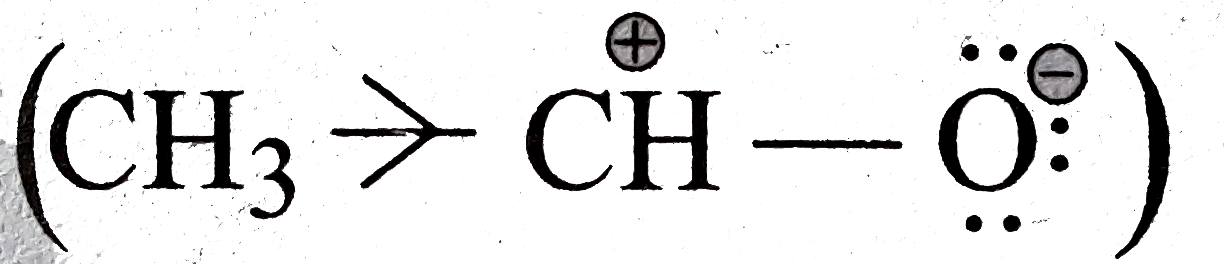
Alkyl is an electron-releasing group. It acts as an electron-donar species. The carbocations in which carbon atom has sextet configuration (and hence electron deficient) can receive a pair of electrons from the alkyl halide. In alkyl halide, the polarity of bond `(C - X)` has partical positive charge on carbon atom and hence the carbon atom becomes and electrophile centre at which a nucleophile can attack. Moreover, when alkyl group is attached to `pi-system` like in ethanol due to greater `EN` of `O` than `C,pi overline e^, s` are withdrawn by oxygen through electromeric effect and `C-1` aquires a positive change and oxygen atom acquires a negative charge . So to overcome the deficiency of `overline e` on `C-1, (CH_3)` group attached to it gives `sigma overline e^, s` to `C-1` and thus `(CH_3)` group acts as an `overline e` donar via inductive effect.
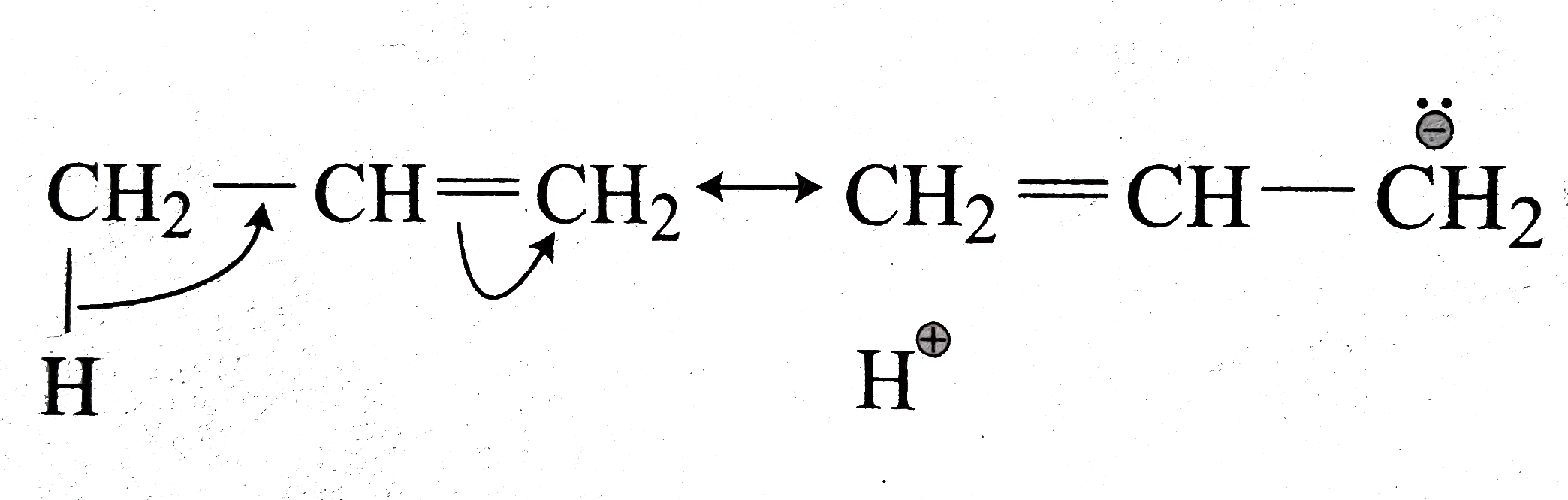
This can also be explained by hyperconjugation, e.g.,
.
Promotional Banner

Topper's Solved these Questions

  • GENERAL ORGANIC CHEMISTRY

    CENGAGE CHEMISTRY ENGLISH|Exercise Comprehension|20 Videos
  • GENERAL ORGANIC CHEMISTRY

    CENGAGE CHEMISTRY ENGLISH|Exercise Multiple Correct|22 Videos
  • GENERAL ORGANIC CHEMISTRY

    CENGAGE CHEMISTRY ENGLISH|Exercise Subjective|11 Videos
  • CLASSIFICATION AND NOMENCLATURE OF ORGANIC COMPOUNDS

    CENGAGE CHEMISTRY ENGLISH|Exercise Analytical and Descriptive Type|3 Videos
  • HYDROGEN, WATER AND HYDROGEN PEROXIDE

    CENGAGE CHEMISTRY ENGLISH|Exercise Subjective Archive (Subjective)|3 Videos

Similar Questions

Explore conceptually related problems

Explain why alkyl groups act as electron donors when attacted to a pi-system .

Explain why can more than 8 electrons not be accommodated in L shell?

The resonance effect is defined as 'the polarity produced in the molecule by the interaction of two pi -bonds or between a pi -bond and lone pair of electrons present on an adjacentatom.' The effect is transmitted through the chain. In positive resonance effect, the transfer of electrons is away from an atom or substituent group attached to the conjugated system. This electron displacement makes certain positions in the molecule of high electron densities. In negative resonance effect, the transfer of electrons is towards the atom or substituent group attached to the conjugated system. Which of the following does not show resonance effect ?

The resonance effect is defined as 'the polarity produced in the molecule by the interaction of two pi -bonds or between a pi -bond and lone pair of electrons present on an adjacentatom.' The effect is transmitted through the chain. In positive resonance effect, the transfer of electrons is away from an atom or substituent group attached to the conjugated system. This electron displacement makes certain positions in the molecule of high electron densities. In negative resonance effect, the transfer of electrons is towards the atom or substituent group attached to the conjugated system. What is the IUPAC name for :

The resonance effect is defined as 'the polarity produced in the molecule by the interaction of two pi -bonds or between a pi -bond and lone pair of electrons present on an adjacentatom.' The effect is transmitted through the chain. In positive resonance effect, the transfer of electrons is away from an atom or substituent group attached to the conjugated system. This electron displacement makes certain positions in the molecule of high electron densities. In negative resonance effect, the transfer of electrons is towards the atom or substituent group attached to the conjugated system. Which of the following shows +M effect ?

The resonance effect is defined as 'the polarity produced in the molecule by the interaction of two pi -bonds or between a pi -bond and lone pair of electrons present on an adjacentatom.' The effect is transmitted through the chain. In positive resonance effect, the transfer of electrons is away from an atom or substituent group attached to the conjugated system. This electron displacement makes certain positions in the molecule of high electron densities. In negative resonance effect, the transfer of electrons is towards the atom or substituent group attached to the conjugated system. Which of the following carboxylate ions is the most stable ?

The resonance effect is defined as 'the polarity produced in the molecule by the interaction of two pi -bonds or between a pi -bond and lone pair of electrons present on an adjacentatom.' The effect is transmitted through the chain. In positive resonance effect, the transfer of electrons is away from an atom or substituent group attached to the conjugated system. This electron displacement makes certain positions in the molecule of high electron densities. In negative resonance effect, the transfer of electrons is towards the atom or substituent group attached to the conjugated system. Which of the following intermediates is pyramidal in shape ?

The resonance effect is defined as 'the polarity produced in the molecule by the interaction of two pi -bonds or between a pi -bond and lone pair of electrons present on an adjacent atom.' The effect is transmitted through the chain. In positive resonance effect, the transfer of electrons is away from an atom or substituent group attached to the conjugated system. This electron displacement makes certain positions in the molecule of high electron densities. In negative resonance effect, the transfer of electrons is towards the atom or substituent group attached to the conjugated system. Which of the following free radicals is the most stable ?

Explain why : Fluorine has lower electron affinity than chlorine.

The resonance effect is defined as 'the polarity produced in the molecule by the interaction of two pi -bonds or between a pi -bond and lone pair of electrons present on an adjacentatom.' The effect is transmitted through the chain. In positive resonance effect, the transfer of electrons is away from an atom or substituent group attached to the conjugated system. This electron displacement makes certain positions in the molecule of high electron densities. In negative resonance effect, the transfer of electrons is towards the atom or substituent group attached to the conjugated system. The correct statement regarding a carbonyl compound with a hydrogen atom on its alpha carbon, is

CENGAGE CHEMISTRY ENGLISH-GENERAL ORGANIC CHEMISTRY-Concept
  1. Using curved-arrow notation, show the formation of reactive intermedi...

    Text Solution

    |

  2. Giving justification, categorise the following molecules/ions as nucle...

    Text Solution

    |

  3. Identify electrophilic centre in the following: CH(3)CH=O, CH(3)CN, CH...

    Text Solution

    |

  4. Which bond is more polar in the following pairs of molecules: (a) H(...

    Text Solution

    |

  5. In which C–C bond of CH(3)CH(2)CH(2)Br , the inductive effect is expec...

    Text Solution

    |

  6. Write resonance structures of CH(2)=CH–CHO . Indicate relative stabili...

    Text Solution

    |

  7. Explain why the following two structures, I and II cannot be the major...

    Text Solution

    |

  8. Explain why (CH(3))(3)overset(+)Cis more stable than CH(3)overset(+)CH...

    Text Solution

    |

  9. Draw the complete structures of bromomethane

    Text Solution

    |

  10. Which of the following pairs of structures do not constitude resonance...

    Text Solution

    |

  11. Which is expected to be more stable, (I) O2NCH2CH2O^- or (II) CH3C...

    Text Solution

    |

  12. Draw the resonance structures for the following compounds. Show the el...

    Text Solution

    |

  13. Explain why alkyl groups act as electron donors when attached to a n s...

    Text Solution

    |

  14. Classify the reagents shown in bonds in the following equations as nuc...

    Text Solution

    |

  15. Classify the following reactions in one of the reaction type studied i...

    Text Solution

    |

  16. What is the relationship between the members of following pairs of str...

    Text Solution

    |

  17. For the following bond cleavages, use curved-arrows to show the electr...

    Text Solution

    |

