
Home
Class 11
CHEMISTRY
Equal amount of an RCl(C4 H9Cl) is react...

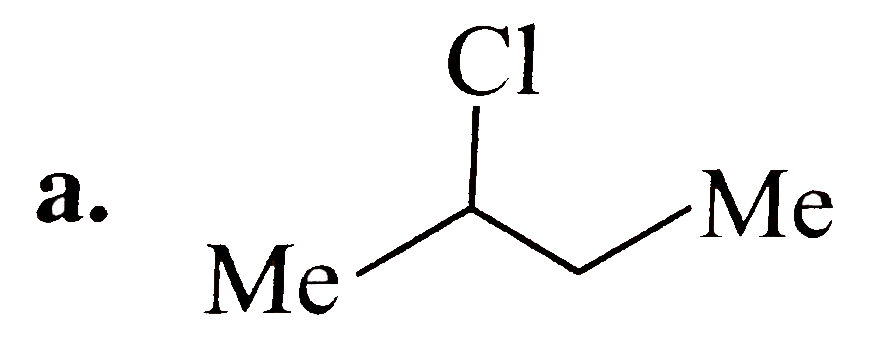
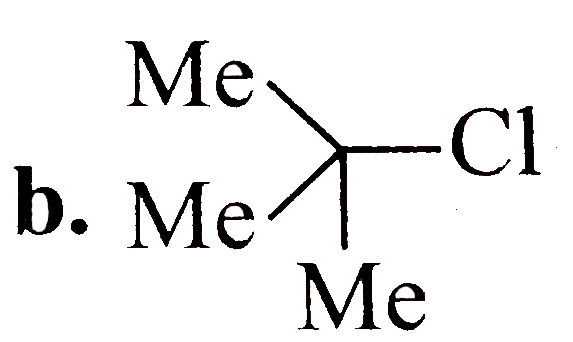
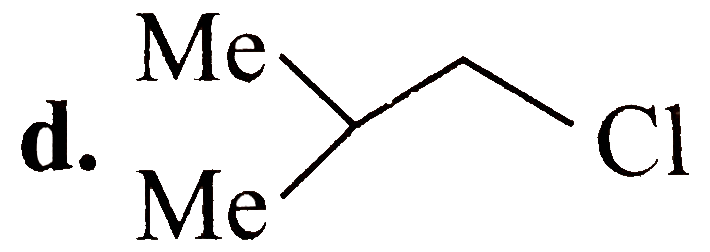
Equal amount of an `RCl(C_4 H_9Cl)` is reacted at the same temperature with equal volume of `0.2 M` and `0.4 M` solution of `KOH`, respectively, in two separate experiments. The time taken for the reaction of `50 %` of `(C_4 H_9 Cl)` was found to be same, the alkyl halide is :

A

B

C

D

Text Solution

AI Generated Solution

The correct Answer is:

To solve the problem, we need to analyze the information given about the reaction of the alkyl halide \( C_4H_9Cl \) with two different concentrations of \( KOH \). ### Step-by-Step Solution: 1. **Understanding the Reaction**: - We have an alkyl halide \( C_4H_9Cl \) reacting with \( KOH \). - The concentrations of \( KOH \) used are \( 0.2 M \) and \( 0.4 M \). 2. **Observing the Reaction Rate**: - The time taken for the reaction to reach 50% completion is the same for both concentrations of \( KOH \). - This indicates that the rate of reaction is independent of the concentration of the nucleophile \( KOH \). 3. **Identifying the Reaction Mechanism**: - Since the rate of reaction does not depend on the concentration of \( KOH \), we can conclude that the reaction follows an \( SN1 \) mechanism. - In an \( SN1 \) mechanism, the rate-determining step involves the formation of a carbocation, which is dependent only on the concentration of the alkyl halide. 4. **Determining the Type of Alkyl Halide**: - The \( SN1 \) mechanism is favored by tertiary (3°) alkyl halides, followed by secondary (2°) and then primary (1°) alkyl halides. - Given that the reaction is independent of the nucleophile concentration, we can infer that \( C_4H_9Cl \) must be a tertiary alkyl halide. 5. **Conclusion**: - Therefore, the alkyl halide \( C_4H_9Cl \) is a tertiary alkyl halide. ### Final Answer: The alkyl halide is a tertiary alkyl halide (3° halide). ---

To solve the problem, we need to analyze the information given about the reaction of the alkyl halide \( C_4H_9Cl \) with two different concentrations of \( KOH \). ### Step-by-Step Solution: 1. **Understanding the Reaction**: - We have an alkyl halide \( C_4H_9Cl \) reacting with \( KOH \). - The concentrations of \( KOH \) used are \( 0.2 M \) and \( 0.4 M \). ...
Promotional Banner

Topper's Solved these Questions

  • ORGANIC REACTION MECHANISM

    CENGAGE CHEMISTRY ENGLISH|Exercise Assertion-Reasoning|12 Videos
  • ORGANIC REACTION MECHANISM

    CENGAGE CHEMISTRY ENGLISH|Exercise Archives|8 Videos
  • ORGANIC REACTION MECHANISM

    CENGAGE CHEMISTRY ENGLISH|Exercise Multiple Correct|30 Videos
  • NCERT BASED EXERCISE

    CENGAGE CHEMISTRY ENGLISH|Exercise Chemical Equilibrium|73 Videos
  • P-BLOCK GROUP 13 - BORON FAMILY

    CENGAGE CHEMISTRY ENGLISH|Exercise Exercise Archives (Subjecive)|9 Videos

Similar Questions

Explore conceptually related problems

In two separate experiments equal quantities of alkyl halide, C_4H_9Cl , were treated at the same temperature with equal volume of 0.1 molar and 0.2 molar solutions of NaOH respectively. In the two experiments, t_(1//2) of the two reaction were the same. The most likely structure of halide is

Equal volumes of 0.2M HCI and 0.4M KOH are mixed. The concentration of ions in the resulting solution are:

A buffer solution has equal volume of 0.20 M NH_(4)OH and 0.02 MNH_(4)Cl : The pK_(b) of the base is 5. The pH is

Total number of isomers of C_(4)H_(9)Cl are

The number of structural isomers of for C_(4)H_(9)Cl are:

Under the same conditions, how many mL of M KOH and 0.5M H_(2)SO_(4) solutions, respectively, when mixed to form a total volume of 100mL , produces the highest rise in temperature?

The resistance of two electrolytes X and Y ere found to be 45 and 100 respectively when equal volumes of both the solutions were taken in the same cell in two different experiments. If equal volumes of these solutions are mixed in the same cell, what will be the conductance of the mixture?

CENGAGE CHEMISTRY ENGLISH-ORGANIC REACTION MECHANISM-Single correct
  1. Which of the following is the strongest nucleophile ?

    Text Solution

    |

  2. Rearrangement reactions are shown by :

    Text Solution

    |

  3. Equal amount of an RCl(C4 H9Cl) is reacted at the same temperature wit...

    Text Solution

    |

  4. Which of the following statements is correct about the following reac...

    Text Solution

    |

  5. Which statement is correct about the above reaction ?

    Text Solution

    |

  6. In SN^2, solvolysis RX in which the solvent is a nucleophile, what is ...

    Text Solution

    |

  7. A partially racemised (+) - 2-bromo-octane (2^@ RX) on reaction with a...

    Text Solution

    |

  8. Which of the compound in each of the following pairs will react faster...

    Text Solution

    |

  9. Which statement is correct about the following reactions ? .

    Text Solution

    |

  10. Which statement is correct about the following reactions ? .

    Text Solution

    |

  11. Which statement is correct about the following reactions ? .

    Text Solution

    |

  12. The decreasing order of dehydrohalogenation of the following compounds...

    Text Solution

    |

  13. The decreasing order of nucleophilicities of the following is : (I) ...

    Text Solution

    |

  14. The decreasing order of nucleophilicities of the following is : (I) ...

    Text Solution

    |

  15. The decreasing order of the basic character of the following is : (I...

    Text Solution

    |

  16. The decreasing order of nucleophilicities in DMSO (dimethylsulphoxide)...

    Text Solution

    |

  17. In which of the following reactions, SN^2 rate increases on changing t...

    Text Solution

    |

  18. In which of the following reactions, retention of configuration takes ...

    Text Solution

    |

  19. Necessary conditions for Fiels-Alder reactions are :

    Text Solution

    |

  20. Which of the following compounds would undergo Diels-Alder reaction wi...

    Text Solution

    |
