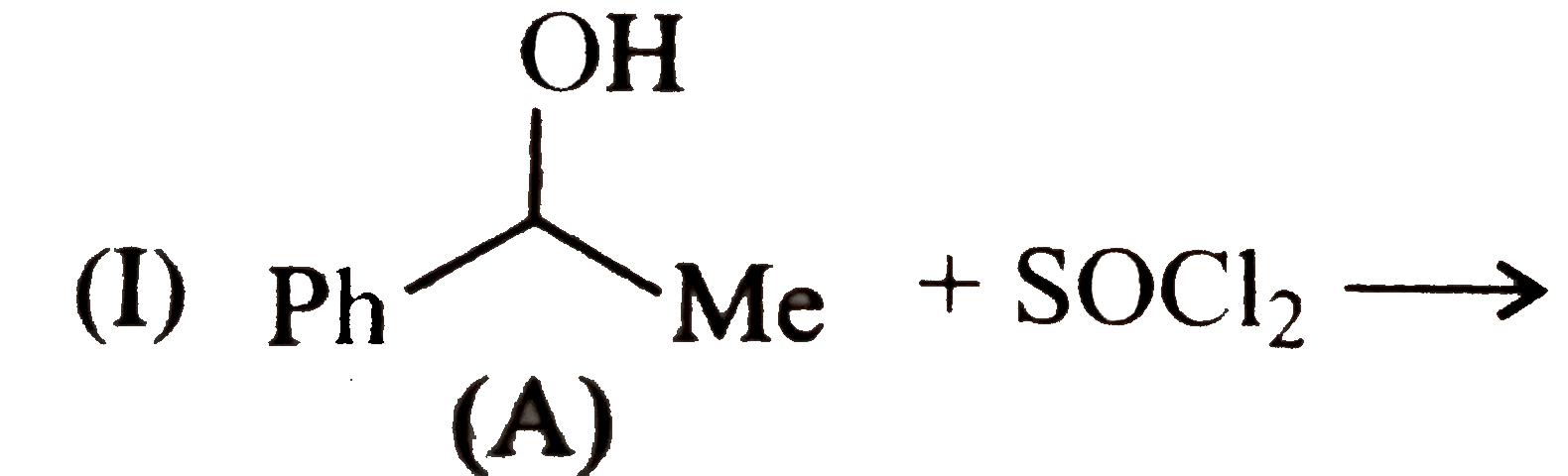
 .
. A
B
C
D
Text Solution
Verified by Experts
The correct Answer is:



Topper's Solved these Questions
ORGANIC REACTION MECHANISM
CENGAGE CHEMISTRY ENGLISH|Exercise Assertion-Reasoning|12 VideosORGANIC REACTION MECHANISM
CENGAGE CHEMISTRY ENGLISH|Exercise Archives|8 VideosORGANIC REACTION MECHANISM
CENGAGE CHEMISTRY ENGLISH|Exercise Multiple Correct|30 VideosNCERT BASED EXERCISE
CENGAGE CHEMISTRY ENGLISH|Exercise Chemical Equilibrium|73 VideosP-BLOCK GROUP 13 - BORON FAMILY
CENGAGE CHEMISTRY ENGLISH|Exercise Exercise Archives (Subjecive)|9 Videos
Similar Questions
Explore conceptually related problems
CENGAGE CHEMISTRY ENGLISH-ORGANIC REACTION MECHANISM-Single correct
- The decreasing order of nucleophilicities in DMSO (dimethylsulphoxide)...
Text Solution
|
- In which of the following reactions, SN^2 rate increases on changing t...
Text Solution
|
- In which of the following reactions, retention of configuration takes ...
Text Solution
|
- Necessary conditions for Fiels-Alder reactions are :
Text Solution
|
- Which of the following compounds would undergo Diels-Alder reaction wi...
Text Solution
|
- Which of the following reaction would undergo Diels-Alder reaction ? ...
Text Solution
|
- The decresing order of reactivity towards SE (substitution by electrop...
Text Solution
|
- Which of the following is a free radical susbtitution reaction ?
Text Solution
|
- Reagent I and II, respectively, are :
Text Solution
|
- Which product is racemic in the above reaction ?
Text Solution
|
- Consider the following reactions.
Text Solution
|
- Which of the following is a non-aromatic compound ?
Text Solution
|
- The decreasing order of reactivity towards ArSN reaction of the follow...
Text Solution
|
- Consider the following reaction : The product is :
Text Solution
|
- Refer to Q.No. 38 and find out which of the following statements is w...
Text Solution
|
- Which of the following is not a rearrangement reaction ?
Text Solution
|
- Arrange the following in the reactions order of NA (nucleophilic addit...
Text Solution
|
- Arrange the following in the decreasing order of nucleophilic acyl sub...
Text Solution
|
- Which of the following reactions will not give Hofmann alkene ?
Text Solution
|
- Which of the following is the best method for the preparation of compo...
Text Solution
|