Home
Class 11
CHEMISTRY
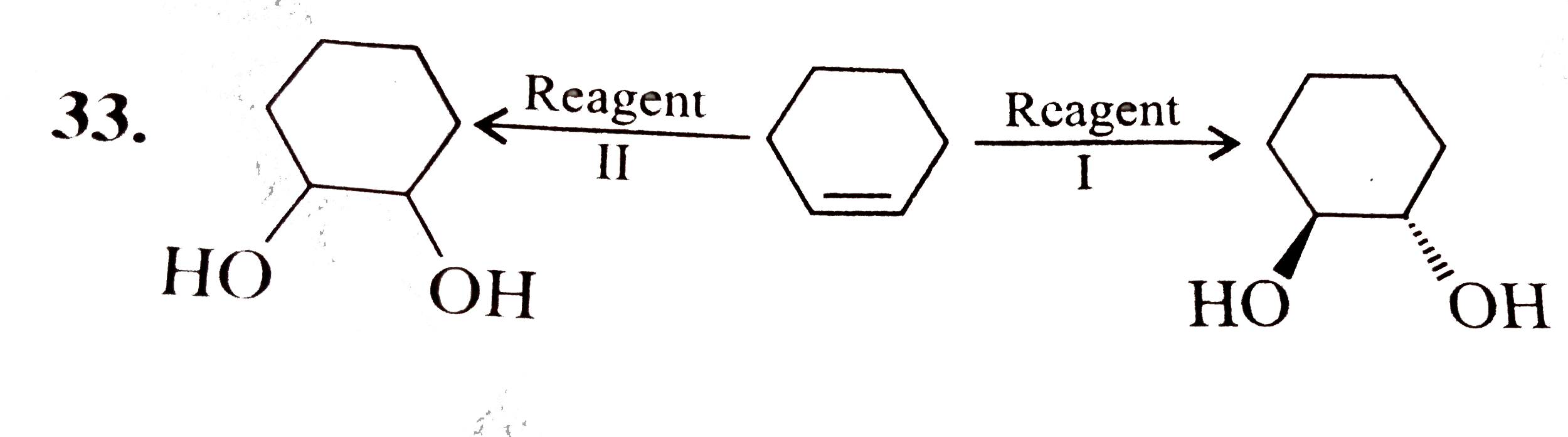
Reagent I and II, respectively, are :...


Reagent `I` and `II`, respectively, are :

A

`OsO_4//NaHSO_3, MMPP//H_2 O`

B

Cold alkaline `KMnO_4, OsO_4//NaHSO_3`

C

`PhCO_3 H//H_2 O`, Cold alkaline `KMnO_4`

D

`MMPP//H_2 O, HCO_3 H//H_2 O`

Text Solution

Verified by Experts

The correct Answer is:

C
Promotional Banner

Topper's Solved these Questions

  • ORGANIC REACTION MECHANISM

    CENGAGE CHEMISTRY ENGLISH|Exercise Assertion-Reasoning|12 Videos
  • ORGANIC REACTION MECHANISM

    CENGAGE CHEMISTRY ENGLISH|Exercise Archives|8 Videos
  • ORGANIC REACTION MECHANISM

    CENGAGE CHEMISTRY ENGLISH|Exercise Multiple Correct|30 Videos
  • NCERT BASED EXERCISE

    CENGAGE CHEMISTRY ENGLISH|Exercise Chemical Equilibrium|73 Videos
  • P-BLOCK GROUP 13 - BORON FAMILY

    CENGAGE CHEMISTRY ENGLISH|Exercise Exercise Archives (Subjecive)|9 Videos

Similar Questions

Explore conceptually related problems

Pigment molecule present at reaction centre of PS-I and PS-II respectively are

In the following reaction sequence, products I, J, and L are formed. K represents a reagent. The structures of product I is : The structures of compounds J and K , respectively, are : The structure of product L is :

In the following reaction sequence, products I, J, and L are formed. K represents a reagent. The structures of product I is : The structures of compounds J and K , respectively, are : The structure of product L is :

In the following reaction sequence, products I, J, and L are formed. K represents a reagent. The structures of product I is : The structures of compounds J and K , respectively, are : The structure of product L is :

In the following reaction sequence, products I, J, and L are formed. K represents a reagent. The structures of product I is : The structures of compounds J and K , respectively, are : The structure of product L is :

The reagents X and Y are respectively:

A system goes from A and B via two processes. I and II as shown in figure. If DeltaU_1 and DeltaU_2 are the changes in internal energies in the processes I and II respectively, then

A system goes from A and B via two processes. I and II as shown in figure. If DeltaU_1 and DeltaU_2 are the changes in internal energies in the processes I and II respectively, then

A system goes from A and B via two processes. I and II as shown in figure. If DeltaU_1 and DeltaU_2 are the changes in internal energies in the processes I and II respectively, then

In the phase diagram showns, the point Q corresponds to the triple point of water. The region I, II and III respectively correspond to phases

CENGAGE CHEMISTRY ENGLISH-ORGANIC REACTION MECHANISM-Single correct
  1. The decresing order of reactivity towards SE (substitution by electrop...

    Text Solution

    |

  2. Which of the following is a free radical susbtitution reaction ?

    Text Solution

    |

  3. Reagent I and II, respectively, are :

    Text Solution

    |

  4. Which product is racemic in the above reaction ?

    Text Solution

    |

  5. Consider the following reactions.

    Text Solution

    |

  6. Which of the following is a non-aromatic compound ?

    Text Solution

    |

  7. The decreasing order of reactivity towards ArSN reaction of the follow...

    Text Solution

    |

  8. Consider the following reaction : The product is :

    Text Solution

    |

  9. Refer to Q.No. 38 and find out which of the following statements is w...

    Text Solution

    |

  10. Which of the following is not a rearrangement reaction ?

    Text Solution

    |

  11. Arrange the following in the reactions order of NA (nucleophilic addit...

    Text Solution

    |

  12. Arrange the following in the decreasing order of nucleophilic acyl sub...

    Text Solution

    |

  13. Which of the following reactions will not give Hofmann alkene ?

    Text Solution

    |

  14. Which of the following is the best method for the preparation of compo...

    Text Solution

    |

  15. Which statement is correct about the above reaction ?

    Text Solution

    |

  16. An alkyl halide of formula C6 H13 Br on treatment with potassium t-but...

    Text Solution

    |

  17. (A) and (B) are :

    Text Solution

    |

  18. Which of the following reactions would give trans-alkene ? .

    Text Solution

    |

  19. Which of the following reactions is Hofmann elimination ? .

    Text Solution

    |

  20. Draw the structure of the following compounds: cyclopropane.

    Text Solution

    |
