Home
Class 11
CHEMISTRY
Which of the following reactions will no...

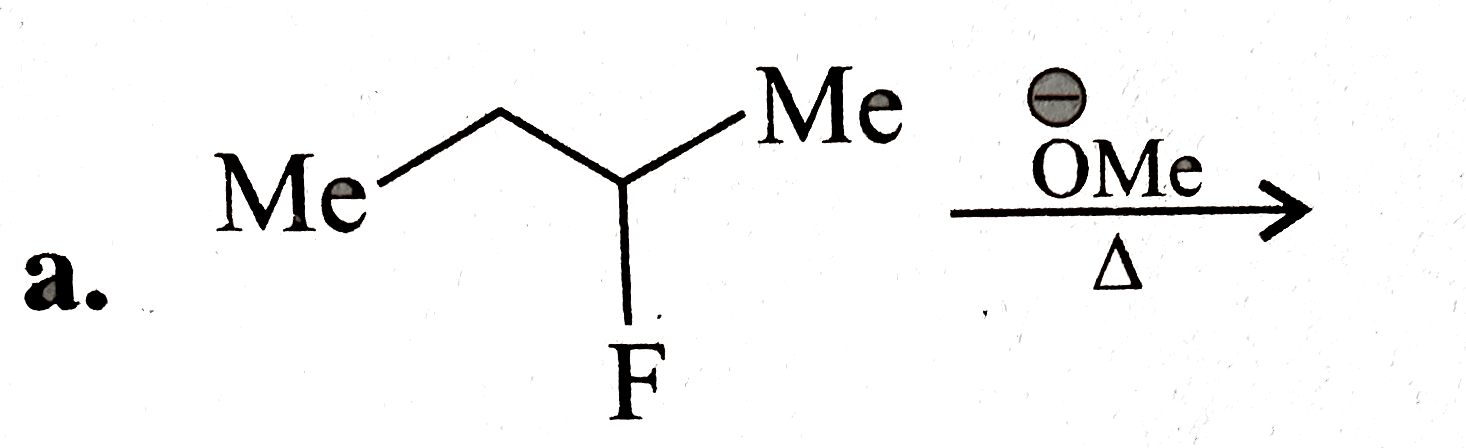
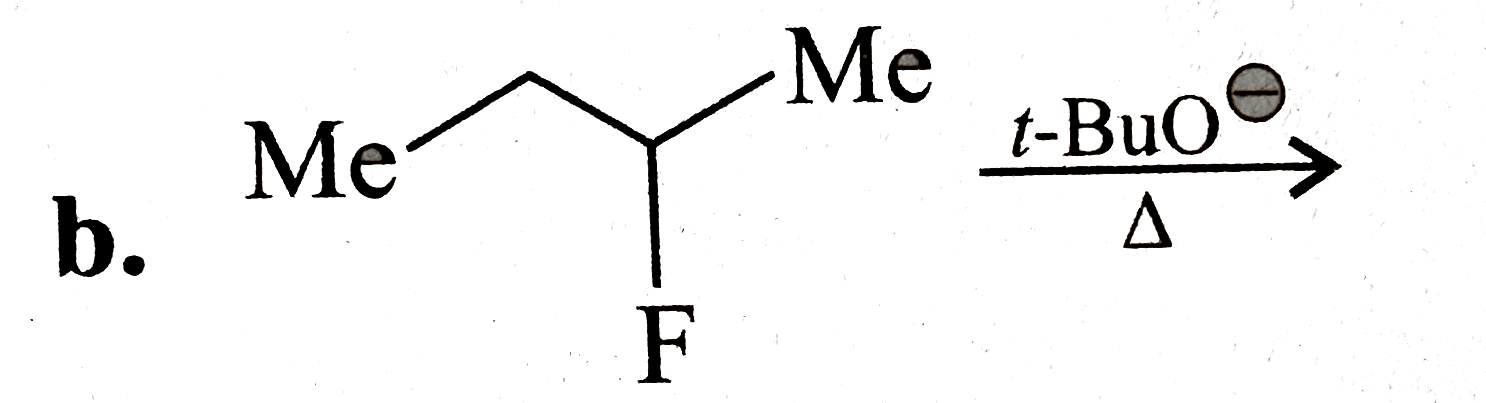
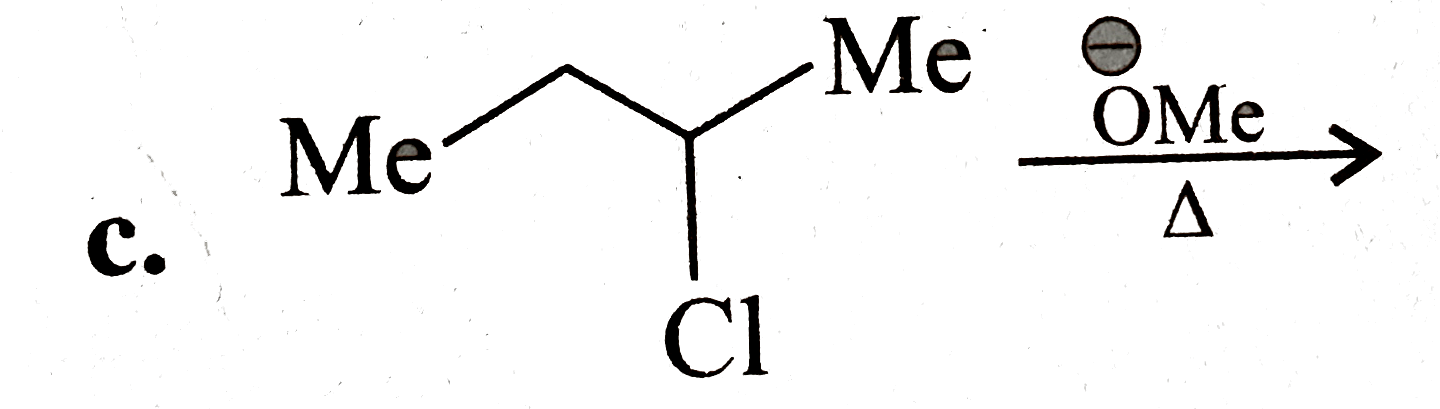
Which of the following reactions will not give Hofmann alkene ?

A

B

C

D

Text Solution

AI Generated Solution

The correct Answer is:

To determine which of the following reactions will not give Hofmann alkene, we need to analyze the conditions that favor the formation of Hofmann alkenes. Hofmann alkenes are typically formed under specific conditions, which include: 1. **Use of a bulky base**: Bulky bases, such as tert-butoxide, favor the formation of less substituted alkenes (Hofmann alkenes) due to steric hindrance. 2. **Poor leaving groups**: Reactions involving poor leaving groups (e.g., NR3+, SR2+, F-) also lead to the formation of Hofmann alkenes. 3. **Steric hindrance at the gamma carbon**: If there is steric hindrance at the gamma carbon, this can also lead to the formation of Hofmann alkenes. 4. **Presence of double bonds at the beta carbon**: If the alkyl halide contains one or more double bonds at the beta carbon, it can also lead to the formation of Hofmann alkenes. Now, let's analyze the given cases: 1. **First Case**: The leaving group is chlorine (Cl), which is a poor leaving group. Therefore, Hofmann alkene will form. 2. **Second Case**: This case involves both a poor leaving group and a bulky base. Hence, Hofmann alkene will also form. 3. **Third Case**: Here, we have a good leaving group (Cl) and a non-bulky base (OME). In this situation, the reaction will favor the formation of the more substituted alkene (Zaitsev product) instead of Hofmann alkene. 4. **Fourth Case**: This case involves alkyl halides with double bonds at the beta carbon, which will favor the formation of Hofmann alkenes. Based on this analysis, the reaction that will **not** give Hofmann alkene is the **third case**. ### Final Answer: The correct answer is **C** (the third case).

To determine which of the following reactions will not give Hofmann alkene, we need to analyze the conditions that favor the formation of Hofmann alkenes. Hofmann alkenes are typically formed under specific conditions, which include: 1. **Use of a bulky base**: Bulky bases, such as tert-butoxide, favor the formation of less substituted alkenes (Hofmann alkenes) due to steric hindrance. 2. **Poor leaving groups**: Reactions involving poor leaving groups (e.g., NR3+, SR2+, F-) also lead to the formation of Hofmann alkenes. 3. **Steric hindrance at the gamma carbon**: If there is steric hindrance at the gamma carbon, this can also lead to the formation of Hofmann alkenes. ...
Promotional Banner

Topper's Solved these Questions

  • ORGANIC REACTION MECHANISM

    CENGAGE CHEMISTRY ENGLISH|Exercise Assertion-Reasoning|12 Videos
  • ORGANIC REACTION MECHANISM

    CENGAGE CHEMISTRY ENGLISH|Exercise Archives|8 Videos
  • ORGANIC REACTION MECHANISM

    CENGAGE CHEMISTRY ENGLISH|Exercise Multiple Correct|30 Videos
  • NCERT BASED EXERCISE

    CENGAGE CHEMISTRY ENGLISH|Exercise Chemical Equilibrium|73 Videos
  • P-BLOCK GROUP 13 - BORON FAMILY

    CENGAGE CHEMISTRY ENGLISH|Exercise Exercise Archives (Subjecive)|9 Videos

Similar Questions

Explore conceptually related problems

Which of the following reactions will not give propane ?

Which of the following reaction will not give methane?

Which of the following reactions will give alkyne?

Which of the following reactions is Hofmann elimination ? .

CENGAGE CHEMISTRY ENGLISH-ORGANIC REACTION MECHANISM-Single correct
  1. The decresing order of reactivity towards SE (substitution by electrop...

    Text Solution

    |

  2. Which of the following is a free radical susbtitution reaction ?

    Text Solution

    |

  3. Reagent I and II, respectively, are :

    Text Solution

    |

  4. Which product is racemic in the above reaction ?

    Text Solution

    |

  5. Consider the following reactions.

    Text Solution

    |

  6. Which of the following is a non-aromatic compound ?

    Text Solution

    |

  7. The decreasing order of reactivity towards ArSN reaction of the follow...

    Text Solution

    |

  8. Consider the following reaction : The product is :

    Text Solution

    |

  9. Refer to Q.No. 38 and find out which of the following statements is w...

    Text Solution

    |

  10. Which of the following is not a rearrangement reaction ?

    Text Solution

    |

  11. Arrange the following in the reactions order of NA (nucleophilic addit...

    Text Solution

    |

  12. Arrange the following in the decreasing order of nucleophilic acyl sub...

    Text Solution

    |

  13. Which of the following reactions will not give Hofmann alkene ?

    Text Solution

    |

  14. Which of the following is the best method for the preparation of compo...

    Text Solution

    |

  15. Which statement is correct about the above reaction ?

    Text Solution

    |

  16. An alkyl halide of formula C6 H13 Br on treatment with potassium t-but...

    Text Solution

    |

  17. (A) and (B) are :

    Text Solution

    |

  18. Which of the following reactions would give trans-alkene ? .

    Text Solution

    |

  19. Which of the following reactions is Hofmann elimination ? .

    Text Solution

    |

  20. Draw the structure of the following compounds: cyclopropane.

    Text Solution

    |
