Home
Class 11
CHEMISTRY
An alkyl halide of formula C6 H13 Br on ...

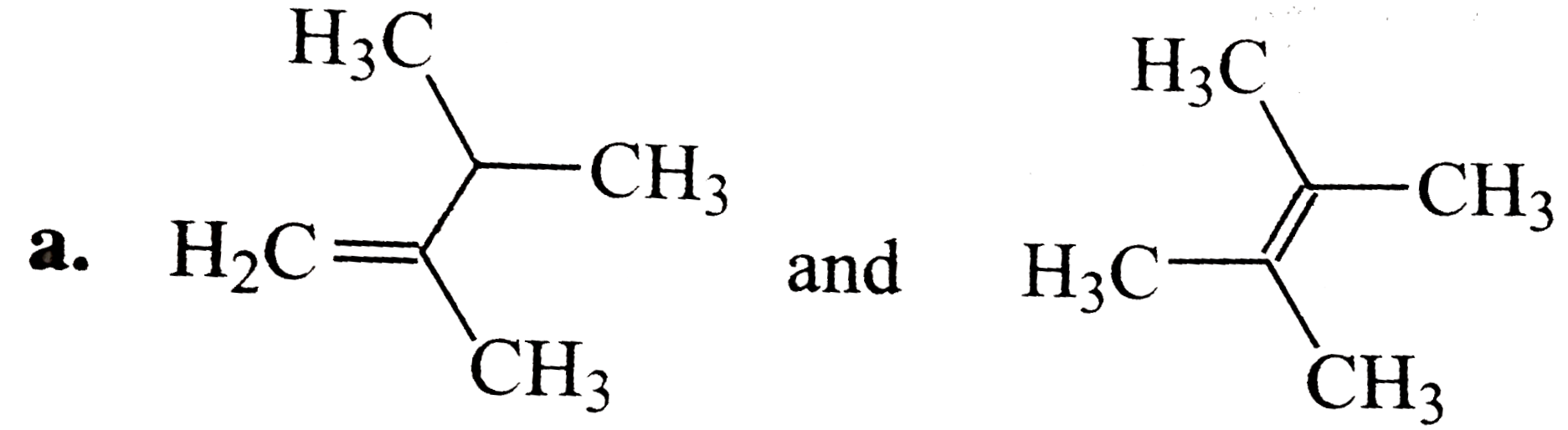
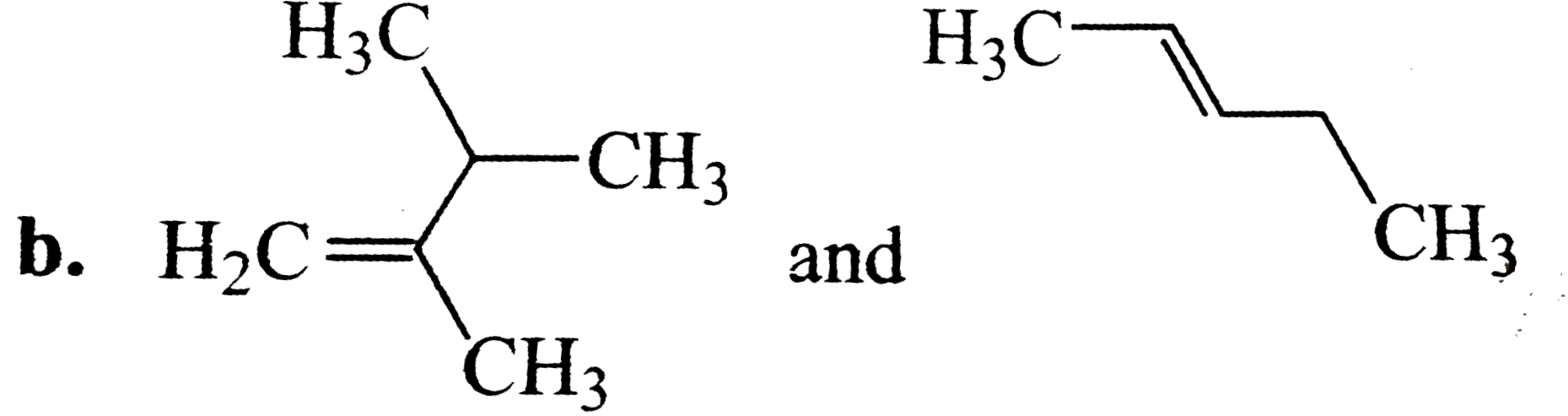
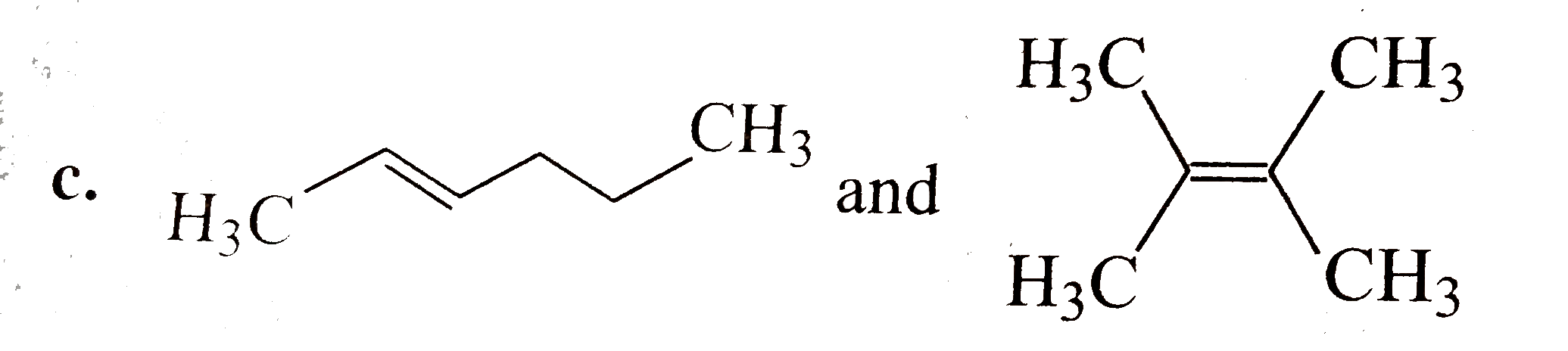
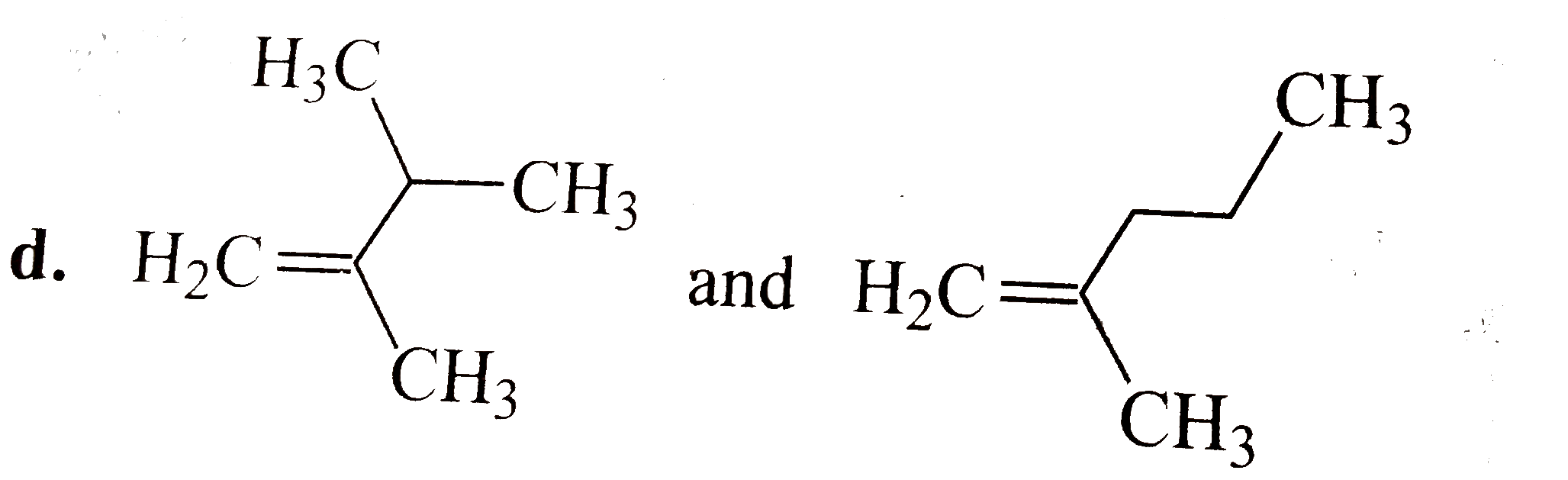
An alkyl halide of formula `C_6 H_13 Br` on treatment with potassium t-butoxide gives two isomeric alkenes dimethy butane. Isomeric alkene are :

A

B

C

D

Text Solution

AI Generated Solution

The correct Answer is:

To solve the problem, we need to determine the isomeric alkenes that can be formed from the alkyl halide with the formula `C6H13Br` when treated with potassium t-butoxide. ### Step-by-Step Solution: 1. **Identify the Alkyl Halide Structure**: The alkyl halide has the formula `C6H13Br`. This indicates that it is a six-carbon compound with a bromine atom. The possible structures for this alkyl halide can be: - 1-bromo-hexane (linear structure) - 2-bromo-pentane (branched structure) - 3-bromo-pentane (branched structure) - 2-bromo-2-methylbutane (more branched structure) For the purpose of forming dimethyl alkenes, we will focus on the branched structures. 2. **Determine the Reaction with Potassium t-Butoxide**: Potassium t-butoxide is a strong, bulky base that favors elimination reactions (E2 mechanism). The elimination will lead to the formation of alkenes. 3. **Possible Elimination Products**: - From 2-bromo-pentane: - Elimination can occur to form 2-methyl-2-pentene (major product due to more substituted double bond). - Elimination can also occur to form 2-methyl-1-pentene (minor product). - From 3-bromo-pentane: - Elimination can lead to the formation of 2-methyl-2-pentene (major product). - Elimination can also lead to 3-methyl-1-pentene (minor product). 4. **Identify the Isomeric Alkenes**: The two isomeric alkenes that can be formed from the elimination reaction are: - 2-methyl-2-pentene - 2-methyl-1-pentene 5. **Conclusion**: Therefore, the isomeric alkenes formed from the alkyl halide `C6H13Br` upon treatment with potassium t-butoxide are 2-methyl-2-pentene and 2-methyl-1-pentene. ### Final Answer: The isomeric alkenes are **2-methyl-2-pentene and 2-methyl-1-pentene**.

To solve the problem, we need to determine the isomeric alkenes that can be formed from the alkyl halide with the formula `C6H13Br` when treated with potassium t-butoxide. ### Step-by-Step Solution: 1. **Identify the Alkyl Halide Structure**: The alkyl halide has the formula `C6H13Br`. This indicates that it is a six-carbon compound with a bromine atom. The possible structures for this alkyl halide can be: - 1-bromo-hexane (linear structure) - 2-bromo-pentane (branched structure) ...
Promotional Banner

Topper's Solved these Questions

  • ORGANIC REACTION MECHANISM

    CENGAGE CHEMISTRY ENGLISH|Exercise Assertion-Reasoning|12 Videos
  • ORGANIC REACTION MECHANISM

    CENGAGE CHEMISTRY ENGLISH|Exercise Archives|8 Videos
  • ORGANIC REACTION MECHANISM

    CENGAGE CHEMISTRY ENGLISH|Exercise Multiple Correct|30 Videos
  • NCERT BASED EXERCISE

    CENGAGE CHEMISTRY ENGLISH|Exercise Chemical Equilibrium|73 Videos
  • P-BLOCK GROUP 13 - BORON FAMILY

    CENGAGE CHEMISTRY ENGLISH|Exercise Exercise Archives (Subjecive)|9 Videos

Similar Questions

Explore conceptually related problems

An alkyl halide (A) of formula C_(6)H_(11)Cl on treatement with potassium tertiary butoxie gives two isomeric alkenes (B) and (C) C_(6)H_(10) . Both alkene on hydrogenation give methycyclopentane. Predict the structure of (A), (B) and (C).

An alkyl halide (X) of the folmula C_(6)H_(13)Cl on treatment with potassium tertiary butoxide gives two isomeric alkenes (Y) and (Z)(C_(6)H_(12)) . Both the alkenes on hydrogenation give 2,3- dimethyl butane. Perdict the structures of (X),(Y) , and (Z)

An alkyl halide with molecular formula C_6H_(13)Br on dehyrohalogenation gives two isomeric alkenes X and Y with molecular formula C_6H_(12) . On reductive ozonolysis X and Y gives four compounds CH_3COCH_3 , CH_3CH_2CHO and (CH_3)_2CHCHO . The alkyl halide is

A white precipitate was formed slowly when silver nitrate was added to compound (A) with molecular formula C_(6)H_(13)Cl .Compound (A) on treatment with hot alcoholic potassium hydroxide gave a misture of two isomeric alkenes (B) and (C) , havinig the formuls C_(6)H_(12) . The mixture of (B) and (C) , on ozonolsis, furnished four compounds. i. CH_(3)CHO ,ii C_(2)H_(5)CHO iii. CH_(3)COCH_(3) ,(iv) CH_(3)-underset(CH_(3))underset(|)(CH)-CHO What are the structures of (A),(B)and (C) ?

CENGAGE CHEMISTRY ENGLISH-ORGANIC REACTION MECHANISM-Single correct
  1. The decresing order of reactivity towards SE (substitution by electrop...

    Text Solution

    |

  2. Which of the following is a free radical susbtitution reaction ?

    Text Solution

    |

  3. Reagent I and II, respectively, are :

    Text Solution

    |

  4. Which product is racemic in the above reaction ?

    Text Solution

    |

  5. Consider the following reactions.

    Text Solution

    |

  6. Which of the following is a non-aromatic compound ?

    Text Solution

    |

  7. The decreasing order of reactivity towards ArSN reaction of the follow...

    Text Solution

    |

  8. Consider the following reaction : The product is :

    Text Solution

    |

  9. Refer to Q.No. 38 and find out which of the following statements is w...

    Text Solution

    |

  10. Which of the following is not a rearrangement reaction ?

    Text Solution

    |

  11. Arrange the following in the reactions order of NA (nucleophilic addit...

    Text Solution

    |

  12. Arrange the following in the decreasing order of nucleophilic acyl sub...

    Text Solution

    |

  13. Which of the following reactions will not give Hofmann alkene ?

    Text Solution

    |

  14. Which of the following is the best method for the preparation of compo...

    Text Solution

    |

  15. Which statement is correct about the above reaction ?

    Text Solution

    |

  16. An alkyl halide of formula C6 H13 Br on treatment with potassium t-but...

    Text Solution

    |

  17. (A) and (B) are :

    Text Solution

    |

  18. Which of the following reactions would give trans-alkene ? .

    Text Solution

    |

  19. Which of the following reactions is Hofmann elimination ? .

    Text Solution

    |

  20. Draw the structure of the following compounds: cyclopropane.

    Text Solution

    |
