Home
Class 11
CHEMISTRY
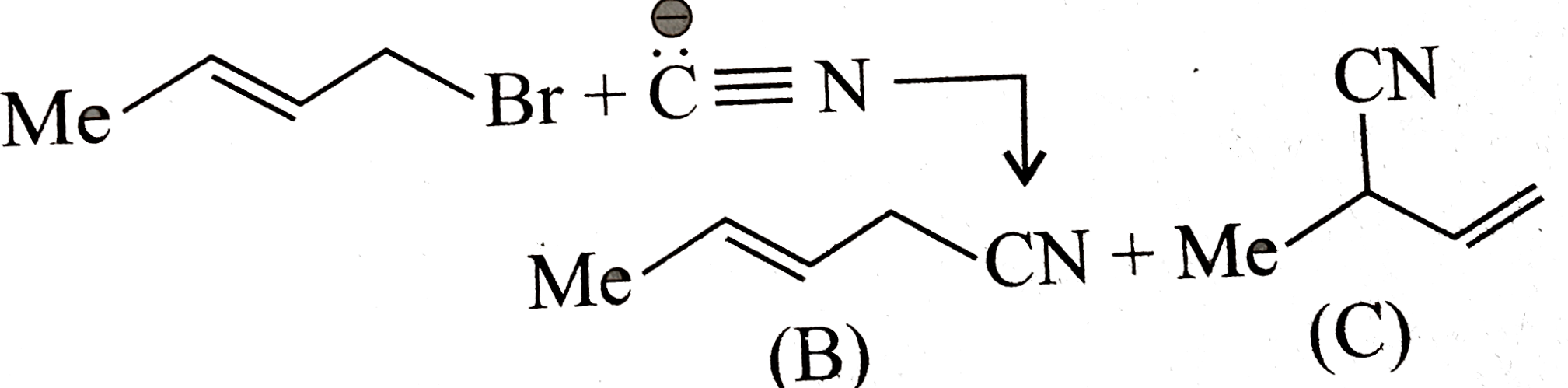
The product (B) results by SN^2 mechanis...


The product `(B)` results by `SN^2` mechanism and product `(c)` results by `SN^(2')` mechanism.

A

If both `(A)` and `(R )` are true, but `( R)` is the correct explanation of `(A)`

B

If both `(A)` and `( R)` are true, but `(R )` is not the correct explanation of `(A)`.

C

If `(A)` is true but `( R)` is false.

D

If `(A)` is false but `( R)` is true.

Text Solution

Verified by Experts

The correct Answer is:

A
Promotional Banner

Topper's Solved these Questions

  • ORGANIC REACTION MECHANISM

    CENGAGE CHEMISTRY ENGLISH|Exercise Archives|8 Videos
  • ORGANIC REACTION MECHANISM

    CENGAGE CHEMISTRY ENGLISH|Exercise True/False|2 Videos
  • ORGANIC REACTION MECHANISM

    CENGAGE CHEMISTRY ENGLISH|Exercise Single correct|43 Videos
  • NCERT BASED EXERCISE

    CENGAGE CHEMISTRY ENGLISH|Exercise Chemical Equilibrium|73 Videos
  • P-BLOCK GROUP 13 - BORON FAMILY

    CENGAGE CHEMISTRY ENGLISH|Exercise Exercise Archives (Subjecive)|9 Videos

Similar Questions

Explore conceptually related problems

Statement 1: The products (A) and (B) are Statement 2: Path I takes place by SN^(2) mechanism and Path II take place by SN^(1) mechanism.

Use of Cannabis products results in

Which one hydrolyses at a faster rate by SN^1 mechanism ? .

SN^(2) reaction is a bimolecular reaction which takes places by the formation of T.S. Veolcity of the reaction depends on the concentration of the substrate as well as the nucleophile. The reaction is favoureed by strong Nu^(o-) and in the presence of polar aprotic sovlent, optically active halides give. Walken inversion by SN^(2) mechanism. The presence of hero group (atom) at beta-C atom, unsaturation at beta-C and (-overset(O)overset(||)(C)-) group at alpha-C atomn favor SN^(2) mechanism. Allyl halides and benzyl halides give SN^(1) and SN^(2) reactions. Allyl halides alos give SN^(2) mechanism EDG at ortho- and para- postions in benzyl halides favors SN^(1) mechanism, wheras EWG favors SN^(2) mechanism. Which of the following will give SN^(2) mechanism?

SN^(2) reaction is a bimolecular reaction which takes places by the formation of T.S. Veolcity of the reaction depends on the concentration of the substrate as well as the nucleophile. The reaction is favoureed by strong Nu^(o-) and in the presence of polar aprotic sovlent, optically active halides give. Walden inversion by SN^(2) mechanism. The presence of hetro group (atom) at beta-C atom, unsaturation at beta-C and (-overset(O)overset(||)(C)-) group at alpha-C atomn favor SN^(2) mechanism. Allyl halides and benzyl halides give SN^(1) and SN^(2) reactions. Allyl halides alos give SN^(2) mechanism EDG at ortho- and para- postions in benzyl halides favors SN^(1) mechanism, wheras EWG favors SN^(2) mechanism. Which of the following will gives SN^(2) mechanism gt

SN^(2) reaction is a bimolecular reaction which takes places by the formation of T.S. Veolcity of the reaction depends on the concentration of the substrate as well as the nucleophile. The reaction is favoureed by strong Nu^(o-) and in the presence of polar aprotic sovlent, optically active halides give. Walken inversion by SN^(2) mechanism. The presence of hero group (atom) at beta-C atom, unsaturation at beta-C and (-overset(O)overset(||)(C)-) group at alpha-C atomn favor SN^(2) mechanism. Allyl halides and benzyl halides give SN^(1) and SN^(2) reactions. Allyl halides alos give SN^(2) mechanism EDG at ortho- and para- postions in benzyl halides favors SN^(1) mechanism, wheras EWG favors SN^(2) mechanism. Which of the following will give SN^(1) reaction?

SN^(2) reaction is a bimolecular reaction which takes places by the formation of T.S. Veolcity of the reaction depends on the concentration of the substrate as well as the nucleophile. The reaction is favoureed by strong Nu^(o-) and in the presence of polar aprotic sovlent, optically active halides give. Walken inversion by SN^(2) mechanism. The presence of hero group (atom) at beta-C atom, unsaturation at beta-C and (-overset(O)overset(||)(C)-) group at alpha-C atomn favor SN^(2) mechanism. Allyl halides and benzyl halides give SN^(1) and SN^(2) reactions. Allyl halides alos give SN^(2) mechanism EDG at ortho- and para- postions in benzyl halides favors SN^(1) mechanism, wheras EWG favors SN^(2) mechanism. Which of the following will give Walden inversion ?

The product obtained a result of a reaction of nitrogen with CaC_(2) is

Which of the following will give SN^(2) mechanism?

Tertiary alkyl halide are practically inert to substitution by SN^(2) mechanism because of-
