Home
Class 11
CHEMISTRY
Draw the structure of following compound...

Draw the structure of following compounds:
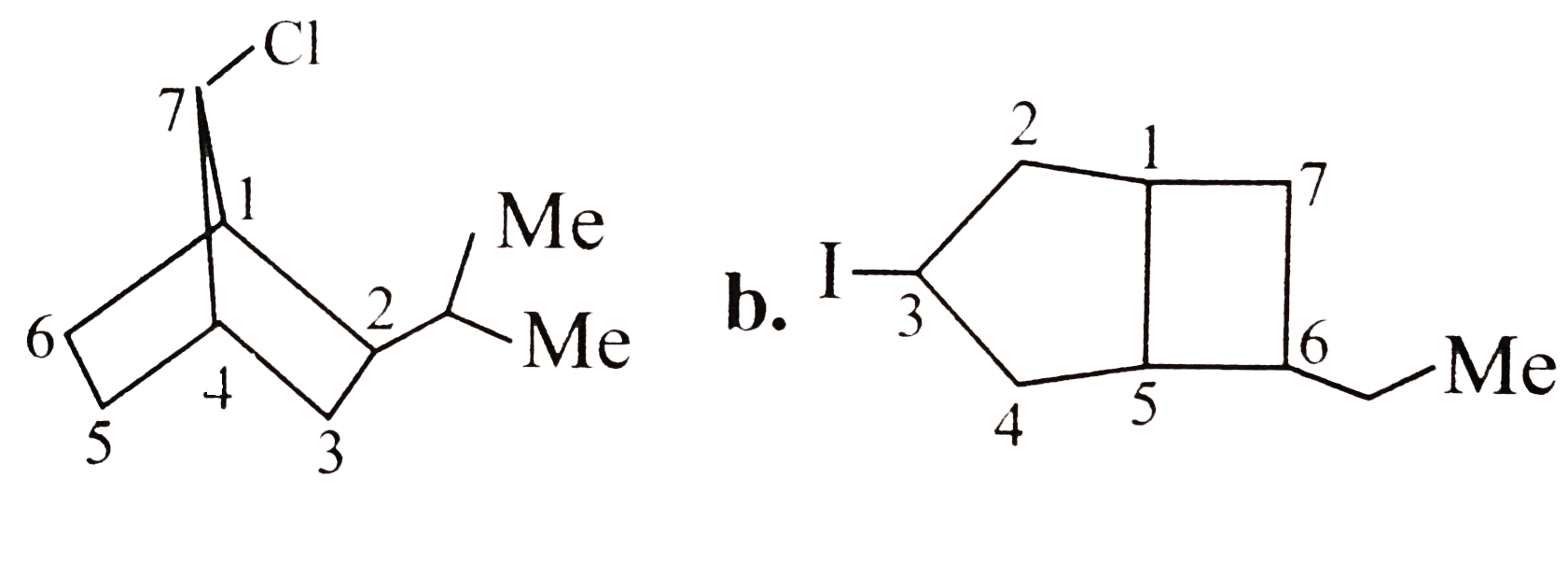
a. 2-Isopropyl-7-chlorobicyclo `[2.2.1]` heptane
b. 6-Ethan-3-Iodo bicyclo `[3.2.0]` heptane
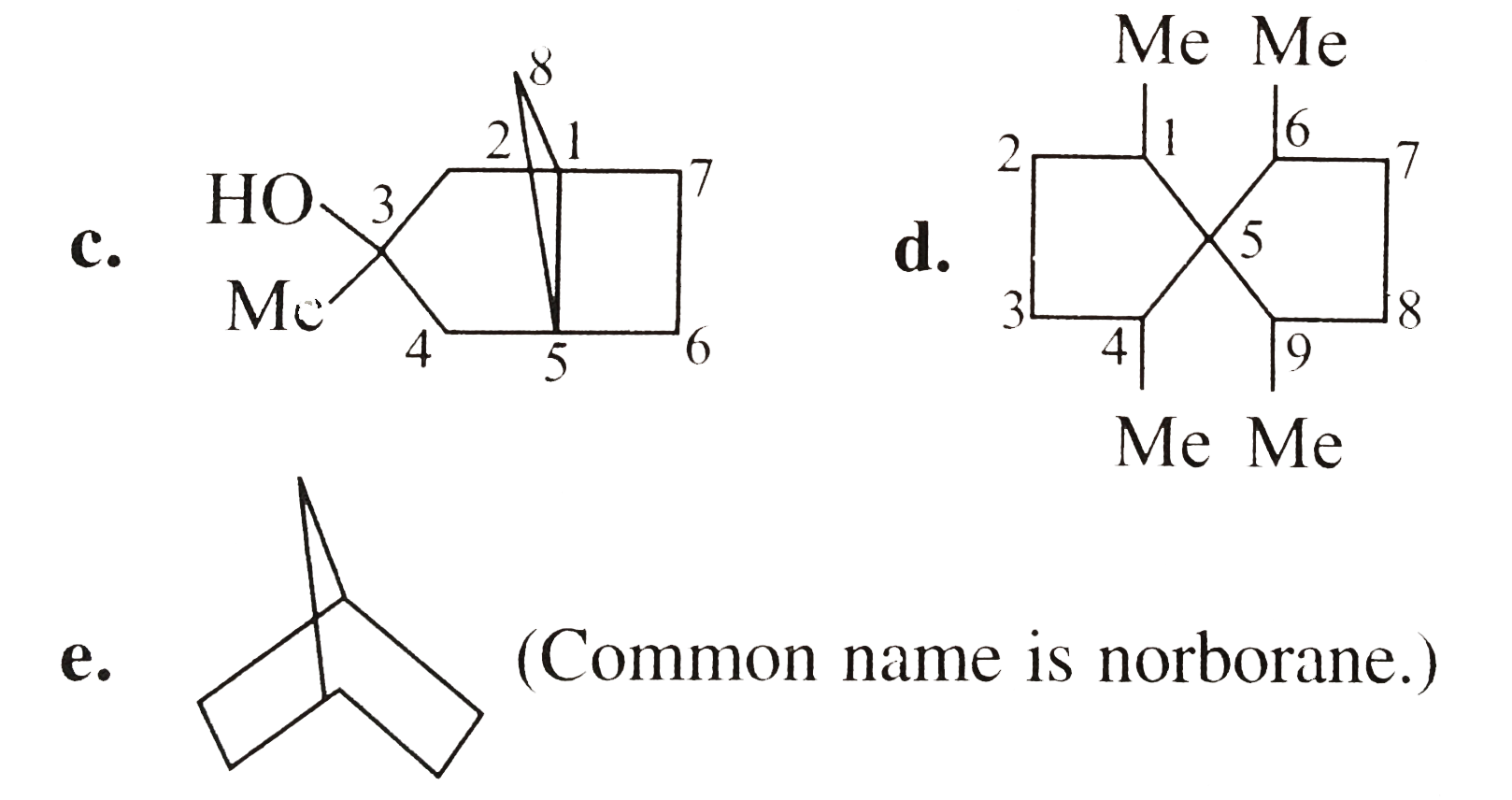
c. 3-Methan tricyclo `[3.2.1.0]` ocation-3-ol
d. 1,4,6,9-Tetramethyl spiro `[4.4]` nonane
e. Bicyclo `[2.2.1]` heptane

Text Solution

Verified by Experts
a. b.
Promotional Banner

Topper's Solved these Questions

  • ALKANES AND CYCLOALKANES

    CENGAGE CHEMISTRY ENGLISH|Exercise SOLVED EXAMPLES|19 Videos
  • ALKANES AND CYCLOALKANES

    CENGAGE CHEMISTRY ENGLISH|Exercise EXERCISES|24 Videos
  • ALKENES AND ALKADIENES

    CENGAGE CHEMISTRY ENGLISH|Exercise Single correct Answer|14 Videos

Similar Questions

Explore conceptually related problems

Draw the structure of the following compounds all showing C and H atoms. (a) 2-methyl -3-iso propyl heptanes (b) Dicyclopropyl methane.

Give the number of stereoisomers of the following compounds. a. 2-Bromobicyclo [2.2.1] heptane or 2-bromo norborane b. 2-Ethyl-7-bromo [2.2.1] heptane or 2-ethyl-7-bromonorborane

Write the structures of the following compounds. a. 3,7- Dimethylocta -1,3,6- triene b. 4- Allyl -3- propenyl -1,3- cyclohexadiene c. 2- Ethenyl bicyclo [4.40]-1,5,8- decatriene d. Bicyclo [2.2.1]-2,5- heptadiene

Write the bond line formula for the following compounds: I. Isopropyl alcohol II. 2,3-Dimethyl butanal III. Heptan-4-one

a. Write the structure of 2,2- dibromobicyclo [2.2.1] heptane. b. How many stereocenters does it contain? c. How many stereoisomers are predicted by the 2^(n) rule? d. Only one pair of enantiomers is possible for 2-2 , dibromobicyclo [2.2.1] heptane. Explain.

Derive the structure of (i) 2-Chlorohexane, (ii) Pent-4-en-2-ol, (iii) 3- Nitrocyclohexene, (iv) Cyclohex-2-en-1-ol, (v) 6-Hydroxy- heptanal.

Which of the following represents the correct IUPAC name of the compounds concerned ? (a) 2, 2-Dimethylpentane or 2-Dimethylpentane (b) 2, 3-Dimethylpentane or 3, 4-Dimethylpentane (c) 2, 4, 7-Trimethyloctane or 2, 5, 7-Trimethyloctane. (d) But-3-yn-1-ol ot But-4-ol-1-yne

Which of the following represented the correct IUPAC names for the compounds concerned ? (a) 2, 2-Dichloropentane or 2-Dichloropentane (b) 2, 3-Dimethylpentane or 3, 4-Dimethylpentane (c) 2-Bromo-4-methylpentane or 4-Bromo-2-methylpentane (d) But-3-en-1-ol or But-4-ol-1-ene.

The number of 1^(@), 2^(@) , and 3^(@) H atoms in 3-ethy1-5-methy1 heptane, respectively , is:

A A B C is formed by the lines 2x-3y-6=0;3x-y+3=0a n d3x+4y-12=0. If the points P(alpha,0)a n dQ(0,beta) always lie on or inside the A B C , then: alpha in [-1,2]&beta in [-2,3] b. alpha in [-1,3]&beta in [-2,4] c. alpha in [-2,4]&beta in [-3,4] d. alpha in [-1,3]&beta in [-2,3]