Home
Class 11
CHEMISTRY
There are five isomeric alkenes (A, B, C...

There are five isomeric alkenes (A, B, C, D, and E) that require 1 mol of `H_(2)` per mole of alkene for hydrogenation and give the same product (F) on hydrogenation. F is an alkane having the lowest molecular mass and is opticalar mass and is optically active. Write the structures of the compounds from A to F.

Text Solution

Verified by Experts
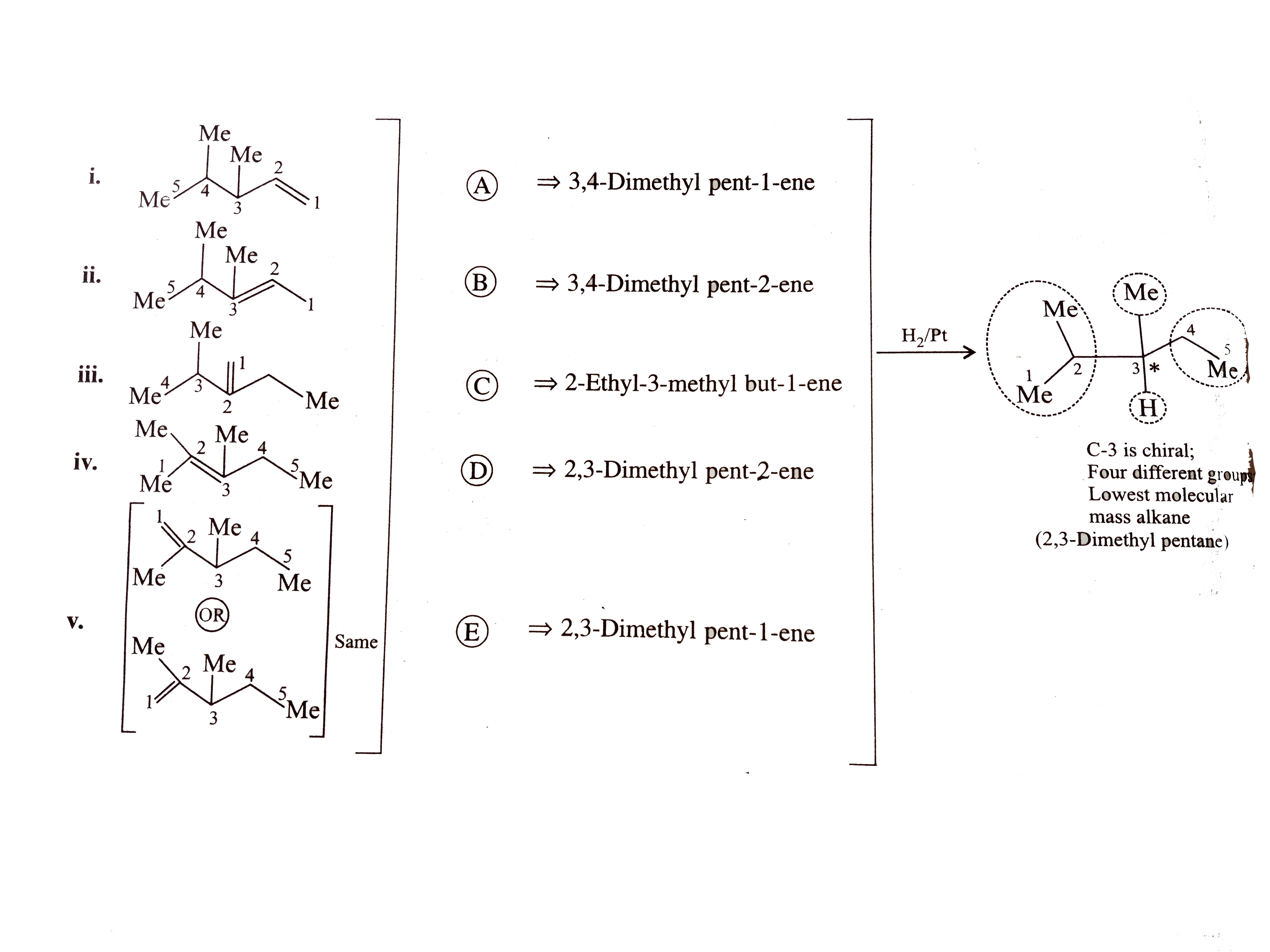
Proceed as in Q. No. 6. Compound (F) will be (II). Therefore, five isomeric alkenes are:
Promotional Banner

Topper's Solved these Questions

  • ALKANES AND CYCLOALKANES

    CENGAGE CHEMISTRY ENGLISH|Exercise Paragraph for problem|24 Videos
  • ALKANES AND CYCLOALKANES

    CENGAGE CHEMISTRY ENGLISH|Exercise True and False|1 Videos
  • ALKANES AND CYCLOALKANES

    CENGAGE CHEMISTRY ENGLISH|Exercise SOLVED EXAMPLES|19 Videos
  • ALKENES AND ALKADIENES

    CENGAGE CHEMISTRY ENGLISH|Exercise Single correct Answer|14 Videos

Similar Questions

Explore conceptually related problems

There are six isomeric alkenes (A, B, C, D, E, and F) that require 1 mol of H_(2) per mole of alkene for hydrogenation and give the same product (G) on hydrogenation. G is an alkane having the lowest molecular mass and is optically active. Write the structure of compounds from A to G.

Give the structure of an optically active alkene (A) having the lowest molecular mass, which on catalytic hydrogenation gives an optically inactive compound (B) .

An optically active alcohol A (C_(6)H_(10)O) absorbs 2 mol of hydrogen per mole of A upon catalytic hydrogenation and gives a product B. The compound B is resistant to oxidation by CrO_(3) and does not show any optical activity Deduce the structures of A and B.

Give the structure of an optically active alkyne (A) having the lowest molecular mass, which on hydrogenation with Lindlard's catalyst and Birch reduction gives the same lowest molecular mass optically active alkene.

An organic compound E (C_5 H_8) on hydrogenation gives compound F (C_5 H_(12) ) . Compound E on ozonolysis gives formaldehyde and 2-ketopropanal. Deduce the structure of compound E.

Write the IUPAC name of the compound (A) which is a 2-methy1 branched alkane having a molecular mass of 254. This compound is a sex-attractant and is isolated from female tiger moths.

When H_(2) is added to two isomeric alkenes A and B having molecular formula C_(5)H_(9)Cl , A gives optically inactive compound while B gives a chiral compound. The two isomers are

No. of structural isomeric alkenes (molecular formula =C_(6)H_(12) ) which all give n-hexane on hydrogenation in presence of metal catalyst

Carbene intermediates are produced by the photolysis of diazomethane (CH_2N_2) or kenene (CH_2 = C = O) . They are also produced by the reaction of CHX_3 with base or by Simmons-Smith reaction. There are two types of carbenes, singlet and triplet. They are so called due to their spin state. An optically active alkene (I) with lowest molecular mass on hydrogenation gives optically inactive alkene, but on insertion of methylene carbene ( : CH_2) in (I) , it gives optically active compound (II) . The compounds (I) and (II) are : .

i. 27.8gm mixture of alkyne and alkane (both containing same number of carbon atoms) is dissolved in 1000gm of benzene. The solution freezes at 2.45^@C (lower than that of benzene). Another 27.8gm mixture requires 0.6 mol of H_2 for complete hydrogenation. Calculate the chemical formula of alkyne and alkane ( K_f for C_6H_6=4.9 ). ii. Alkyne on hydrogenation with H_2+Pt gives the same alkane. Alkyne does not react with ammoniacal AgNO_3 solution. Give the structures of both alkyne and alkane.

CENGAGE CHEMISTRY ENGLISH-ALKANES AND CYCLOALKANES-EXERCISES
  1. a. What is the relative abstraction of H and D ? b. Why free-ra...

    Text Solution

    |

  2. There are six isomeric alkenes (A, B, C, D, E, and F) that require 1 m...

    Text Solution

    |

  3. There are five isomeric alkenes (A, B, C, D, and E) that require 1 mol...

    Text Solution

    |

  4. Write the structure of all the alkenes that can be hydrogenated to fro...

    Text Solution

    |

  5. Write the reaction of benzyl magnesium obmide with CH(3)OD and also id...

    Text Solution

    |

  6. Calculate the percentage of compounds obtained by monobromination of i...

    Text Solution

    |

  7. Which factors determine the reactivity of halogens in the subsitution ...

    Text Solution

    |

  8. Predict the percentage of ismoers formed during monobromination of 2,3...

    Text Solution

    |

  9. In the study of chlorination of propane, four prouducts A, B, C, and D...

    Text Solution

    |

  10. Chloro derivative of an organic compound 'X' on reduction with zinc-co...

    Text Solution

    |

  11. An alkyl halide is reduced to the corresponding alkane by tributyl sta...

    Text Solution

    |

  12. When a mixture of 2-merthyl propane and C C1(4) is reacted at 403-413 ...

    Text Solution

    |

  13. Alkanes are monochlorinate with t-butyl hypochlorite as a radical ...

    Text Solution

    |

  14. Delta Hc^(-) (the standard enthalpy of combustion) of butane and 2-met...

    Text Solution

    |

  15. Arrange the following compounds according to the decreasing order of h...

    Text Solution

    |

  16. Which of the following has the highest boiling point ? i. 2-Methyl ...

    Text Solution

    |

  17. How many geometrical isomers are possible for 1,2,4-Trimethyl cyclohex...

    Text Solution

    |

  18. Complete the following reaction: i. ii.

    Text Solution

    |

  19. Equal amounts of (e, e) and (a, a) conformers of trans-1,2-dichloro cy...

    Text Solution

    |

  20. Which isomer has the lower energy and which is fiexible in cis and tra...

    Text Solution

    |

