Home
Class 11
CHEMISTRY
With the help of the following equation ...

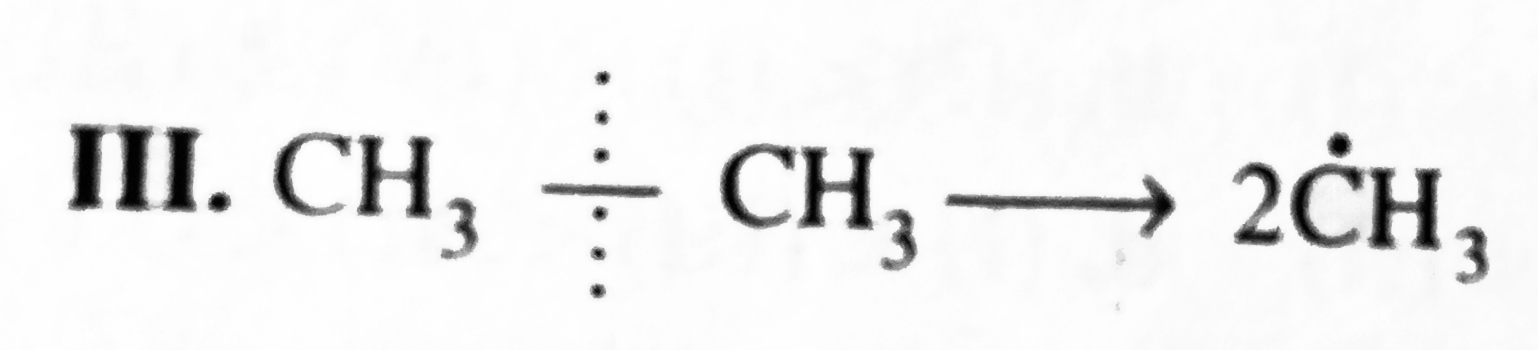
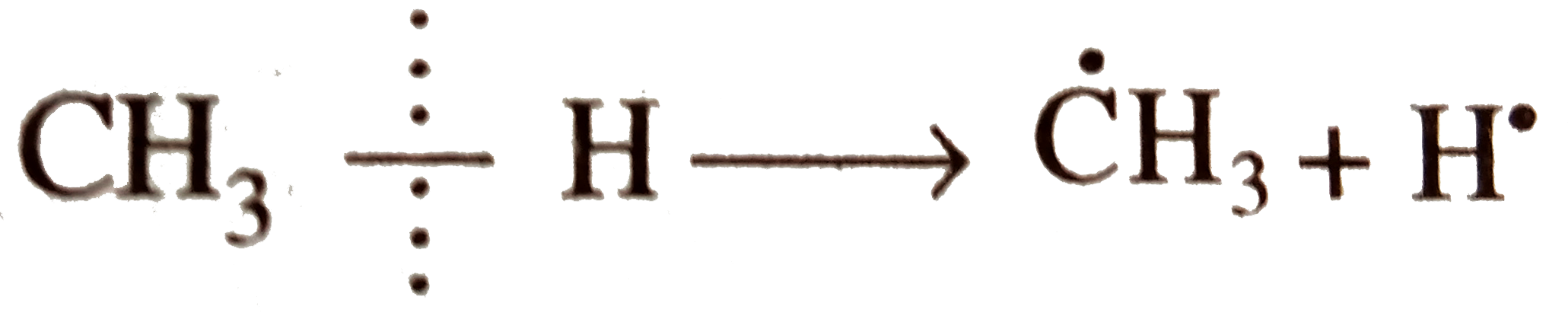
With the help of the following equation and data choose the wrong statement .
I. `E_(act) = + 435.1 kJ`
II. `E_(act) = + 410.0 kJ`
III. `E_(act) = + 368.0 kJ`
IV. `E_(act) = + 343.0 kJ`
V. `E_(act) = 355.6 kJ`

A

(a) Thermal creaking of (C--H) bond of methane occurs at 1500 K and that of (C--H) bond of ethen break at 800 - 900 K.

B

(b) during homolysis of ethane at high temperature, the (C--C) bond breaks more radily than (C--H) bonds.

C

(c) During the cracking of n-butane, reaction (IV) occurs more readily than reaction (V).

D

(d) Formation of `CH_(3) C^(.)H_(2)` radical by reaction (II) will take place at lower temperature than the formation of `C^(.)_(2)H_(5)` radical by reaction (IV).

Text Solution

Verified by Experts

The correct Answer is:

D

Lower the `E_(act)` of first step of chain propagatiopn reaction, more easily the bond can be broken. Also this bond breaking will take place comparatively at a lower temperature.
Promotional Banner

Topper's Solved these Questions

  • ALKANES AND CYCLOALKANES

    CENGAGE CHEMISTRY ENGLISH|Exercise Archives|13 Videos
  • ALKANES AND CYCLOALKANES

    CENGAGE CHEMISTRY ENGLISH|Exercise MCQ|20 Videos
  • ALKENES AND ALKADIENES

    CENGAGE CHEMISTRY ENGLISH|Exercise Single correct Answer|14 Videos

Similar Questions

Explore conceptually related problems

The E^(@) at 25^(@) C for the following reaction at the indicated concentrations is 1.50 V. Calculate the DeltaG in kJ // mol 25^(@) C :

Rate constant k = 1.2 xx 10^(3) mol^(-1) L s^(-1) and E_(a) = 2.0 xx 10^(2) kJ mol^(-1) . When T rarr oo :

Following are the values of E_(a) and DeltaH for three reactions carried out at the same temperature : I :E_(a)=20kJ mol^(-1),DeltaH=-60kJmol^(-1) II :E_(a)=10kJ mol^(-1),DeltaH=-20kJ mol^(-1) III : E_(a)=40 kJ mol^(-1),DeltaH=+15kJ mol^(-1) If all the three reaction have same frequency factor then fastest and slowest reaction are :

Using the bond enthalpy data given below, calculate the enthalpy of formation of acetone (g). Bond enegry C-H = 413.4 kJ mol^(-1) , Bond enegry C-C = 347.0 kJ mol^(-1) , Bond enegry C=O = 728.0 kJ mol^(-1) , Bond enegry O=O = 495.0 kJ mol^(-1) , Bond enegry H-H = 435.8 kJ mol^(-1) , Delta_("sub")H^(Theta)C(s) = 718.4 kJ mol^(-1)

In the circuit shown below E_(1) = 4.0 V, R_(1) = 2 Omega, E_(2) = 6.0 V, R_(2) = 4 Omega and R_(3) = 2 Omega . The current I_(1) is

What is the activation energy for the reverse of this reaction? N_(2)O_(4)(g)rarr2NO_(2)(g) Data for the given reaction is : DeltaH=+54 kJ and E_(a)=+57.2kJ :

Calculate the lattice energy of the reaction Li^(o+)(g) +CI^(Theta) (g) rarr LiCI(s) from the following data: Delta_("sub")H^(Theta)(Li) = 160.67 kJ mol^(-1), (1)/(2)D(CI_(2)) = 122.17 kJ mol^(-1) IP(Li) = 520.07 kJ mol^(-1),E_(A)(CI) = - 365.26 kJ mol^(-1) and Delta_(f)H^(Theta)(LiCI) =- 401.66 kJ mol^(-1)

The heat of atomization of a compound XY_(3) in gaseous state is E kJ mol^(-1) what is the X-Y bond energy of kJ mol^(-1) unit?

A photon having lambda = 854 Å cause the ionization of a nitrogen atom. Give the I.E. per mole of nitrogen in KJ

Half cell reactions for some electrodes are given below I. A + e^(-) rarr A^(-) , E^(@) = 0.96V II. B^(-) + e^(-) rarr B^(2-) , E^(@) = -0.12V III. C^(+) + e^(-) rarr C, E^(@) =+0.18V IV. D^(2+) + 2e^(-) rarr D, E^(@) = -1.12V Largest potential will be generated in which cell?

CENGAGE CHEMISTRY ENGLISH-ALKANES AND CYCLOALKANES-Single Correct
  1. There are two ways for the preparation of 2,2-dimethylbutane by Corey...

    Text Solution

    |

  2. Which of the statement is/are true about the reactivity of halogenatio...

    Text Solution

    |

  3. With the help of the following equation and data choose the wrong stat...

    Text Solution

    |

  4. Text Solution

    |

  5. Which of the following statements is wrong ?

    Text Solution

    |

  6. Arrange the following compounds in the increasing order of homolytic (...

    Text Solution

    |

  7. There is no ring strain in cyclohexane, but cyclobutane has an angle s...

    Text Solution

    |

  8. Octane number can be changed by:

    Text Solution

    |

  9. Which of the following yields both alkane and alkene ?

    Text Solution

    |

  10. Hydrocarbon which is liquid at room temperature is

    Text Solution

    |

  11. In the free-radical chlorination of methane, the chain-intiation step ...

    Text Solution

    |

  12. 2-Methyl butane reacting with Br(2) in sunlight mainly gives:

    Text Solution

    |

  13. Which of the following has the lowest boiling point ?

    Text Solution

    |

  14. Which hydrocarbnon is mainly present in gobar gas ?

    Text Solution

    |

  15. Methyl bromide is converted into ethane by heating it in ether medium ...

    Text Solution

    |

  16. Reactivity of hydrogen atoms attached to different carbon atoms in alk...

    Text Solution

    |

  17. Of the five isomeric hexanes, the isomer which can give two monochlori...

    Text Solution

    |

  18. The compound having only primary hydrogen atoms is

    Text Solution

    |

  19. Which of the following has the higest knocking property ?

    Text Solution

    |

  20. Which of the following reactions will not give propane ?

    Text Solution

    |