Home
Class 11
CHEMISTRY
Which of the following reactions will no...

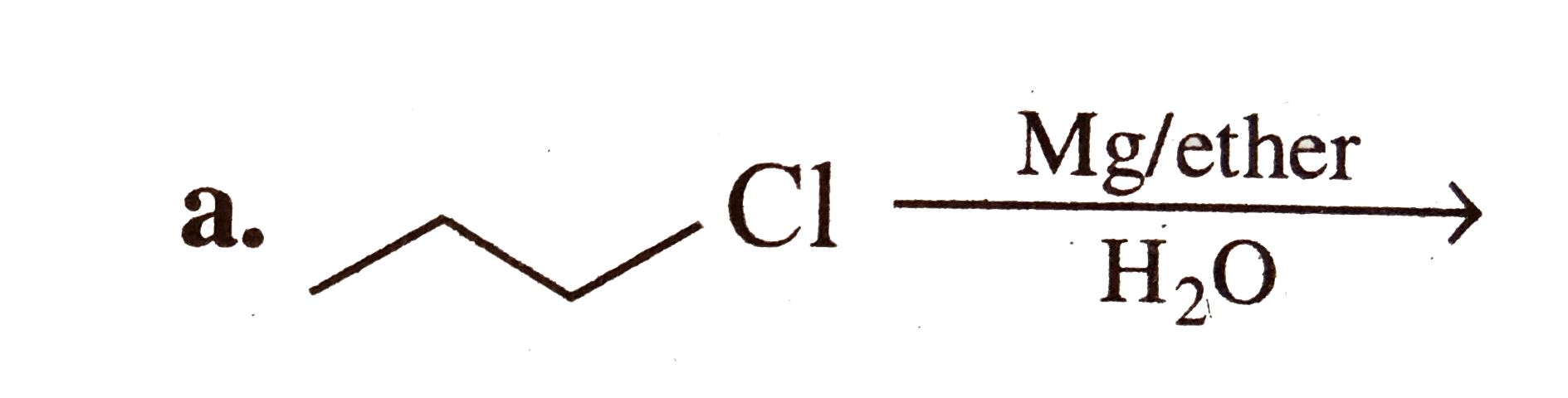
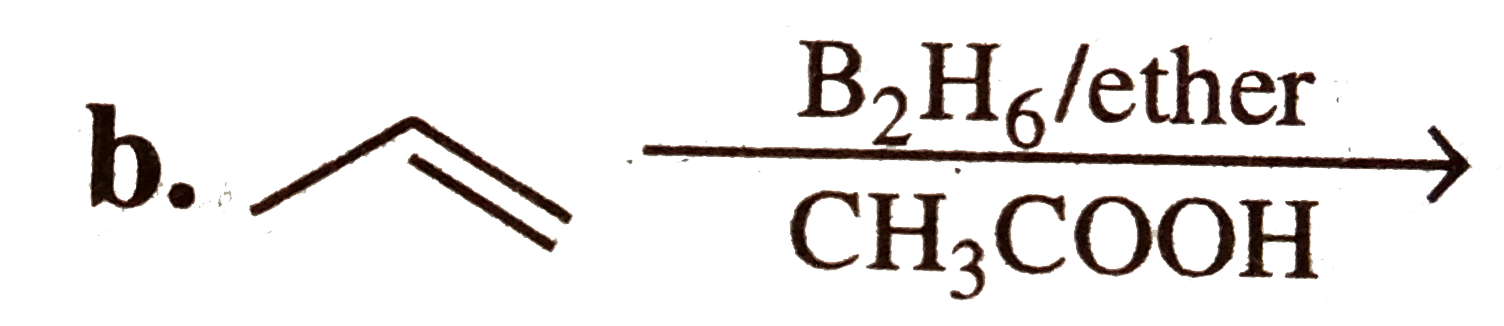
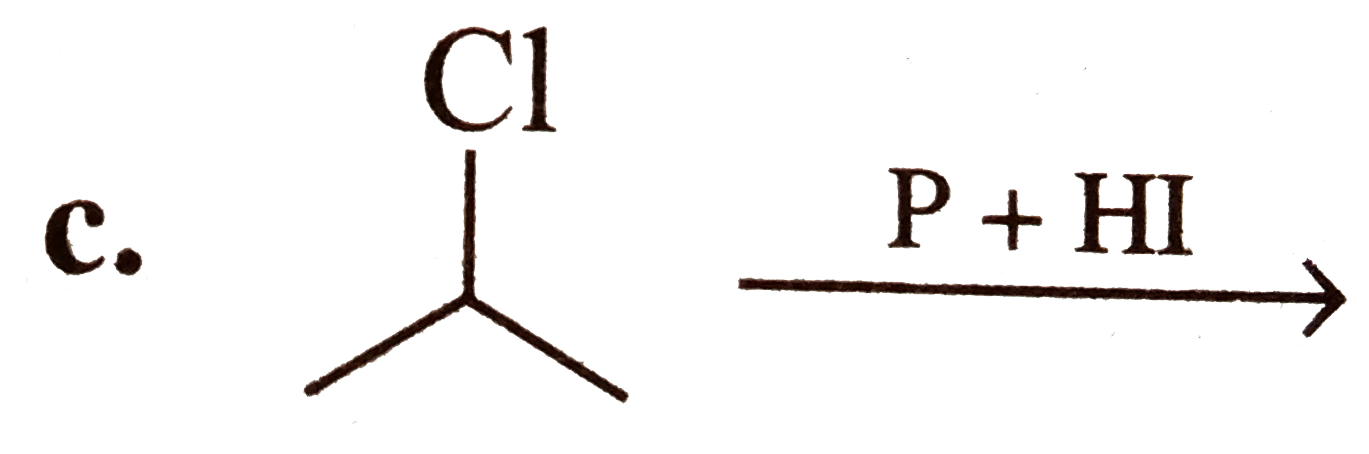
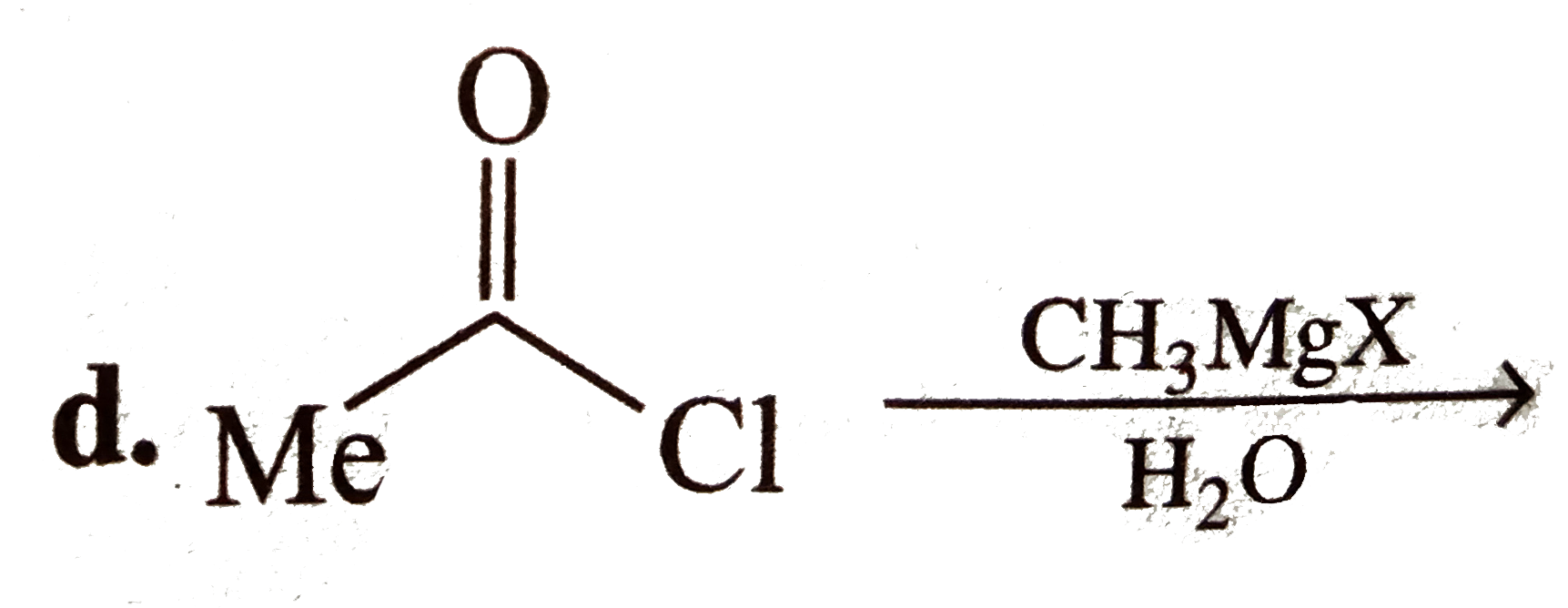
Which of the following reactions will not give propane ?

A

B

C

D

Text Solution

AI Generated Solution

The correct Answer is:

To determine which of the given reactions will not produce propane, we will analyze each reaction step by step. ### Step 1: Analyze Reaction A - **Reaction A** involves a chlorine compound reacting with magnesium in ether, followed by the addition of water. - The chlorine atom is replaced by a methyl group (Me) during the reaction with magnesium, forming a Grignard reagent. - When water is added, it reacts with the Grignard reagent to form propane (C3H8) and magnesium hydroxide chloride (Mg(OH)Cl). - **Conclusion**: Reaction A produces propane. ### Step 2: Analyze Reaction B - **Reaction B** involves a compound reacting with diborane (B2H6) in ether, followed by the addition of acetic acid (CH3COOH). - The reaction with B2H6 leads to the formation of a trialkylborane, which upon hydrolysis with acetic acid will yield propane. - **Conclusion**: Reaction B produces propane. ### Step 3: Analyze Reaction C - **Reaction C** involves a chlorine compound reacting with phosphorus and hydroiodic acid (HI). - The chlorine atom is replaced, leading to the formation of propane. - **Conclusion**: Reaction C produces propane. ### Step 4: Analyze Reaction D - **Reaction D** involves a carbonyl compound (with a double bond to oxygen) reacting with a Grignard reagent (CH3MgX) followed by water. - The reaction with the Grignard reagent will lead to the formation of an alcohol, not propane. The carbonyl compound does not lead to the formation of propane in this case. - **Conclusion**: Reaction D does not produce propane. ### Final Answer The reaction that will not give propane is **Reaction D**. ---

To determine which of the given reactions will not produce propane, we will analyze each reaction step by step. ### Step 1: Analyze Reaction A - **Reaction A** involves a chlorine compound reacting with magnesium in ether, followed by the addition of water. - The chlorine atom is replaced by a methyl group (Me) during the reaction with magnesium, forming a Grignard reagent. - When water is added, it reacts with the Grignard reagent to form propane (C3H8) and magnesium hydroxide chloride (Mg(OH)Cl). - **Conclusion**: Reaction A produces propane. ...
Promotional Banner

Topper's Solved these Questions

  • ALKANES AND CYCLOALKANES

    CENGAGE CHEMISTRY ENGLISH|Exercise Archives|13 Videos
  • ALKANES AND CYCLOALKANES

    CENGAGE CHEMISTRY ENGLISH|Exercise MCQ|20 Videos
  • ALKENES AND ALKADIENES

    CENGAGE CHEMISTRY ENGLISH|Exercise Single correct Answer|14 Videos

Similar Questions

Explore conceptually related problems

Which of the following reaction will not give methane?

Which of the following reactions will not give Hofmann alkene ?

Which of the following reaction will not give primary amine ?

Which of the following reactions would give propanal ?

Which of the following reactions will give alkyne?

CENGAGE CHEMISTRY ENGLISH-ALKANES AND CYCLOALKANES-Single Correct
  1. The compound having only primary hydrogen atoms is

    Text Solution

    |

  2. Which of the following has the higest knocking property ?

    Text Solution

    |

  3. Which of the following reactions will not give propane ?

    Text Solution

    |

  4. Which of the following is a tetracyclic compound ?

    Text Solution

    |

  5. The most stable confomation of cis-1,4-di-t-buty1 cyclohexane is:

    Text Solution

    |

  6. The the most stable conformer of cis-cyclohexan-1,4-diol is:

    Text Solution

    |

  7. The the most stable conformer of cis-cyclohexan-1,4-diol is:

    Text Solution

    |

  8. The total number of isomer including stereosisomers for 1,2-dimethyl c...

    Text Solution

    |

  9. The toal number of isomers including stereoisomers for 1,3- dimethyl ...

    Text Solution

    |

  10. The most stable from trans-1,2-dimethyl cyclohexane is:

    Text Solution

    |

  11. Consider the following reaction: Barium adipate Compound (B) is:

    Text Solution

    |

  12. The decreasing order of boiling points of the following compounds is: ...

    Text Solution

    |

  13. The decreasing order of melting points of the following compounds is: ...

    Text Solution

    |

  14. The decreasing order of the acidic character of the following is: (I)

    Text Solution

    |

  15. Which of the following reactions will not give four-membered cyclic co...

    Text Solution

    |

  16. The structue of alkane or cycloalkane with molecular formula C(8)H(18)...

    Text Solution

    |

  17. The structure of the compound with molecular formula C(6)H(12) that ha...

    Text Solution

    |

  18. The structure of the compound with molecular formula C(6)H(12) that ha...

    Text Solution

    |

  19. The structure of the compound with molecular formula C(8)H(14) that ha...

    Text Solution

    |

  20. Give the decreasing order of the stability of the following or increas...

    Text Solution

    |
