


Home
Class 11
CHEMISTRY
C4H6underset(1 mol)overset(H2+Pt)rarrC4H...

`C_4H_6underset(1 mol)overset(H_2+Pt)rarrC_4H_8overset(O_3//H_2O)rarr` Acedic acid
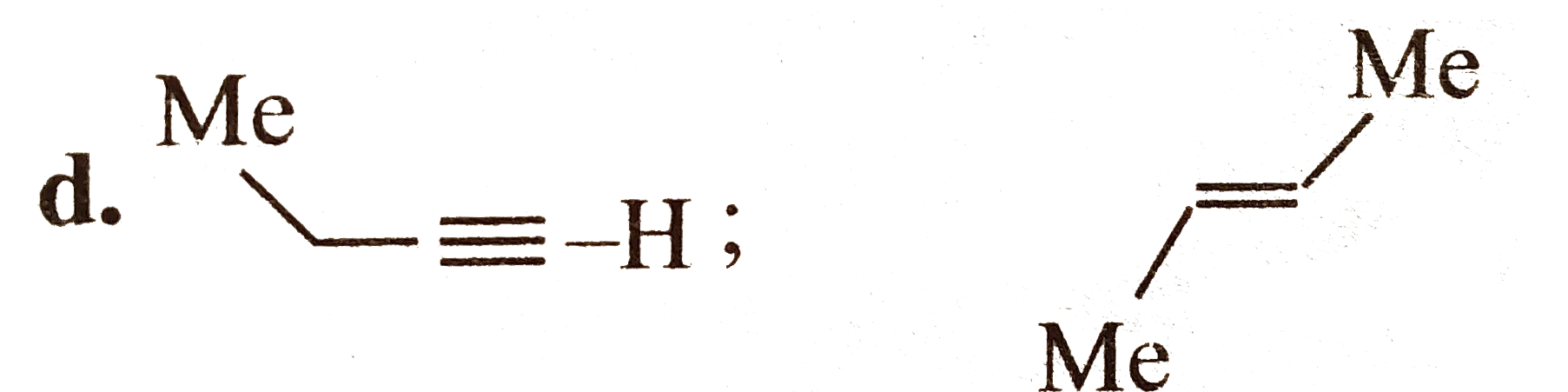
(A) and (B), respectively, are:

A

B

C

D

Text Solution

AI Generated Solution

The correct Answer is:

To solve the problem, we need to identify the compounds A and B based on the given reactions and molecular formulas. ### Step-by-Step Solution: 1. **Identify the Structure of Compound A (C₄H₆)**: - The molecular formula C₄H₆ indicates that the compound is an alkyne or a diene due to the unsaturation (fewer hydrogens than alkanes). - The possible structures for C₄H₆ include 1-butyne (CH₃C≡CCH₃) or 1,3-butadiene (CH₂=CH-CH=CH₂). - Since we are looking for a compound that can undergo hydrogenation (addition of H₂), we can consider 1,3-butadiene as a likely candidate. 2. **Reaction of A with H₂ and Pt**: - When 1,3-butadiene reacts with H₂ in the presence of platinum (Pt), it undergoes hydrogenation. - This reaction will result in the formation of 1-butene (C₄H₈) through the addition of hydrogen across the double bonds. 3. **Identify Compound B (C₄H₈)**: - The product of the hydrogenation, 1-butene (C₄H₈), can further react with ozone (O₃) followed by hydrolysis (H₂O). - Ozonolysis of 1-butene will lead to the formation of two molecules of acetic acid (CH₃COOH). 4. **Final Identification**: - Therefore, compound A is 1,3-butadiene (C₄H₆) and compound B is 1-butene (C₄H₈). - The ozonolysis of 1-butene produces acetic acid (CH₃COOH). ### Summary: - A (C₄H₆) = 1,3-butadiene - B (C₄H₈) = 1-butene

To solve the problem, we need to identify the compounds A and B based on the given reactions and molecular formulas. ### Step-by-Step Solution: 1. **Identify the Structure of Compound A (C₄H₆)**: - The molecular formula C₄H₆ indicates that the compound is an alkyne or a diene due to the unsaturation (fewer hydrogens than alkanes). - The possible structures for C₄H₆ include 1-butyne (CH₃C≡CCH₃) or 1,3-butadiene (CH₂=CH-CH=CH₂). - Since we are looking for a compound that can undergo hydrogenation (addition of H₂), we can consider 1,3-butadiene as a likely candidate. ...
Promotional Banner

Topper's Solved these Questions

  • ALKYNES

    CENGAGE CHEMISTRY ENGLISH|Exercise Exercises (Single Correct Answers Type)|30 Videos
  • ALKYNES

    CENGAGE CHEMISTRY ENGLISH|Exercise Exercises (Archives - Single Correct Answer Type)|6 Videos
  • ALKYNES

    CENGAGE CHEMISTRY ENGLISH|Exercise Exercises (Linked Comprehension Type)|51 Videos
  • ALKENES AND ALKADIENES

    CENGAGE CHEMISTRY ENGLISH|Exercise Single correct Answer|14 Videos
  • APPENDIX - INORGANIC VOLUME 1

    CENGAGE CHEMISTRY ENGLISH|Exercise chapter-7 Single correct answer|1 Videos

Similar Questions

Explore conceptually related problems

CH_3-C-=Noverset(H_2"O"//Delta)rarr(A)overset(H_2"O"//H^+)rarr(B)(A) and (B) respectively are

In the reaction sequence C_(6)H_(5)CHO overset(NH_(2)OH//H^(o+))underset(Delta)rarr(X) overset(P_(2)O_(5)//Delta)rarr (Y) overset(H_(2)O,H^(+))rarr(Z) (X), (Y) and (Z) respectively be

overset("Conc. "H_(2)SO_(4))rarr Boverset(O_(3)// H_(2)O // Zn)rarr C. A, B and C are -

C_(8)H_(10) overset(O_(3), H_(2)O)rarrC_(4)H_(6)O_(2) Acid (B), Identify (A) and (B) in the above reaction

A(C_4H_6) underset(1 "mole") overset(H_2 , Li)to B(C_4 H_8) underset( 2H_2 O""//Zn)overset(1. O_3)to CH_3 CHO Thus A and B are :

Write the product of following reactions : (a) CH_(3)-overset(H_(3)C)overset(|)(C )=overset(CH_(3))overset(|)(C )-CH_(3) underset(Zn//H_(2)O)overset(O_(3))rarr , (b) CH_(3)-C-=C-CH_(3) underset(Zn//H_(2)O)overset(O_(3))rarr ( c) CH_(3)-C-=C-CH_(3)overset(O_(3)//H_(2)O_(2))rarr , (d) CH_(3)-overset(CH_(3))overset(|)(C )=CH-CH_(3) overset(O_(3)//H_(2)O_(2))rarr

C_(2)H_(2) underset( H_(2)SO_(4))overset( Hg(OH)_(2) 1%) (rarr) A overset( [O])(rarr) B , B is :

C_6 H_5 NH_2 underset(0^@ C) overset( NaNO_2 //HCI)to (A) overset(H_3 PO_2 // H_2 O ) to (B ) the compound (B ) is :

overset(|HgSO_4//H_2 SO_4)rarr(A) overset (2 mol of MeMgBr//H_3 O^(oplus))rarr (B) . (B) is :

Which of the statements are correct? R--=-Runderset(Catalyst)overset(H_2+P-2)rarr(A)overset(MMPP)rarr(B)overset(H^(+)//H_2O)rarr+(C) (D)overset(MMPP)rarr(E)overset(H^(+)//H_2O)rarr(F)

CENGAGE CHEMISTRY ENGLISH-ALKYNES-Exercises (Multiple Correct Answers Type)
  1. In the following sequence of reactions, Which of the statements a...

    Text Solution

    |

  2. Acetylene is thermodynamically unstable and readily explodes, therefor...

    Text Solution

    |

  3. Which of the statements are correct for alkyne with molecular formul...

    Text Solution

    |

  4. For the conversion of alkyne to cis-alkene, H2+ Lindlar's catalyst is ...

    Text Solution

    |

  5. i. Me--=-Hunderset((ii)H2O2//overset(Ө)OH)overset((i) Sia2BH)rarrA i...

    Text Solution

    |

  6. Which of the following statements are correct?

    Text Solution

    |

  7. Which of the following statement(s) is/are correct:

    Text Solution

    |

  8. Compound (B) is same when (A) is:

    Text Solution

    |

  9. Which of the statements are correct? R--=-R^'underset(+EtOH)overset(...

    Text Solution

    |

  10. Which of the statements are correct? R--=-Runderset(Catalyst)overset...

    Text Solution

    |

  11. Hydroboration oxidation and acid hydration will yield the same produ...

    Text Solution

    |

  12. C4H6underset(1 mol)overset(H2+Pt)rarrC4H8overset(O3//H2O)rarr Acedic a...

    Text Solution

    |

  13. All reagents, [Cu(NH3)2]^(o+), [Ag(NH3)2]^(o+), CH3MgBr, and NaNH2 r...

    Text Solution

    |

  14. Compound (A) does not react with Tollens or Grignard reagent, but afte...

    Text Solution

    |

  15. Compound (A) reacts with [Cu(NH3)2]^(+) and Tollens reagent, but after...

    Text Solution

    |

  16. Which of the statements are correct?

    Text Solution

    |

  17. Reagents used in conversion from (A) to (B) are:

    Text Solution

    |

  18. Which gas is in an antidote of Lewisite (a poisonous gas used in World...

    Text Solution

    |

  19. Which statements are correct:

    Text Solution

    |

  20. Which statements are correct for reagents A, B, C, and D?

    Text Solution

    |
